$500 Starter to $5,000 Reference Atmos (5 Home Theater Builds)
Building a home theater is not an all-or-nothing proposition. You do not need to drop five grand on day one to get something that sounds dramatically better than a soundbar. The path from "two decent speakers on a shelf" to "reference-level Atmos system that shakes the foundation" is a series of intentional upgrades, each one built on what came before.
This guide lays out five complete system configurations at five budget tiers. Every component is named, every price is current as of March 2026, and every trade-off between tiers is spelled out. If you are starting from zero, start at the tier that matches your budget. If you already have gear, find the tier closest to your current setup and look one level up for your next upgrade path.
The $500 Tier: Stereo Foundation (2.0)
At $500, the goal is two excellent speakers and a receiver that can grow with you. No subwoofer, no center channel, no surrounds. That sounds minimal until you hear it. Two properly placed bookshelf speakers on dedicated stands, powered by even a budget AVR with room correction, will produce stereo imaging that makes soundbar owners question their life choices.
The reason this works is that stereo mastering is the foundation of all audio. Every movie soundtrack is mixed on a stereo monitoring chain before surround channels are added. Two speakers reproduce the core of the content. Everything else is enhancement.
$500 Component List
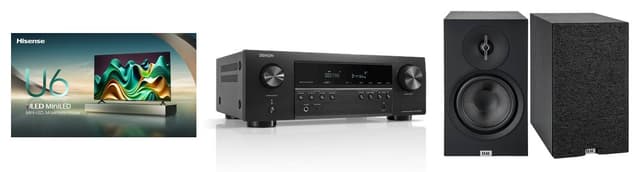
- Receiver: Denon AVR-S670H ($250). Entry-level Denon with Audyssey MultEQ room correction, HDMI eARC, Dolby Atmos decoding, and 5.2 channels. You are only using two channels now, but this receiver will power a 5.1 system when you are ready to expand. That growth path matters: you buy the receiver once and add speakers over time.
- Speakers: JBL Stage A130 ($200/pair). The best value bookshelf speaker currently on the market. JBL's waveguide horn design gives these wider dispersion than most speakers at double the price, and the frequency response is flat enough that room correction has a clean starting point to work with.
- Speaker wire: 14-gauge, 50ft ($15). Amazon Basics or Monoprice. The speaker wire gauge calculator confirms 14-gauge is correct for runs under 50 feet at 8 ohms.
- Speaker stands ($35-50). These position the tweeters at seated ear height and decouple the speakers from whatever surface they would otherwise sit on.
Total: ~$500-515.
This is a complete, usable system on day one. It handles movies, music, and gaming well, and every future purchase builds on it rather than replacing it.
Rob's take
The upgrade priority order is the most useful thing in this guide. Subwoofer first, always. I've heard well-calibrated 5.1 systems with a $600 sub and $400 bookshelf speakers that sound better than setups with $2,000 towers and no proper bass. Bass extension and room-filling impact are where home theater separates from listening to speakers in a living room.
The $1,000 Tier: Adding Impact (3.1)
The jump from stereo to 3.1 adds two things that fundamentally change the experience: a center channel for anchored dialogue, and a subwoofer for low-frequency foundation. The center channel handles 60 to 70 percent of a movie's audio. Our center channel guide covers the full selection and placement breakdown.
$1,000 Component List
- Everything from the $500 tier above.
- Center channel: JBL Stage A125C ($150). Same waveguide design as the A130 bookshelves for perfect timbre matching.
- Subwoofer: Dayton Audio SUB-1200 ($175). The budget sub that provides genuine bass extension to the mid-30Hz range. If you can stretch to $430, the RSL Speedwoofer 10S MKII is a significant upgrade. See the full subwoofer buying guide.
- Subwoofer cable: 15ft ($10). The room mode calculator helps determine optimal sub placement.
Total: ~$850-1,100 depending on subwoofer choice.
The $1,500 Tier: Full Surround (5.1)
At $1,500 you fill out a complete 5.1 system. The addition of surround speakers transforms the experience from "nice speakers in front of you" to "sound coming from everywhere." Our speaker placement guide has the full angle reference.
$1,500 Component List
- Everything from the $1,000 tier above.
- Surround speakers: Polk Audio Monitor XT15 ($100/pair). Compact, clean, and cheap. Surrounds handle ambient effects, not heavy lifting.
- Optional subwoofer upgrade: SVS PB-1000 Pro ($500) or RSL Speedwoofer 12S ($550) if budget allows.
Total: ~$1,100-1,700 depending on sub choice.
The $2,500 Tier: Entering Atmos (5.1.2)
At $2,500, the system gains a height dimension. Dolby Atmos adds overhead sound objects that create three-dimensional audio.
$2,500 Component List
- Receiver upgrade: Denon AVR-X1800H ($550). Audyssey MultEQ XT, 7.2 channels for 5.1.2 Atmos. The AVR buying guide covers this upgrade path.
- Front speakers upgrade: KEF Q150 ($400/pair). Coaxial Uni-Q driver provides better imaging. Move the JBL A130s to surround duty.
- Center upgrade: KEF Q250c ($400). Matching Uni-Q driver for the Q150 fronts.
- Subwoofer: SVS PB-2000 Pro ($900). Authoritative output to below 20Hz in rooms up to 3,000 cubic feet.
- Atmos height speakers: Polk OWM3 ($100/pair). On-wall heights or Micca M-8C in-ceiling ($70/pair).
Total: ~$2,400-2,600.
The $5,000 Tier: Reference Atmos (7.1.4 or 5.1.4)
At $5,000, you are building a system suitable for a professional review room.
$5,000 Component List
- Receiver: Denon AVR-X3800H ($1,300). Audyssey MultEQ XT32, 9.4 channels. The amplifier headroom calculator confirms this receiver has sufficient ACD power.
- Front L/R: KEF Q350 ($600/pair) or Emotiva T1+ towers ($500/pair).
- Center: KEF R2c ($700) or Emotiva C2+ ($500).
- Surrounds: KEF Q150 ($400/pair). Matched to the front stage.
- Subwoofer: SVS PB-3000 ($1,100) or dual SVS PB-2000 Pro ($1,800). Dual subs smooth bass across multiple seats.
- Atmos heights: 4x Polk OWM3 ($200) or 4x Micca M-8C in-ceiling ($140).
Total: ~$4,800-5,500.
What NOT to Spend Money On
- Expensive speaker wire. The speaker wire calculator tells you the right gauge. That is the entire decision.
- Speaker packages from TV brands. Almost universally worse values than dedicated speaker companies.
- "Premium" HDMI cables. The HDMI cable guide covers this in detail.
The Upgrade Path
The smartest approach is not buying everything at once. Start at whatever tier fits your budget, then upgrade strategically. The priority order that gives the most impact per dollar:
- Subwoofer. The single biggest impact per dollar at every tier.
- Front L/C/R speakers. These handle the majority of the content.
- Room correction quality. The AVR power ratings article covers the real-world wattage differences between tiers.
- Second subwoofer. Dual subs smooth bass across multiple seats.
- Atmos heights. Height speakers are the last addition.
CinemaConfig's builder lets you assemble any of these builds with current pricing and validates every connection, power requirement, and format compatibility automatically.
Rob Teller
Founder, CinemaConfig
15 years in consumer hardware and software, mostly on the product side. NZXT (cases and cooling), Asetek (liquid cooling, global sales), a short run advising on Alienware's roadmap at Dell, then four ... More about Rob · Affiliate disclosure