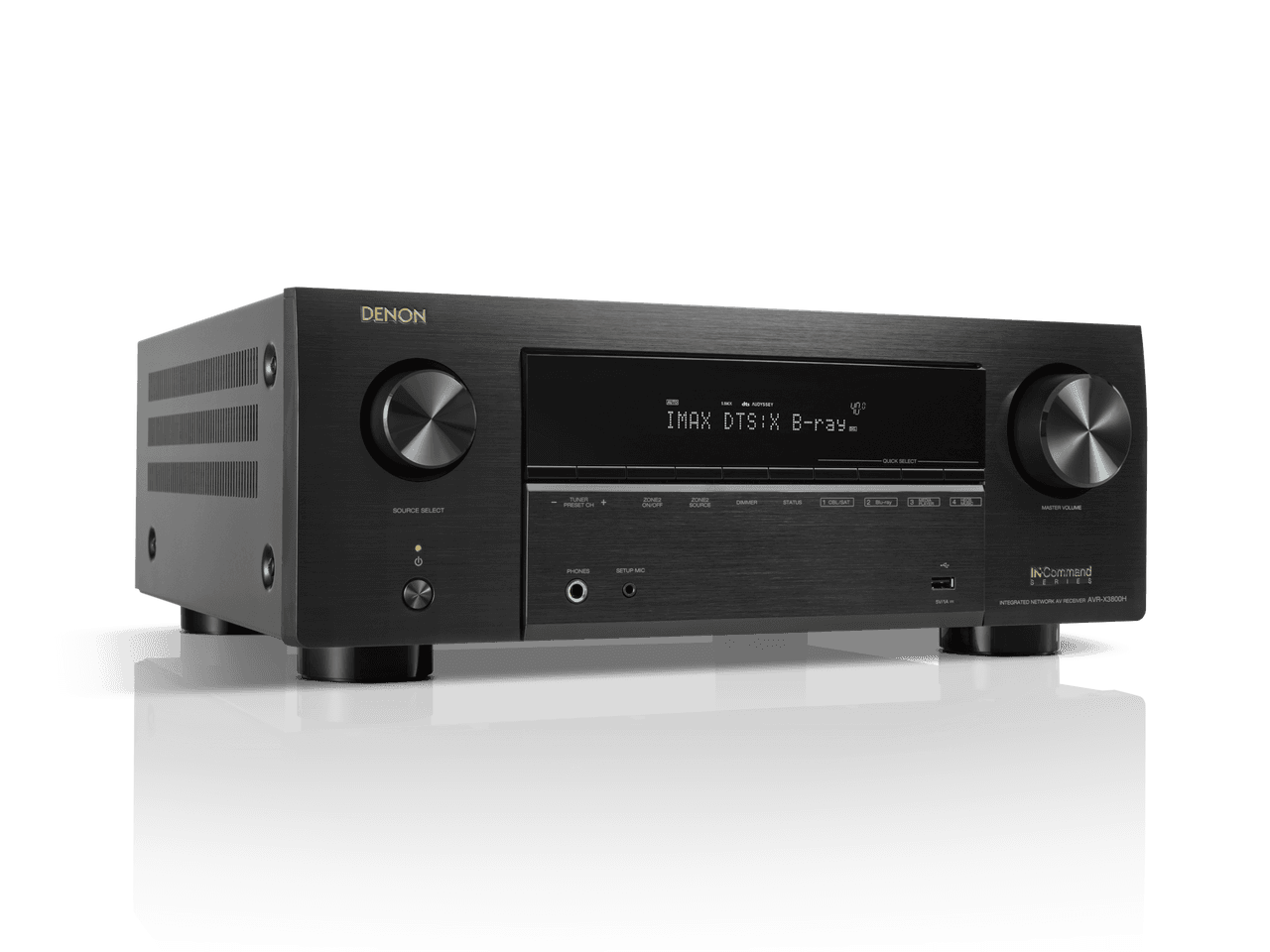
If you want one receiver to start a real home theater, the Denon AVR-X3800H at $1,699 is the answer: 9.4 channels, Audyssey MultEQ XT32, four independent subwoofer outputs, Dirac Live available as a paid upgrade. Almost everything else in the category is either a step down on calibration or a step up on amplification you probably do not need yet.
Most receiver buying guides treat this as a wattage contest. It is not. Two receivers rated 105W and 120W will sound effectively identical on the same speakers in the same room, and the cheaper one will measure closer to its rating with more than two channels driven than the spec sheet suggests on either. What actually separates a $329 Denon AVR-S670H from a $4,699 AVR-A10H is room correction depth, the number of independent sub outputs (one of the most underrated upgrades in audio), and how many channels live inside the chassis before you start buying outboard amps. The wattage difference matters only at the edges, with 4-ohm speakers or very inefficient mains. So the picks below are sorted by what the calibration and channel topology unlock, not by power claims that get inflated the second you drive more than two channels at once.
Four picks across price points, plus two alternates where a different brand's voicing or feature mix is the actual buy reason. The Denon lineup dominates because the Audyssey-to-Dirac upgrade path is the cleanest in the category right now, but the Marantz Cinema 50 earns its bracket on chassis and DAC pedigree, and the Yamaha AVENTAGE 6A is a legitimate alternative for anyone who prefers YPAO's reflection-aware calibration model.
How We Score
We score AV receivers on five dimensions, weighted by what audibly changes a system. Room correction quality leads (Dirac Live > Audyssey MultEQ XT32 > MultEQ > YPAO base > everything else), because EQ is the cheapest fix for the biggest acoustic problem most rooms have. Channel count and topology come next: a 9.4-channel chassis that runs 7.1.2 internally and routes 7.1.4 with one outboard amp is more useful at $1,700 than an 11-channel chassis with weak amp sections. Then independent sub outputs (four > two > one), HDMI 2.1 video features (4K/120, VRR, ALLM on all inputs), and finally rated amplification with a sanity check against Audioholics or Sound & Vision measurements. We discount the 2-channel-driven watt claim every manufacturer leads with, because nobody runs a movie with only two channels active.
What you get at each price point
Each step up has a clear marginal benefit. Skip a tier only if you know what you are giving up.
$329Entry that is actually worth buying
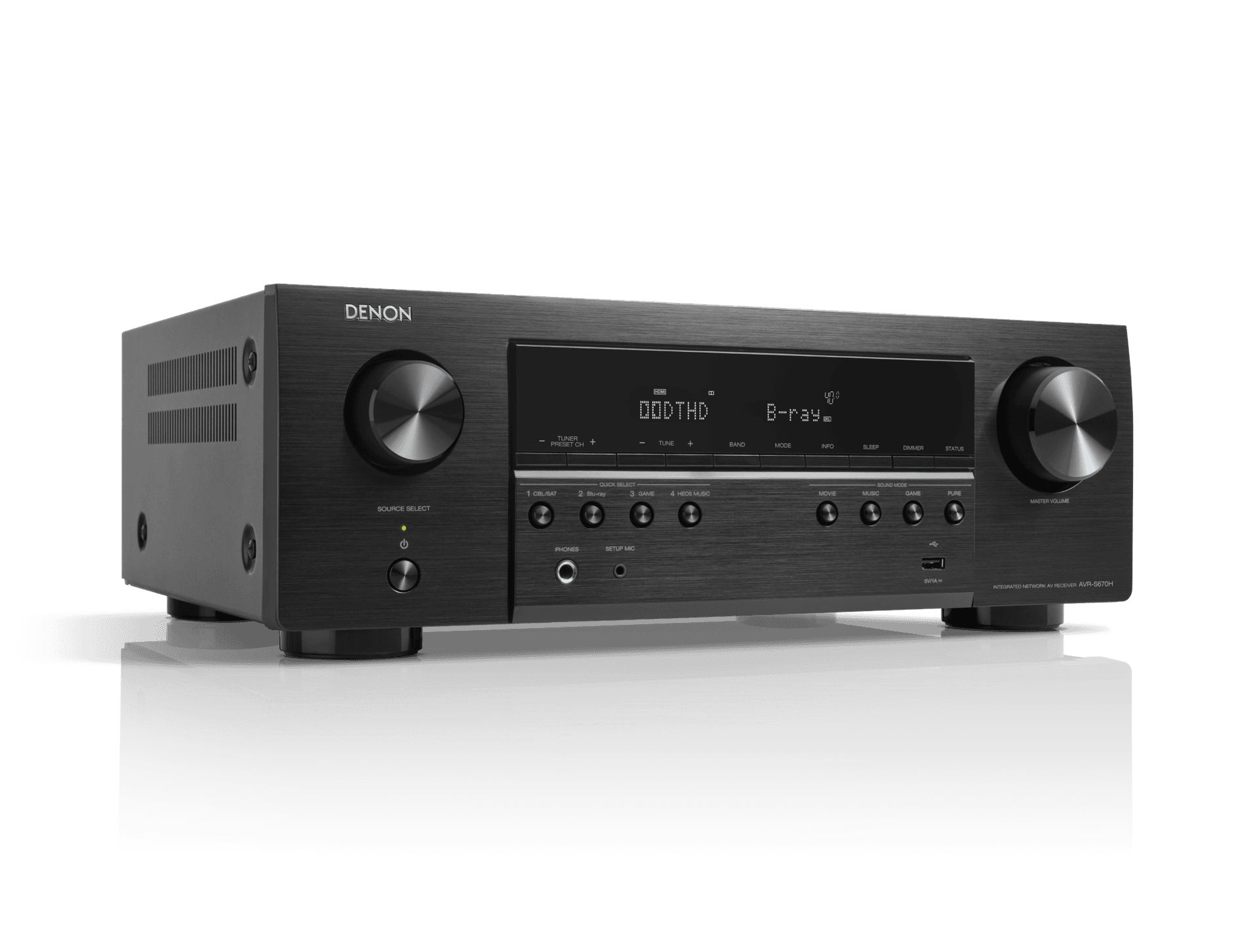
The Denon AVR-S670H is 5.2 channels at 75W with Audyssey MultEQ included. It does not decode Atmos for in-room height channels, so the upgrade path stops at 5.1. Buy it if your room caps at 5.1 and you do not plan to expand.
$700–$1,000First real surround chassis
The Denon AVR-X1800H ($650) and Yamaha RX-V6A ($800) sit here. Seven channels, Atmos in 5.1.2 with no outboard amp, MultEQ XT32 on the Denon. This is the cheapest tier where the room correction is genuinely good.
$1,700–$2,500Where the system stops compromising
The AVR-X3800H ($1,699) and Marantz Cinema 50 ($2,500). Nine internal amp channels, four independent subs, MultEQ XT32, Dirac Live as a paid upgrade. Most home theater builds end here and have no reason to spend more.
$4,000+Flagship territory you mostly do not need
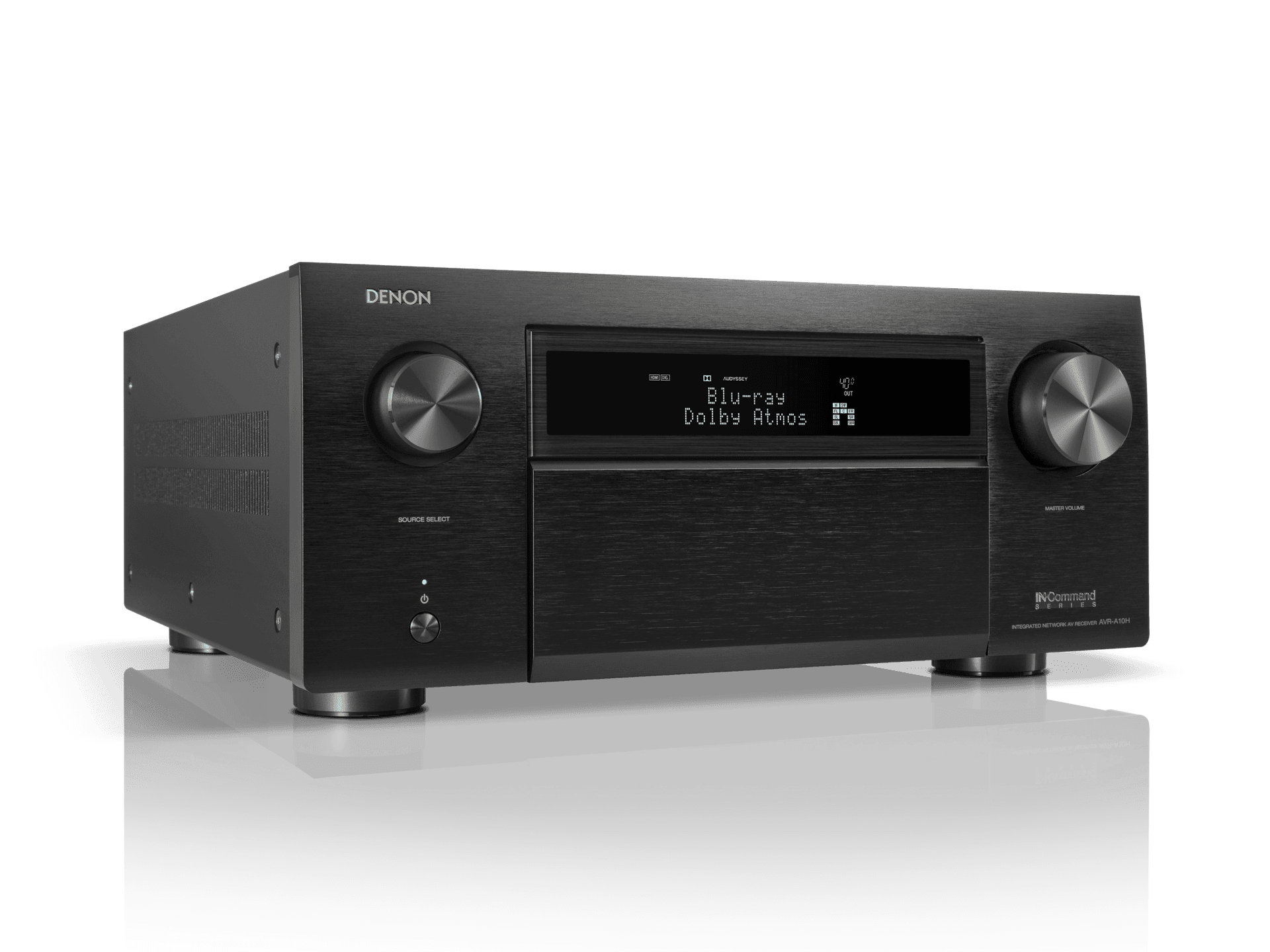
The Denon AVR-A10H ($4,699) and Marantz Cinema 30 ($4,500). Thirteen channels, monoblock-style amp construction, Dirac Live Bass Control sometimes included. Justify it with 7.4.6 Atmos or a 4-ohm speaker rig, not with a feeling that more channels equal better sound.
Best OverallScore: 64/100
Denon
AVR-X3800H
105W per channel (8 ohm, 2ch)11.4 channel processingDolby AtmosMultEQ XT32
The Denon AVR-X3800H earns our top pick among AV receivers, offering 105W per channel (8 ohm, 2ch) and 11.4 channel processing at $1,799.
The AVR-X3800H is where Denon starts shipping the receiver that home-theater enthusiasts actually want. Nine amp channels (so 7.1.2 Atmos in the box, or 5.1.4 with a height layout), four subwoofer outputs (independent, not paired), Audyssey MultEQ XT32, and Dirac Live as a paid software upgrade. Rated 105 W per channel into 8 Ω with 2 channels driven. The four-sub config is the sleeper feature; with two subs at the front corners and two at the back, you get bass smoothing across the listening row that no two-sub system can match. This is the AVR you build a 7.1.4 around, not the X4800H.
Trade-off: The AVR-X3800H's downside is honest: it is a 9-channel chassis trying to look like 11. If you want 7.1.4 internally driven, you either bring an external 2-channel amp for the height pair or step up to the X4800H or Marantz Cinema 50. The other catch is the Dirac Live license, which is sold separately and adds roughly $349 to the real cost once you decide you want it. We think the Audyssey MultEQ XT32 calibration is good enough on its own for most rooms, but the upgrade is real and the Denon platform supports it cleanly.
For the best bang for your buck, the Denon AVR-S670H stands out among AV receivers, offering 75W per channel (8 ohm, 2ch) at $649.
The AVR-S670H is the cheapest Denon worth buying for a real home theater, the entry pick where Audyssey MultEQ at this price is what makes the audible difference between a $250 receiver and a $1,200 one. Five channels, two sub outputs, HDMI eARC, and a growth path to 5.1.2 Atmos via an external amp later. The trade-off is the basic MultEQ algorithm; if your room has a serious bass peak (most do), MultEQ XT32 on the X1800H solves it more cleanly. But for the price, no other entry AVR comes close.
Trade-off: The AVR-S670H's amp section is rated 75W per channel, 2 channels driven. With 5 channels active it will measure closer to 50W per channel, which is fine for 87dB-sensitive bookshelves in a small room and marginal for floorstanders in anything bigger. The bigger issue is that this generation's MultEQ is the basic, non-XT version: it sets distances, levels, and crossovers, and applies a mild correction curve that does not touch the worst bass-mode problems. If your room has a 50Hz peak (and most rectangular rooms do), MultEQ XT32 on the X1800H or X3800H solves it cleanly. The S670H lives with it.
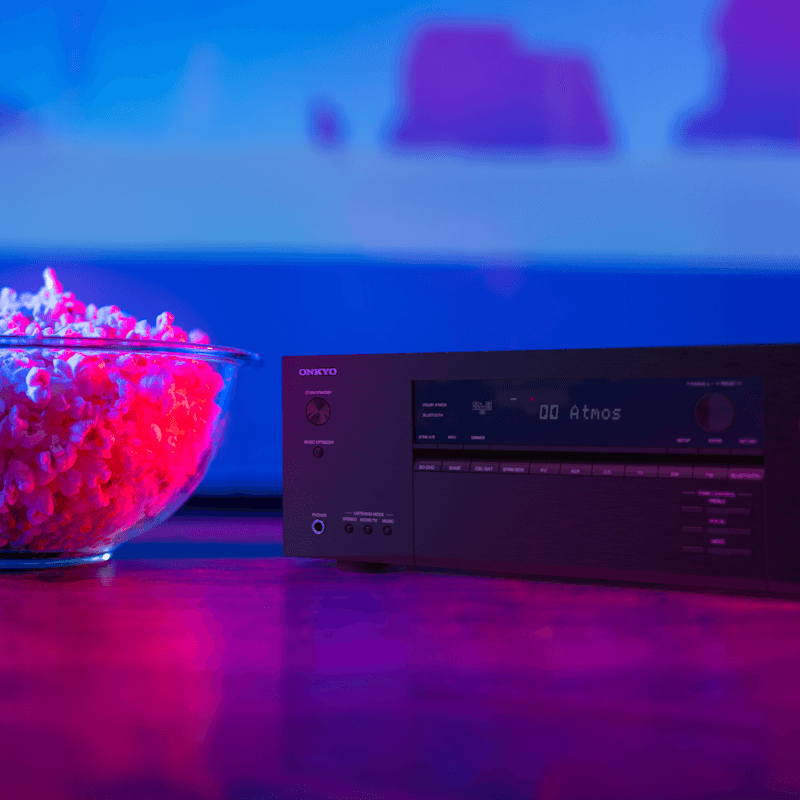
The Onkyo TX-SR3100 proves you don't need to break the bank among AV receivers, offering 80W per channel (8 ohm, 2ch) and Dolby Atmos at $500.
The TX-SR3100 is the 2024 entry of Onkyo's relaunched TX-SR series under Premium Audio Company ownership, the 5.2-channel AVR with HDMI 2.1 4K/120 Hz passthrough and 8K/60 Hz support on the input side. 5.2-channel processing means no internal amps for Atmos height channels (any height deployment would require 5.1.2 minimum); the AVR processes the Atmos signal and feeds height channels via pre-out only. At its retail pricing the cross-shop is the Denon AVR-S570BT ($379) and the Yamaha RX-V4A; the Onkyo buy reason is the HDMI 2.1 spec set at the 5.2-channel entry price, the trade-off is the 5-channel internal amp count that demands an external 2-channel amp for any Atmos build versus the 7.2-channel competitors that handle 5.1.2 internally.
The Denon AVR-A10H represents the pinnacle among AV receivers, offering 150W per channel (8 ohm, 2ch) and 13.4 channel processing at $5,199.
The AVR-A10H is Denon's flagship for buyers who don't need the 15-channel ceiling of the A1H, which is most people. Thirteen channels of amplification at 150 W each, four independent sub outputs (not paired), Audyssey MultEQ XT32, and Dirac Live as a paid upgrade. The honest framing versus the older AVC-X8500H it replaces is that the A10H finally adds the four-sub independent config and Dirac, which together are why anyone shops at this price tier. At $4,699 it sits below the A1H's $6,500 MSRP and above the X6800H's $2,800; the A10H is the right pick for a 7.1.4 build with outboard amplification on the height channels.
Trade-off: The AVR-A10H's case relative to the X6800H ($2,800) is narrower than the price difference suggests. The A10H adds two amp channels, a heavier transformer, and audiophile-grade DACs across all 17 channels. None of that is audible in a typical 7.2.4 build with 8-ohm speakers. The honest buy reason is 9.4.4 or 7.4.6 inside one chassis with no external amplifier, and the four independent sub outputs paired with Dirac Live Bass Control if you spring for the license. If you have a five-figure speaker budget and a dedicated theater room, this is the right tier. For most builds it is not.
For 5.1.4 (two in-ceiling pairs) or 7.1.2 (one in-ceiling pair plus surround backs), yes, all 9 channels run inside the chassis with no outboard amp. For 7.1.4 (the most common dedicated-theater layout), a 9-channel receiver runs 9 of the 11 needed speakers and you bring a stereo amp for the remaining height pair. Most 9-channel receivers expose 11 processing channels via pre-outs to make this clean.
Does Dirac Live make Audyssey MultEQ XT32 obsolete?
Not exactly. Audyssey corrects across the full audible range and is fully automated. Dirac corrects on the same principle but with a more advanced impulse-response model and (with Bass Control) genuinely better handling of low-frequency mode problems. In a problem room with multiple subwoofers, Dirac with Bass Control beats MultEQ XT32. In a well-treated room with one sub, the difference is small and arguable. The Dirac license on a Denon or Marantz is roughly $349 and is a real upgrade, not marketing.
Why do four subwoofer outputs matter?
Two subs at the front corners and two at the back, all calibrated independently, smooth bass response across the listening row in a way that no two-sub or single-sub system can match. The acoustic reason is room-mode cancellation: four sources at carefully chosen positions average out the bass peaks and nulls that a single source creates. The AVR-X3800H, Marantz Cinema 50, and A10H all offer four independent (not paired) sub outputs, which is the spec to confirm before paying for a four-sub setup.
Is HDMI 2.1 with 4K/120 worth paying extra for?
If you own a PS5, Xbox Series X, or a PC with an RTX 30/40/50-series GPU, yes. Confirm the receiver supports 4K/120 on all HDMI inputs, not just one. The early HDMI 2.1 receivers (2021-2022) had a documented bug on certain Sound United chipsets that caused intermittent black-screen issues with 4K/120 sources; the X3800H and later are clean.
How much does manufacturer wattage actually inflate the rating?
Roughly 25-40 percent on most receivers when you go from 2 channels driven to all channels driven into 8 ohms, and more into 4 ohms. A receiver rated 105W per channel will typically measure 70-85W per channel with all channels driven simultaneously. Audioholics publishes the full bench data for most major models; check before believing a 150W marketing number on a $1,000 receiver.
We do not personally bench-test every AVR against a precision load bank. The amplifier comparisons in this guide lean on the Audioholics and Sound & Vision measurement archives, which test most major models with multiple channels driven into 4 and 8 ohms. Where a model lacks a published all-channels-driven measurement (the Marantz Cinema 30, for example, has measured 2-channel and 5-channel data but limited public data on 11-channel drive), we say so rather than infer from the spec sheet. Take the bass calibration claims especially seriously: Audyssey, Dirac, YPAO, and DCAC measure rooms differently and there is no single right answer for which sounds best, only which best matches your room's particular failures.
The 2026 buying picture is unusual in this category. Denon and Marantz are slowly walking Dirac Live from optional-paid to included-by-default as the platform matures (the Cinema 30 already ships with Bass Control), and the next refresh on the X3800-class chassis is the place to watch. If you can wait until late 2026 and your current system still works, do. If you cannot, the X3800H is the receiver that bracket has been chasing for a decade.
CinemaConfig may receive compensation for purchases made at participating retailers linked on this site. This compensation does not affect what products or prices are displayed, or the order of prices listed. See our affiliate disclosure.