Real Builds at 4 Price Points (Home Theater Cost Breakdown)
A complete 5.1 system that will embarrass a $1,500 Sonos Arc setup costs $1,100 in components. Here's every dollar.
The home theater internet has a "best of" list problem. Ten products in a flat list, no context for how they fit together, no total cost, no explanation of what you actually gain by spending more. You're left reverse-engineering a system from a pile of isolated recommendations.
This is the opposite of that. Four complete builds at four price points. Every component named, every price listed, every trade-off stated. Each tier builds on the previous one, so you can see exactly what your next $500 buys you, and when the returns start diminishing.
Tier 1: $465 - Stereo That Beats Any Soundbar
This is the entry point. Two speakers and a receiver. That's it.
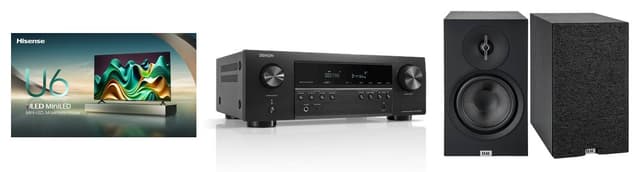
- Denon AVR-S670H - $250. 5.2-channel receiver with HDMI eARC, Dolby Atmos decoding, and a competent room correction system (Audyssey MultEQ). It will run this stereo setup now and grow into a 5.1 or even 5.1.2 system later without replacing the receiver.
- JBL Stage A130 - $200/pair. Bookshelf speakers with a 5.25-inch woofer and 1-inch aluminum dome tweeter. Clean, detailed, and surprisingly dynamic for the price. They measure well, they sound great, and they are the best value in this price range right now.
- 16-gauge speaker wire, 50ft - $15. Amazon Basics or equivalent. It carries signal. That is all it needs to do.
Total: $465.
What does $465 sound like? Genuinely good. Vocals are clear and present. Stereo imaging puts instruments in space around you in a way no soundbar can physically replicate. Soundbars fire from a single point below your TV and use psychoacoustic tricks to fake width. Two properly placed speakers 6-8 feet apart actually produce a real soundstage.
What it can't do: there's no center channel, so dialogue comes from a "phantom center" where your brain locates it between the two speakers. This works well if you're sitting in the sweet spot, less well for a wide couch. And there's no subwoofer, which means bass rolls off below 55-60Hz. You'll hear music fine, but action movies will feel thin. The T. rex in Jurassic Park doesn't land without a sub.
Why it still beats soundbars: even a $800 Sonos Arc or Samsung HW-Q990D can't match the raw driver area and separation of two real speakers powered by a proper amplifier. The soundbar is a convenience product. This is an audio system.
Rob's take
The jump from Tier 1 to Tier 2 — from stereo to 3.1 — is the most impactful single upgrade in home theater. Adding a subwoofer reveals an entire octave of movie soundtrack that literally didn't exist in your stereo setup. Everything else on the ladder is incremental improvement. That first sub is transformative.
Tier 2: $1,015 - 3.1 That Feels Like a Theater
Start with the Tier 1 system. Add two things:
- JBL Stage A125C center channel - $150. Timbre-matched to the A130 bookshelf speakers (same tweeter, same voicing). This is the single component that transforms "nice stereo" into "home theater." Dialogue is anchored to the screen regardless of where you sit.
- RSL Speedwoofer 10S MKII - $400. 10-inch ported subwoofer, 350 watts RMS. Digs down to around 24Hz in-room, which is deep enough for everything short of the most extreme pipe organ recordings. Direct-to-consumer pricing from RSL makes this competitive with subs that cost $200 more from retail brands.
Total: ~$1,015.
This is the biggest jump on the entire ladder. The difference between Tier 1 and Tier 2 is not incremental; it's transformative. The center channel solves dialogue clarity for good. The subwoofer adds the entire bottom octave of movie soundtracks that was simply missing before. Explosions have weight. Music has body. The room pressurizes during the Dune sandworm scenes in a way that you feel in your chest.
If you can only reach one tier, reach this one.
Budget alternative: under $800 total
Swap the RSL Speedwoofer for a Dayton Audio SUB-1200 ($175). It's a 12-inch sub with a 120-watt amplifier. It won't dig as deep or play as clean as the RSL; you'll notice boominess in some content and it runs out of headroom in rooms larger than about 2,000 cubic feet, but it's a real subwoofer for $175. Total system cost drops to ~$790, which is a complete 3.1 home theater for less than the price of a Sonos Arc alone.
The Dayton is the kind of sub you outgrow in a year. That's fine. It proves the concept, and when you upgrade to the RSL or something better, the Dayton becomes a perfectly adequate bedroom or office sub.
Tier 3: $2,500 - 5.1.2 Dolby Atmos
Here's where we step up the receiver, move to better speakers, add surrounds, and bring Atmos into the mix.
- Denon AVR-X1800H - $650. 7.2-channel receiver with Audyssey MultEQ XT32, which is a significantly better room correction algorithm than the base MultEQ in the S670H. XT32 uses more filter points to smooth out bass response, and in rooms with acoustic problems (which is every room), the difference is audible. Also adds a second sub output and enough channels for 5.1.2 Atmos.
- KEF Q150 bookshelf speakers x2 pairs - $800 ($400/pair). Four Q150s: two for left/right, two for surrounds. The Uni-Q driver design gives these wider dispersion than conventional speakers, which means less sensitivity to exact placement, a real advantage for surround channels where you can't always put the speaker in the ideal spot.
- KEF Q250c center channel - $400. Matching center from the same Q series. Same Uni-Q driver, voiced to blend perfectly with the Q150s. This matters more than people think. Mismatched timbres between the center and L/R speakers create a jarring tonal shift when sounds pan across the front stage.
- SVS PB-2000 Pro - $900. 12-inch ported subwoofer, 550 watts RMS. This is the sub that makes enthusiast forums stop arguing. It digs to 17Hz in-room, plays clean at reference levels, and has a smartphone app for tuning DSP settings. In rooms up to 3,000 cubic feet, it will pressurize the space enough that you feel bass in your body, not just hear it. It is also the size of a small end table and weighs 55 pounds, so discuss placement with anyone who shares your living space before ordering.
- In-ceiling Atmos speakers (pair) - $100. Micca M-8C or Polk Audio RC80i. For Atmos height channels, you don't need expensive speakers; they handle ambient effects and height cues, not full-range music. A $50/each in-ceiling speaker does this job well. If you can't cut into the ceiling, upfiring Atmos modules ($100-150/pair) are a compromise that works better in some rooms than others.
Total: ~$2,850. You can shave this closer to $2,500 by catching KEF sales (the Q150 drops to $300/pair regularly) or substituting the HSU VTF-2 MK5 ($600) for the SVS sub.
What changes at this tier: everything gets better, but three things stand out. First, Audyssey XT32 room correction is a genuine leap: it tames room modes that the base MultEQ can't touch, which means tighter, more defined bass and smoother frequency response at your seat. Second, the KEF Uni-Q drivers produce a more cohesive soundstage than the JBL Stages. Sounds pan more naturally, and off-axis response is better. Third, Atmos height channels add a vertical dimension to the soundfield that's surprisingly effective with well-mixed content. The rain scene in Blade Runner 2049 sounds like rain falling around and above you instead of just from in front.
This is where most enthusiasts land and stay for years. It's the sweet spot.
Tier 4: $5,000+ - 7.1.4 Reference
Time for honesty: the jump from $2,500 to $5,000 is smaller than the jump from $500 to $1,000. You are paying for refinement, headroom, and the last 10-15% of performance. If that sentence makes you hesitate, stay at Tier 3. You'll be happy there.
Still here? Alright.
- Denon AVR-X3800H - $1,500. 9.4-channel receiver. Enough channels for 7.1.4 Atmos without an external amp. Audyssey MultEQ XT32 with the optional Audyssey app ($20) for manual tuning. Dirac Live upgrade available ($350) if you want even more precise room correction. Pre-outs for every channel if you decide to add external amplification later.
- KEF R3 Meta bookshelf speakers - $1,300/pair. For L/R mains. The R3 Meta uses KEF's 12th-generation Uni-Q driver with Metamaterial Absorption Technology, a fancy name for a real technology that reduces high-frequency distortion from the back of the tweeter. The result is a cleaner, more natural top end and wider sweet spot. These are speakers you can listen to critically for hours without fatigue.
- KEF R2c Meta center channel - $700. Matches the R3 Meta. At this budget, a matching center is non-negotiable.
- KEF Q150 x2 pairs - $800. For the four surround channels (side + rear). You don't need R-series for surrounds; Q-series is excellent for ambient and effects duty, and the Uni-Q driver keeps the tonal family consistent even if it's not the same tier.
- SVS PB-3000 - $1,500. 13-inch ported sub, 800 watts RMS. Or (better option for the money) dual SVS PB-2000 Pro ($1,800). Two subs in different positions smooth out room modes far more effectively than one bigger sub. If your room allows two sub positions, always go dual over single.
- In-ceiling Atmos speakers x2 pairs - $200. Four height channels for full 7.1.4. Same Micca or Polk in-ceiling speakers as Tier 3.
Total: ~$6,000 with dual subs, ~$5,500 with a single PB-3000.
Who is this for? People with a dedicated theater room (or at least a room where speaker placement doesn't have to compromise with furniture and foot traffic). People who watch movies critically and notice the difference between good and great. People who have lived with a Tier 3 system and know specifically what they want more of.
If you're building your first system, do not start here. Start at Tier 2 or 3, live with it for six months, and then you'll know exactly which upgrade will make you happiest. Throwing $5,000 at a first system without knowing your preferences is how people end up with expensive gear that doesn't match their room or taste.
Where Your Money Actually Goes
There's an old rule of thumb: spend 50% of your budget on speakers. It's decent advice at Tier 1 and Tier 2. At higher tiers, the receiver and subwoofer take a bigger share because room correction and low-frequency output scale with cost more linearly than speaker quality does.
Here's roughly how each tier breaks down:
- Tier 1 ($465): 54% receiver, 43% speakers, 3% wire. The receiver is "oversized" relative to the speakers, by design. It's future-proofing.
- Tier 2 ($1,015): 25% receiver, 35% speakers, 39% subwoofer. The sub takes the biggest single bite. Good. Bass is the hardest thing to reproduce and the easiest to get wrong.
- Tier 3 ($2,850): 23% receiver, 42% speakers, 32% subwoofer, 3% Atmos. Speakers reclaim the largest share as you move to higher-quality drivers.
- Tier 4 ($5,500): 27% receiver, 36% speakers (all channels), 33% subwoofer(s), 4% Atmos. Remarkably similar ratios to Tier 3; you're just buying better versions of everything.
Where NOT to Spend
Expensive HDMI cables
A $10 certified Ultra High Speed HDMI cable from Amazon Basics carries the same signal as a $200 AudioQuest cable. HDMI is a digital signal: it either arrives intact or it doesn't. There is no "better quality" transmission from expensive copper. Buy cables rated for the bandwidth you need (48Gbps for 4K/120Hz, 18Gbps for 4K/60Hz) and move on. This has been measured, tested, and proven repeatedly. It's still a scam.
Speaker packages from TV brands
Samsung, LG, and Sony all sell speaker systems branded to match their TVs. These are almost universally bad value; you're paying for the brand name and the matching aesthetic, not for audio performance. A $500 Samsung speaker package gets destroyed by a $465 Denon + JBL setup that you can upgrade incrementally.
"Premium" speaker wire
16-gauge copper speaker wire is 16-gauge copper speaker wire. For runs under 50 feet, you will not hear a difference between $15 Amazon Basics and $80 "oxygen-free" boutique cable. For runs over 50 feet, step up to 14-gauge. That's the entirety of the decision.
The Used Market Is Your Friend
Quality speakers are built to last decades. The drivers, crossovers, and cabinets in a well-made speaker don't degrade meaningfully over 10 or even 20 years of normal use. A 10-year-old pair of Paradigm Monitor towers for $200 on Facebook Marketplace will outperform brand-new $200 speakers from most brands. A used KEF Q350 pair for $250 beats anything new at that price.
The rule: buy receivers new, buy speakers used.
Receivers age out because connectivity standards change: HDMI 2.1, eARC, Atmos decoding, and room correction algorithms all improve with new models. A 2018 receiver might lack eARC entirely. But a 2018 pair of KEF LS50s sounds exactly as good as the day they shipped.
Check Facebook Marketplace, Audiogon, US Audio Mart, and r/AVexchange. Inspect the woofer surrounds for rot (foam surrounds on speakers older than 15 years may need re-foaming; rubber surrounds last indefinitely). Test both channels. That's your due diligence.
One Build, Validated
Picking components is the fun part. Making sure they all actually work together (that the receiver has enough channels, that the speaker impedance is safe, that the HDMI chain supports the formats you want) is the tedious part where mistakes happen. CinemaConfig's builder lets you assemble any of these builds with current pricing and validates every connection, power requirement, and format compatibility automatically. It's the part of this process that a spreadsheet can't do.
Rob Teller
Founder, CinemaConfig
15 years in consumer hardware and software, mostly on the product side. NZXT (cases and cooling), Asetek (liquid cooling, global sales), a short run advising on Alienware's roadmap at Dell, then four ... More about Rob · Affiliate disclosure