Dolby Atmos Speaker Placement: 5.1.2 and 7.1.4 Setup Guide, what we recommend
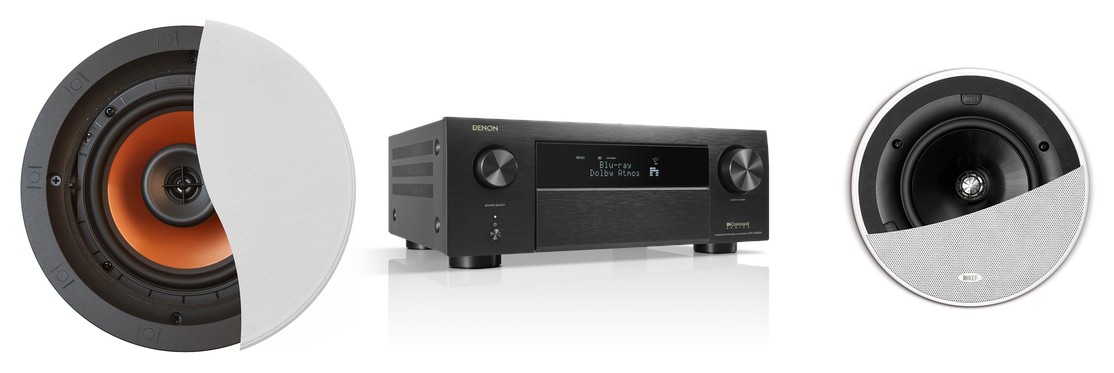
Dolby Atmos adds a height dimension to surround sound. Instead of audio being mixed for a flat plane of speakers around you, Atmos lets sound designers place audio objects anywhere in three-dimensional space, including above your head. The effect, when done right, is a noticeable improvement in immersion. Rain falls from above. Helicopters pan overhead. Ambient soundscapes gain a vertical dimension that flat surround cannot replicate.
But "when done right" is doing a lot of work in that sentence. A poorly implemented Atmos system can sound worse than a well-calibrated 5.1 setup. Here is how to get it right.
The Three Ways to Add Height Channels
1. In-Ceiling Speakers (Best)
Speakers mounted in the ceiling directly above the listening area. This is what Dolby's specification recommends, and it delivers the most convincing overhead effects because the sound is actually coming from above you.
In-ceiling speakers work best in rooms with standard 8 to 10-foot flat ceilings. Vaulted or cathedral ceilings make placement trickier and may require angled baffles to aim the sound toward the listening position.
For Atmos, you do not need expensive in-ceiling speakers. The height channels carry ambient effects and spatial cues, not full-range music. Brands like Polk, Monoprice, and Micca make in-ceiling speakers in the $50 to $100 each range that perform perfectly well for Atmos duty.
2. On-Wall Height Speakers (Good)
Speakers mounted high on the front and rear walls, angled downward toward the listening position. This is a good alternative when cutting holes in the ceiling is not possible (apartments, finished ceilings you do not want to modify).
Dolby specifies that wall-mounted height speakers should be placed at or near ceiling height and angled 30 to 45 degrees downward. The effect is less precise than true ceiling speakers but still provides a meaningful sense of height that flat surround lacks.
3. Upfiring Atmos Modules (Compromised)
Small speakers that sit on top of your existing front speakers and fire sound upward, relying on ceiling reflections to create the illusion of overhead audio. Dolby developed this approach to let people add Atmos without installing ceiling speakers.
The reality is mixed. Upfiring modules work best in rooms with flat, hard ceilings at standard 8-foot height. They are noticeably less convincing than real ceiling or height speakers. High ceilings, textured ceilings, or vaulted ceilings degrade the effect significantly. If your ceiling is anything other than flat drywall at 8 to 9 feet, skip upfiring modules and go with one of the other options.
Rob's take
Upfiring modules are a disappointment in almost every room I've tried them in. The ceiling-bounce effect requires specific conditions — flat drywall at exactly 8 feet, nothing between the module and the ceiling — and the vast majority of rooms don't meet that spec. Two $70 Polk RC80i in-ceiling speakers are better in every way: tighter placement, real overhead localization, no surface dependency. If you can cut two holes in the ceiling, do it.
Atmos Layouts: Which Configuration to Choose
Atmos layouts are described as X.Y.Z, where X is the ear-level speaker count, Y is subwoofers, and Z is height speakers. Common configurations:
5.1.2: The entry point for Atmos. Five ear-level speakers, one sub, two height speakers. The two height speakers go directly above the main listening position (or slightly in front of it). This is the minimum for a convincing Atmos effect and is achievable with any 7-channel AVR by reassigning two surround back channels to heights.
5.1.4: Four height speakers arranged in a rectangle above the listening area (two front heights, two rear heights). This is the sweet spot for most home theaters. Four height speakers create a much more convincing overhead soundstage than two, and the improvement from 2 to 4 heights is larger than the improvement from 4 to 6.
7.1.4: Adds two more ear-level surrounds (rear surrounds behind the listening position) to the 5.1.4 layout. This is the Dolby reference layout for home Atmos and delivers the most complete surround envelope. Requires a 9-channel AVR (or 7-channel AVR with an external 2-channel amp for the heights).
7.1.6 and beyond: Diminishing returns for most rooms. The improvement from 4 to 6 heights is subtle compared to the jump from 2 to 4. Only worth pursuing in larger dedicated theaters where the height speaker spacing can properly justify the additional channels.
Common Atmos Mistakes
Spending the whole budget on Atmos instead of the base layer
A 5.1 system with excellent front speakers, a capable sub, and proper room correction will always sound better than a 7.1.4 system built from cheap speakers with no acoustic treatment. Get the base layer right first. Atmos is a refinement, not a foundation.
Height speakers placed too far forward or back
The Atmos height speakers should create an overhead "zone" that roughly aligns with your seating area. If all four heights are above the front of the room (near the screen), overhead panning effects will not track properly. Follow Dolby's placement guidelines: front heights at about 30 to 55 degrees forward of the listening position, rear heights at 125 to 150 degrees.
Not running room correction on the height channels
Height channels need room correction calibration just like your ear-level speakers. The distance, level, and frequency response of your ceiling speakers will be different from your main channels. Run your AVR's full room correction setup with all channels, including heights. Do not skip this step.
Using mismatched speaker types for heights
Your four Atmos height speakers should ideally be the same model, or at least the same type (all in-ceiling, or all on-wall). Mixing upfiring modules with in-ceiling speakers, or mixing different speaker models across the height positions, creates inconsistencies in the overhead soundstage that room correction cannot fully fix.
Is Atmos Worth It?
For dedicated home theaters with proper placement, yes. The overhead dimension adds genuine immersion for well-mixed Atmos content (most modern action and sci-fi films, many streaming originals, and a growing number of music releases).
For casual living room setups, the investment is harder to justify. If you are choosing between spending $300 on Atmos height speakers or $300 on upgrading your subwoofer, the subwoofer upgrade will make a bigger difference to more of your content. Atmos is a "nice to have" after the fundamentals are solid.
CinemaConfig's builder helps you plan the right Atmos layout for your room. It validates that your AVR supports the channel count you are targeting, checks that your height speakers are compatible with your receiver's power output, and verifies that the full signal chain from source to speaker supports the Atmos formats your content uses. For proper placement of your ear-level speakers, see the speaker placement guide.
Rob Teller
Founder, CinemaConfig
15 years in consumer hardware and software, mostly on the product side. NZXT (cases and cooling), Asetek (liquid cooling, global sales), a short run advising on Alienware's roadmap at Dell, then four ... More about Rob · Affiliate disclosure