Mini LED vs OLED - Which TV Tech Is Better for Your Room?
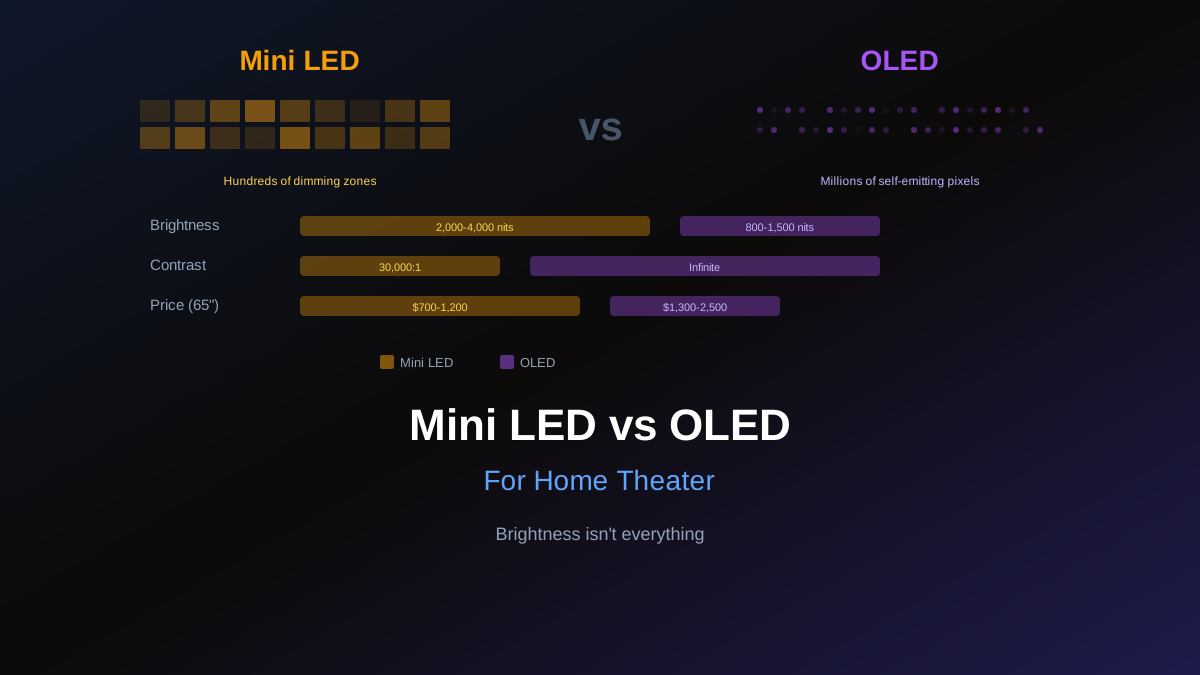
OLED is better for movies in a dark room. Mini LED is better for bright rooms and sports. If your room is somewhere in between (most are), the answer depends on your budget more than the technology.
That is the short version. The long version involves dimming zones, nit counts, blooming artifacts, and a price gap that changes the math at every screen size. We will walk through all of it so you can make the right call for your specific room and viewing habits.
How the Two Technologies Actually Work
OLED panels contain millions of self-emitting pixels. Each pixel produces its own light and can turn off completely. When a pixel is off, it emits zero light. True black, at the pixel level, with no approximation.
Mini LED is still LCD technology at its core. A liquid crystal layer blocks or passes light from a backlight behind it. The "mini" part refers to the backlight: instead of 50-100 dimming zones like older LED TVs, mini LED panels use thousands of tiny LEDs arranged in 500 to 5,000+ zones. Each zone can dim independently, creating much better local contrast than traditional LCD.
More dimming zones means less light bleed between areas. But it is still an approximation. A single dimming zone covers hundreds of pixels, so when a bright object sits next to a dark area, the zone lights up the whole region. That is blooming: a halo of light around bright objects on dark backgrounds. OLED does not have this problem because every pixel controls its own light.
Rob's take
The answer to mini LED vs OLED is almost always determined by your room's light situation, not the technology spec sheet. In a dark, light-controlled room, OLED's contrast advantage is decisive. In a room with afternoon sunlight coming through south-facing windows, mini LED's brightness advantage makes it the practical choice regardless of how you feel about infinite contrast ratios in theory.
Contrast: OLED Wins, Period
OLED's contrast ratio is technically infinite. A pixel that is off emits zero light, so the ratio of brightest-to-darkest is limited only by the bright end. In practice, that means starfields look like actual stars against actual black. Shadows have depth and gradation instead of collapsing into a gray wash.
The best mini LED panels hit around 25,000:1 to 30,000:1 measured contrast. That is excellent by LCD standards (a massive improvement over the 5,000:1 of a typical edge-lit LED from five years ago), but it is still a different league from OLED.
Watch a dark scene from Dune, The Batman, or any Christopher Nolan film on both technologies side by side. The difference is immediately visible. On mini LED, bright specular highlights bleed into surrounding dark areas. On OLED, the bright object pops against a background that is genuinely black. For cinematic content that relies on shadow detail and dark atmosphere, OLED's advantage is not subtle.
Brightness: Mini LED Wins
Peak brightness is where mini LED fights back. Current mini LED flagships hit 2,000 to 4,000 nits of peak brightness in HDR highlights. OLED panels land between 800 and 1,500 nits, with QD-OLED panels at the higher end of that range.
This matters in two scenarios. First, HDR highlight detail: a sunset, an explosion, a glint off metal. Mini LED can push those highlights harder, making HDR content feel more dynamic in a room with any ambient light. Second, daytime viewing in bright rooms. If your TV fights against afternoon sun through windows, mini LED's raw brightness advantage keeps the image punchy where OLED starts looking dim.
For sports in a sunlit living room, mini LED is the clear pick. No contest.
Burn-In: A Shrinking but Real Difference
OLED pixels degrade when displaying static content for extended periods. Modern panels have mitigations (pixel shifting, logo luminance reduction, automatic screen refresh cycles), and real-world burn-in is far less common than it was on early OLED sets. Most people will never see it.
But "minimal risk" is not "zero risk." If your TV displays news tickers, game HUDs, or channel logos for 8+ hours daily, OLED pixels showing those static elements will wear faster than surrounding pixels. Mini LED has no burn-in mechanism at all. The backlight degrades uniformly across the panel.
For a dedicated home theater that plays movies and shows, burn-in is not a concern. For a living room TV that runs cable news all day, mini LED removes the worry entirely.
Price: Where the Decision Gets Interesting
At 65 inches, a TCL QM851G (mini LED) costs around $750. An LG C4 (OLED) costs around $1,300. That is a $550 gap for the same screen size.
At 75 inches, the gap widens further. Mini LED options from TCL and Hisense land in the $1,000-1,200 range. A 77-inch LG C4 runs $1,800-2,000. The OLED premium buys better contrast, but the mini LED budget buys a dramatically larger screen.
This is the real tradeoff for most buyers. OLED is the better technology for dark-room movie watching. But is it $550 better? Is it "two full screen sizes smaller" better? That depends on your priorities.
The Best Mini LEDs for Home Theater
If you go mini LED, these are the models worth considering for 2026:
- TCL QM851G (65": ~$750). Best value in the category. Over 2,000 dimming zones, excellent HDR performance for the price. The contrast is not OLED-level, but it punches well above its price point.
- Hisense U8N (65": ~$700). Slightly fewer dimming zones than the TCL but comparable peak brightness. Strong Google TV platform. Aggressive pricing makes it the budget king.
- Samsung QN90D (65": ~$1,200). Samsung's best non-OLED panel. Superior anti-glare coating, excellent motion handling for sports. Tizen OS is polarizing but functional.
- Sony X93L (65": ~$1,300). Sony's processing applied to a mini LED panel. Best upscaling in the mini LED category. At this price you are close to OLED territory, so it only makes sense if you need the brightness or burn-in resistance specifically.
For full TV recommendations across all technologies and price points, see our budget 4K TV guide.
When to Choose OLED
OLED is the right pick if your room is dark (or you control the lighting), you primarily watch movies and prestige TV, you are willing to pay the premium for the best picture quality available, and you value shadow detail and black levels above all else. A dedicated home theater room with blackout curtains and an OLED is about as good as consumer displays get for film content.
If you are building a serious theater setup, our OLED buying guide breaks down the specific models and panel differences. For understanding the differences between OLED panel types, the QD-OLED vs WOLED comparison goes deeper.
When to Choose Mini LED
Mini LED is the right pick if your room has significant ambient light, you watch a mix of content (sports, gaming, movies, cable), you want the biggest screen possible for your budget, static content (news, game HUDs) runs on the TV for long hours, or the OLED premium does not fit your budget.
A 75-inch mini LED in a bright living room will deliver a more impressive experience than a 55-inch OLED struggling against window glare. Brightness and screen size both contribute to immersion, and mini LED gives you more of both per dollar.
The Middle Ground
Here is the practical framework. If you can afford a 65-inch OLED, that beats a 65-inch mini LED for most home theater use. The contrast advantage is real and visible on any content with dark scenes.
But if the OLED budget only gets you a 55-inch screen while mini LED gets you 75 inches, go bigger. Screen size matters more than panel technology for overall immersion. A 75-inch mini LED filling your field of view will feel more cinematic than a 55-inch OLED, even though the OLED's blacks are deeper.
Use CinemaConfig's viewing distance calculator to find the ideal screen size for your seating distance. If you are sitting 9 feet from the screen, a 75-inch TV fills the THX-recommended field of view. A 55-inch TV at the same distance looks small.
After choosing your display, proper calibration settings make a bigger difference than most people expect. Both OLED and mini LED benefit from turning off motion smoothing, setting the correct color temperature, and enabling filmmaker mode for movie content. A calibrated $800 mini LED outperforms an uncalibrated $1,500 OLED.
The technology gap between OLED and mini LED is narrowing every year. Both are excellent. Pick the one that fits your room, your budget, and your screen size target. Either way, you are getting a dramatically better picture than the TV you are replacing.
Deeper dives in the panel tech cluster: Our complete panel types overview covers every display technology on the market in 2026. For the OLED panel debate specifically, see QD-OLED vs WOLED. And for the next generation of LCD backlighting, RGB Mini LED explained covers why it might close the gap with OLED.
Rob Teller
Founder, CinemaConfig
15 years in consumer hardware and software, mostly on the product side. NZXT (cases and cooling), Asetek (liquid cooling, global sales), a short run advising on Alienware's roadmap at Dell, then four ... More about Rob · Affiliate disclosure