Hisense U8N vs TCL QM851G vs Samsung Q80D - Best Budget 4K TV
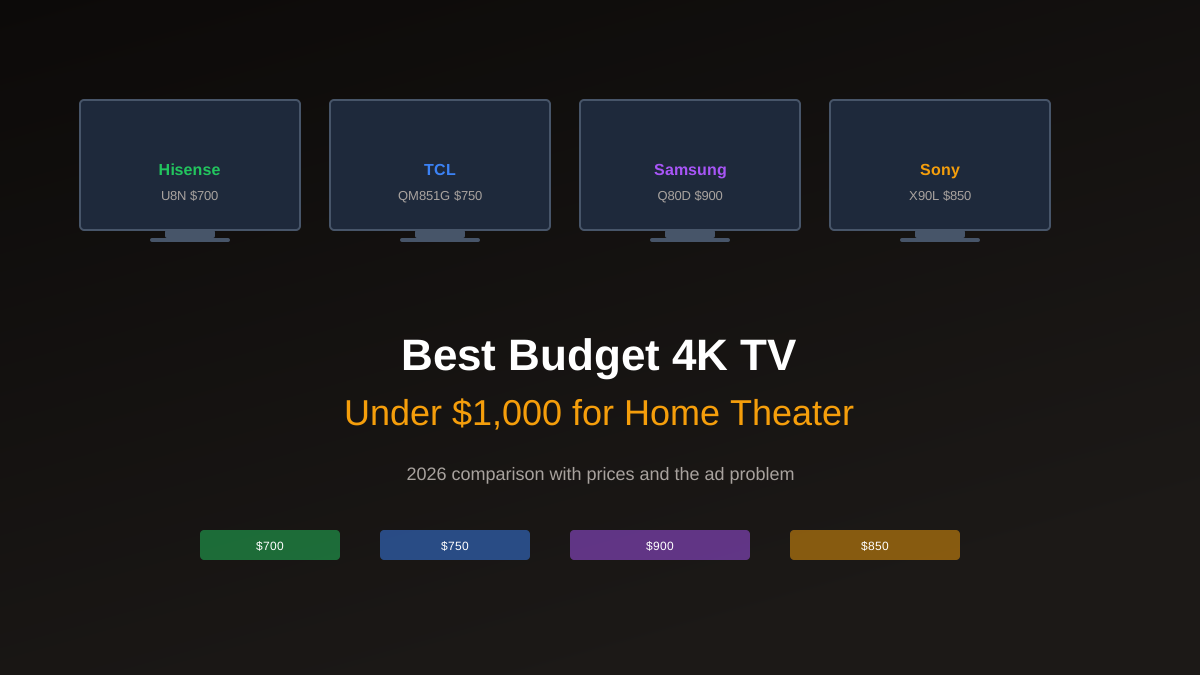
The Hisense U8N ($700 for 65-inch) is the best budget TV for dark-room home theater. The TCL QM851G ($750) wins for bright rooms. The Samsung Q80D ($900) is the safe pick you will slightly overpay for. The Sony X90L ($850) has the best processing but the dimmest picture. All four are good TVs. None of them have good software. We will get to that.
Quick picks:
- Best overall: Hisense U8N 65" ($700). Best contrast and black levels under $1,000. Mini LED backlight punches way above its price.
- Best for bright rooms: TCL QM851G 65" ($750). Brightest in class. Handles window glare better than anything else at this price.
- Safest pick: Samsung Q80D 65" ($900). Polished processing, reliable brand. You are paying $150-200 extra for the logo.
- Best for mixed content: Sony X90L 65" ($850). Noticeably better upscaling of 1080p cable and streaming. Dimmer than the others.
Why This Category Matters
For most people building their first real home theater, the TV comes before the speakers, before the receiver, before anything else. And for most people, $1,000 is the ceiling. That makes the sub-$1,000 65-inch 4K TV the single most important product category in home theater.
The good news: this segment has gotten shockingly competitive. Five years ago, $700 bought you a mediocre edge-lit LCD with washed-out blacks. Today, $700 buys you a mini LED backlight with hundreds of dimming zones, genuinely impressive HDR highlights, and 120Hz refresh rates for gaming. The bad news: every TV in this range is also a billboard.
Rob's take
The Hisense and TCL mini-LED panels represent a genuine shift in the budget TV market. Three years ago, 'budget 4K TV' meant accepting poor local dimming and washed-out HDR. Today, the Hisense U8N and TCL QM8 measure within striking distance of panels costing twice as much. The 'buy OLED or settle' calculus has changed for rooms with ambient light.
Hisense U8N: Best Picture, Worst Software
The Hisense U8N is the TV we keep recommending despite everything Hisense does to make us not want to. The picture quality is genuinely remarkable for $700. The mini LED backlight uses over 500 local dimming zones on the 65-inch model, which gives it contrast performance that embarrasses Samsung and Sony sets costing $200 more. Dark scenes in movies look dark, not gray.
Peak brightness hits around 1,500 nits in HDR, which is overkill for a dark theater room and still plenty for a room with some ambient light. Color accuracy out of the box is better than you would expect from a brand that was selling $300 garbage five years ago.
The catch. You knew there was a catch.
Hisense's Google TV implementation is aggressively, insultingly ad-heavy. The home screen is a wall of promoted content. There are ads in the settings menus. Reddit threads about Hisense's ad behavior regularly hit hundreds of upvotes from people who spent $700 on a TV and immediately got served ads for products they already own.
The fix is simple: budget $150 for an Apple TV 4K and never open the Hisense home screen again. Use the TV as a dumb display. Your total cost is $850 for what we think is the best picture quality under $1,000, period.
TCL QM851G: Brightness Champion
If your TV room has windows, the TCL QM851G is the pick. It is the brightest TV in this price range, hitting around 1,800 nits in focused HDR highlights. That matters when you are watching a Sunday afternoon football game with the curtains open.
The QM851G's mini LED implementation uses fewer dimming zones than the Hisense U8N, so contrast in dark scenes is not quite as precise. You will notice slightly more blooming around bright objects on dark backgrounds. In a bright room, this does not matter. In a dedicated dark theater room, the Hisense is the better pick.
TCL's Google TV platform is less aggressively ad-loaded than Hisense's, though that is a low bar to clear. Motion handling is the QM851G's weak spot: fast camera pans in sports have slightly more judder than the competition. At $750 for the 65-inch, if brightness is your priority, nothing else in this range comes close.
Samsung Q80D: The Brand-Tax Special
The Samsung Q80D is the TV you buy when you want to stop thinking about TVs. It is good at everything, great at nothing, and it costs more than it should. At $900 for the 65-inch, you are paying $150-200 more than a Hisense U8N or TCL QM851G that match or beat it in raw performance metrics.
What you get for that premium: Samsung's processing is the most polished in this group. Motion handling is smooth without looking artificially interpolated. Build quality and remote control feel a tier above the Chinese brands.
For budget-conscious shoppers who are willing to do five minutes of research, the Hisense U8N delivers better picture quality for $200 less.
Sony X90L: The Upscaling King on a Dim Throne
Sony's X90L ($850 for 65-inch) has the best processing in the group by a clear margin. If you watch a lot of 1080p cable, older Blu-rays, or streaming content that maxes out at 1080p, the Sony's upscaling engine makes that content look noticeably better than it does on the Hisense, TCL, or Samsung.
The problem: the X90L is dimmer than every other TV on this list. Peak HDR brightness sits around 1,000 nits, which is 500 nits behind the Hisense and 800 behind the TCL. If processing and film accuracy are your top priorities and you watch in a dark room, the Sony is a legitimate choice. For everyone else, the Hisense U8N gives you more for less.
The Ads Elephant in the Room
Every budget smart TV in 2026 pushes ads. Hisense is the worst offender. Samsung is close behind. TCL and Sony are slightly less aggressive.
Here is our honest recommendation: treat every TV in this price range as a dumb display. Budget an extra $150 for an Apple TV 4K or $200 for an Nvidia Shield Pro. Plug it into HDMI 1, set the TV's input to default to that HDMI port on startup, and never interact with the TV's built-in software again.
What to Skip
Samsung's Crystal UHD lineup (the DU series) trades on the Samsung name while delivering the picture quality of a TV half its price. The DU8000 at $550 for 65 inches sounds like a deal until you see the edge-lit backlight, the 60Hz panel, and the contrast ratio that makes dark scenes unwatchable. Samsung puts "Crystal UHD" branding on these sets specifically to confuse buyers who think they are getting QLED performance. They are not.
More broadly, be skeptical of any 65-inch TV under $400. The TVs in our picks cost $700-900 because that is what it actually costs to build a good 65-inch TV in 2026.
Sizing It Right
Before you buy, run your seating distance through CinemaConfig's viewing distance calculator. If you are sitting 8 feet away, a 65-inch TV is the minimum for 4K to actually look like 4K. Sitting 10 feet back? You want 75 inches. The Hisense U8N 75" at $1,000 is the one exception that stays under budget, and it is a screaming deal if your room needs the size.
Once you have got the TV sorted, the next upgrade that makes the biggest difference is a subwoofer, not better speakers. If you are building a full system, the CinemaConfig builder will check that your AVR, speakers, and TV all play nicely together before you spend a dime.
The budget 4K TV market in 2026 is the best it has ever been, and also the most annoying it has ever been. Buy the Hisense, buy an Apple TV, skip the Samsung Crystal UHD, and go watch something great.
Rob Teller
Founder, CinemaConfig
15 years in consumer hardware and software, mostly on the product side. NZXT (cases and cooling), Asetek (liquid cooling, global sales), a short run advising on Alienware's roadmap at Dell, then four ... More about Rob · Affiliate disclosure


