QD-OLED vs WOLED - Which OLED Panel Should You Buy?
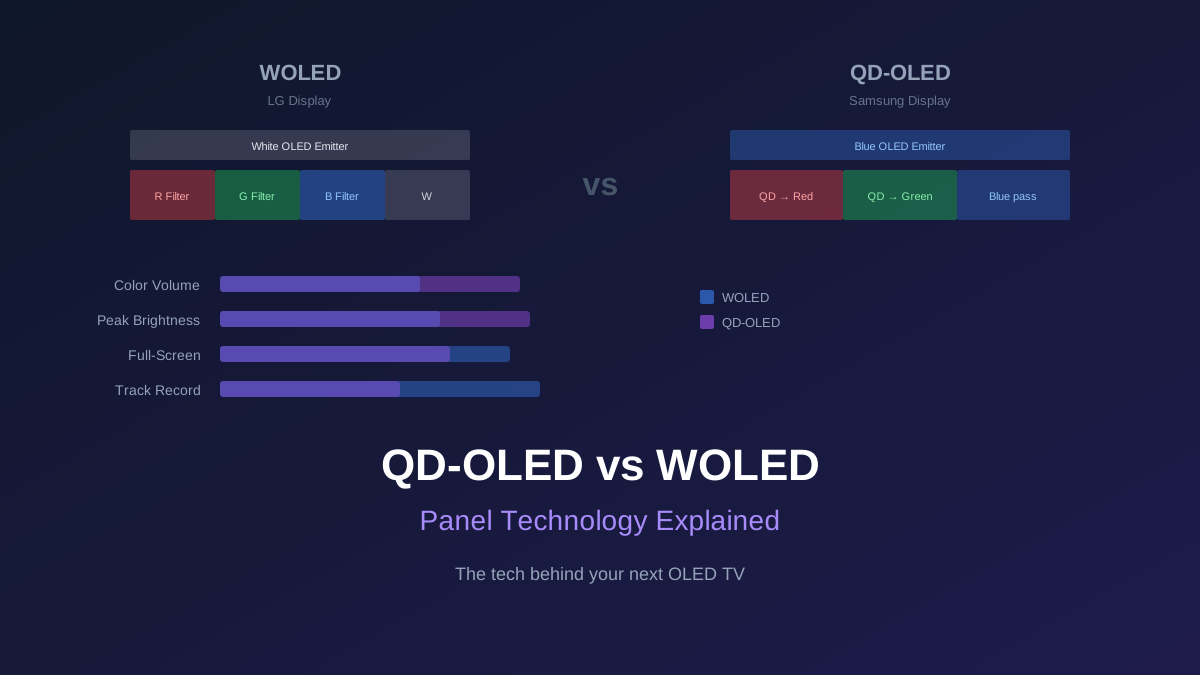
QD-OLED produces more saturated colors and higher peak brightness. WOLED has better full-screen uniformity and a longer reliability track record. For most home theaters, the difference is visible but not decisive.
If you have been shopping for an OLED TV in 2026, you have probably run into these two acronyms. Understanding the difference is useful, but for most buyers, the TV's price, processing, and platform matter more than which panel is inside.
How WOLED Works
WOLED panels are manufactured by LG Display. Every OLED TV from LG, every OLED from Sony's A80 line, and several OLED monitors use WOLED panels. Each pixel contains a white OLED emitter that produces broad-spectrum light, which then passes through color filters (red, green, blue) to create the colors you see on screen. There is also a fourth white subpixel with no filter, which boosts overall brightness.
The most significant recent upgrade to WOLED is MLA (Micro Lens Array), first introduced in the LG G3. MLA places a microscopic lens structure on top of each pixel to direct more light toward the viewer instead of letting it scatter. The result is a 60 to 70 percent brightness increase without changing the underlying OLED chemistry.
Rob's take
QD-OLED's real advantage is color volume at peak brightness — it maintains wider color gamut when pushing HDR highlights than WOLED does. WOLED's real advantage is uniform full-screen brightness, which matters for sports and content mastered at moderate brightness. Most viewers won't perceive the difference in either direction. The processing layer on top of both panels (Sony vs LG vs Samsung) matters more than which substrate is underneath.
How QD-OLED Works
QD-OLED panels are manufactured by Samsung Display. Samsung's S90D and S95D TVs use them. Sony's A95L also uses a QD-OLED panel from Samsung Display, paired with Sony's own processing.
Instead of white emitters with color filters, QD-OLED uses a blue OLED emitter as its light source. That blue light hits a quantum dot conversion layer, where nanoscale semiconductor crystals convert the blue photons into red and green. Blue subpixels pass the light straight through without conversion.
Color filters (WOLED's approach) work by blocking light. Quantum dot conversion (QD-OLED's approach) transforms the light instead of blocking it. More of the original energy reaches your eyes, which translates directly into higher brightness per unit of power and wider color volume.
Color Volume: QD-OLED Wins
QD-OLED panels produce more saturated reds and greens at high brightness levels. A bright red explosion in an HDR movie will look richer and more vivid on a QD-OLED panel. The advantage shows up primarily in HDR content mastered for wide color gamut, including most 4K Blu-rays, Dolby Vision streams, and HDR games.
Peak Brightness: QD-OLED Leads on Highlights
On small specular highlights, QD-OLED panels hit higher peak brightness. The Samsung S95D can push past 2,000 nits on a 10 percent window. WOLED with MLA has closed the gap significantly, with the LG G4 reaching roughly 1,500 to 1,800 nits on similar test patterns.
Full-Screen Brightness: WOLED Wins
When the entire screen is bright (daytime exteriors, snow scenes, sports broadcasts), WOLED panels maintain higher average brightness. WOLED's extra white subpixel gives it an efficiency advantage in these full-screen scenarios.
Viewing Angles and Burn-In
QD-OLED panels can exhibit a slight color shift at extreme off-axis viewing angles. WOLED panels are more color-neutral at those same angles. For typical living rooms where most seats are within 30 degrees of center, this is a non-issue.
Both panel types have improved massively on burn-in resistance. WOLED has the advantage of a longer track record (shipping since 2013). QD-OLED is newer (first shipped 2022), so long-term data beyond 3 to 4 years does not exist yet. For normal home theater use, both should last well beyond a typical ownership cycle.
Which TVs Use Which Panel
WOLED (LG Display): LG B4, LG C4, LG G4 (with MLA), Sony A80L and successors.
QD-OLED (Samsung Display): Samsung S90D, Samsung S95D, Sony A95L.
Note that Sony sources panels from both manufacturers. Our OLED buying guide breaks down the specific model-by-model recommendations.
The Practical Verdict
Buy based on price, features, and your room conditions. Not panel technology. The LG C6 is the best value OLED for most rooms. The Samsung S95H is the pick for the most vivid HDR highlights. The Sony A95L splits the difference with QD-OLED brightness and Sony processing.
Panel technology is one input into picture quality, but it is not the whole story. If you are comparing QD-OLED to WOLED, you are splitting hairs between two excellent technologies. If you are weighing OLED against the latest Mini LED options, our Mini LED vs OLED comparison covers the trade-offs in detail.
More in the panel tech cluster: Our complete panel types overview covers every display technology available in 2026, including RGB Mini LED — the next-gen backlight tech that could reshape the OLED vs LCD debate.
Rob Teller
Founder, CinemaConfig
15 years in consumer hardware and software, mostly on the product side. NZXT (cases and cooling), Asetek (liquid cooling, global sales), a short run advising on Alienware's roadmap at Dell, then four ... More about Rob · Affiliate disclosure


