LG B6 vs Samsung S85H - Best Budget OLED in 2026?
Quick Verdict
- LG B6: The pick for Dolby Vision households and gamers who want 144Hz VRR. US pricing hasn't been announced yet; Canadian MSRP starts at CAD $1,500 for 48".
- Samsung S85H: The pick for Samsung ecosystem buyers and anyone who wants to buy today. Starts at $1,200 for 48" in the US, all five sizes available now.
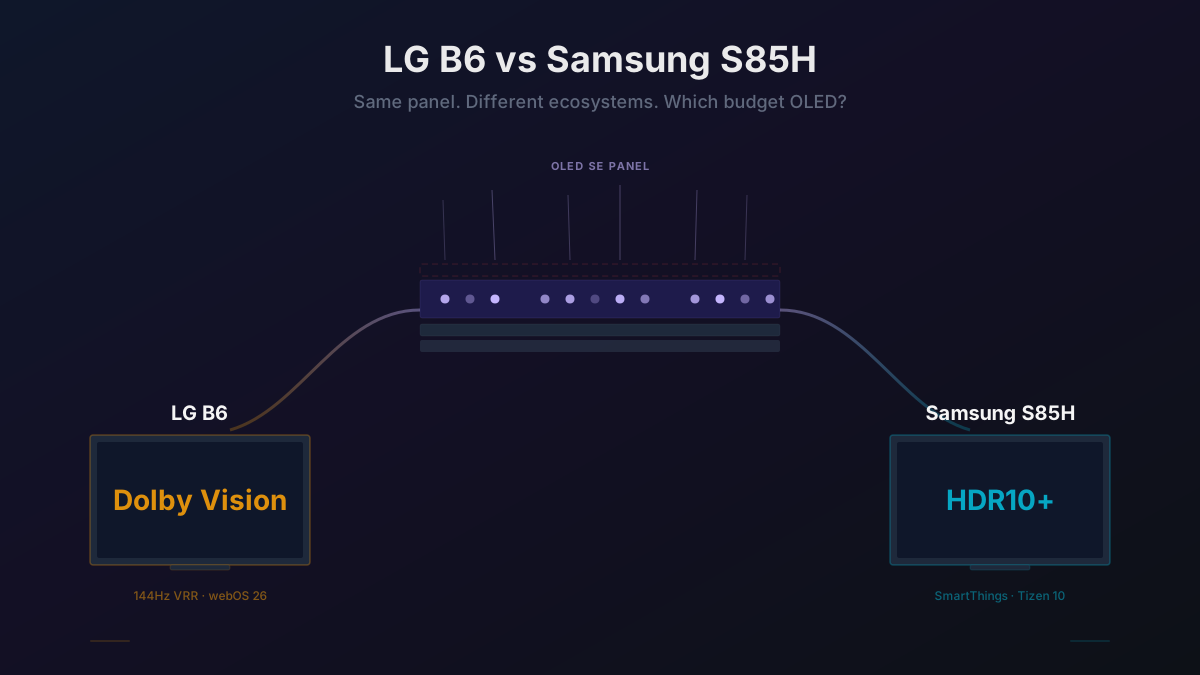
They share the same OLED SE panel from LG Display. The real difference is HDR format support, refresh rate, and which app ecosystem you prefer.
Rob's Take
The OLED SE panel is the real story here, not the brand on the box. LG and Samsung are selling the same display hardware with different software stacks on top. If you already own an Apple TV 4K or stream heavily on Netflix and Disney+ (all Dolby Vision sources), the B6 is the obvious pick. If you're deep in Samsung's SmartThings ecosystem or HDR10+ matters to you for Amazon content, the S85H makes more sense. I would not lose sleep over this choice. Both are fine TVs that get you into OLED territory for the lowest price either company has ever charged at launch.
The Panel They Share (and Why That Matters)
Both the LG B6 and Samsung S85H use LG Display's new OLED SE panel. "SE" stands for Special Edition, which is marketing language for "we removed the polarizer to make it brighter and cheaper." The polarizer in traditional WOLED panels eats about 50% of the light output. Remove it, and brightness jumps from the B5's measured 668 nits to a claimed ~1,000 nits on the B6. That is a meaningful upgrade for the entry-level OLED tier.
The catch: removing the polarizer also removes the built-in anti-glare layer. Reflectivity jumps from the low single digits to about 4.4%, which is more in line with a Mini-LED TV than a traditional OLED. If your room has windows behind the couch or an overhead light that hits the screen, you will notice more reflections than on last year's budget OLEDs.
Neither the B6 nor the S85H gets the anti-glare coating that their pricier siblings use. The LG G6 has Reflection Free Premium (0.3% reflectivity). The Samsung S90H and S95H get Glare Free technology. At the entry level, both brands skip it. This is the biggest compromise of buying budget OLED in 2026: you get the brightness gains from the polarizer-free panel but lose the glare mitigation you'd get by spending more.
No independent lab has published measured brightness for either TV yet (RTINGS reviews are pending as of April 2026). The ~1,000 nit figure is a manufacturer estimate based on the panel architecture. Take it as directional, not gospel. I will be less surprised if both land in the 850-950 nit range under measurement than if they hit a full 1,000.
Where They Diverge: The Ecosystem Gap
The panel is the same. The processing on top is where the B6 and S85H become genuinely different televisions.
HDR Formats
The B6 supports Dolby Vision. The S85H does not. The S85H supports HDR10+ Advanced. The B6 does not. Samsung has refused to license Dolby Vision for years; LG has refused to support HDR10+. Neither company shows any sign of budging.
In practice, this means: if you watch Netflix, Disney+, Apple TV+, or Vudu, the B6 gets the Dolby Vision grade. If you watch Amazon Prime Video or Paramount+ (both HDR10+ sources), the S85H gets the dynamic metadata advantage. For everything else, both decode HDR10, which is fine.
Dolby Vision has a larger content library overall and wider streaming platform adoption. If you forced me to pick one, I would pick Dolby Vision. But if 80% of your streaming is Amazon Prime Video, that calculus flips.
Refresh Rate and Gaming
The B6 runs at 120Hz native with VRR support up to 144Hz. The S85H runs at 120Hz and caps out there. No 144Hz VRR. For console gaming this barely matters (the PS5 Pro and Xbox Series X don't output above 120fps at 4K). For PC gaming with a GPU that pushes past 120fps at 4K, the B6's extra headroom is real.
Both support ALLM and both have dedicated Game Modes. Neither TV has published input lag measurements yet (we will update this post when RTINGS reviews drop), but based on their predecessors, expect something in the 9-12ms range at 4K/60Hz in Game Mode. Good enough for anything short of competitive esports.
Processing Power
This one hurts Samsung. The S85H ships with the NQ4 AI Gen2 processor, which is two years old. The same chip generation powered the 2024 Samsung OLEDs. The LG B6 gets the Alpha 8 Gen3, which is entry-level for LG's 2026 lineup but still current-generation silicon.
The Samsung S90H and S95H both use the NQ4 Gen3. Samsung saved money on the S85H by reusing old silicon, and the upscaling and motion processing differences between Gen2 and Gen3 are noticeable in side-by-side comparisons. Whether you would notice in your living room without a reference TV next to it is another question. Probably not.
The Smart Platform Question
LG runs webOS 26. Samsung runs Tizen OS 10. Both support every major streaming app. Both support AirPlay 2 and Google Cast. The honest answer is that neither platform is bad enough to be a dealbreaker.
Where Samsung pulls ahead: SmartThings Hub is built into the S85H. If you have Samsung smart home devices (lights, locks, cameras, appliances), the TV becomes a control center. It also ships with a Solar Cell Remote that charges from ambient light, which is a small thing that turns out to be nice when you never have to find AAA batteries. Samsung also promises seven years of Tizen OS updates, which is the longest commitment in the TV industry.
Where LG pulls ahead: webOS has a snappier interface in my experience, and LG's 2026 lineup added FlexConnect for wireless surround sound with compatible LG speakers. If you plan to build a wireless home theater around the TV without running speaker wire, that matters.
A tangent that is worth your time: both LG and Samsung now run ads on their smart TV platforms. LG's webOS has had a persistent ad banner on the home screen for years. Samsung's Tizen does the same. If this bothers you (and it should), you can use an Apple TV 4K or Roku Ultra as your primary interface and mostly ignore the built-in OS. The irony of paying $1,200+ for a display and then needing a $130 streaming box to avoid ads on it is not lost on me.
Pricing and Availability: Samsung Wins on Timing
The Samsung S85H is available now at Samsung.com and Best Buy in all five sizes. US pricing:
- 48": $1,199.99
- 55": $1,499.99
- 65": $1,999.99
- 77": $2,799.99
- 83": $4,499.99
The LG B6 is in a stranger spot. LG has announced the B6 and it is listed on LG Canada (CAD $1,500 for 48", $1,800 for 55", $2,300 for 65"), but US pricing and availability have not been announced as of April 13, 2026. LG's US launch has so far prioritized the G6 and C6; the B6 appears to be arriving in a second wave.
If you need a TV this week, Samsung wins by default. If you can wait, the LG B6 will almost certainly launch at competitive US pricing (the B5 launched at $1,300 for 55" and routinely dropped below $800 within months). History suggests the B6 will be aggressively priced once it hits US retailers.
One more pricing note: the 2025 models (LG B4, Samsung S85F) are on steep clearance right now. A B4 OLED 48" is going for $600 at Best Buy. If you don't care about the brightness bump from the OLED SE panel, last year's budget OLEDs are an extraordinary deal at current prices.
Audio: Both Are Bad (Plan Accordingly)
Both TVs ship with 20W, 2.0-channel speaker systems. This is the minimum Samsung and LG can get away with. For solo Netflix viewing in a quiet room, they are adequate. For anything approaching a home theater experience, you need external audio on day one.
Samsung's OTS Lite (Object Tracking Sound Lite) and Q-Symphony features provide marginal improvements to the built-in speakers and better integration with Samsung soundbars. LG counters with FlexConnect wireless surround support. Neither makes the built-in speakers good. They make them slightly less bad.
Budget your TV purchase accordingly. A $1,200 TV plus a $300 soundbar will sound dramatically better than a $1,500 TV with built-in speakers.
Matching a soundbar or speaker system to your new OLED? The CinemaConfig builder pairs your TV with compatible audio gear and sources based on your room size and budget.
Who Should Buy Which
Buy the LG B6 if you stream Dolby Vision content (Netflix, Disney+, Apple TV+), game on PC at high frame rates, or want webOS and FlexConnect wireless surround. Wait for US pricing if you are in the States.
Buy the Samsung S85H if you want to buy right now, use Samsung SmartThings for your smart home, stream primarily on Amazon Prime Video (HDR10+), or want the security of Samsung's seven-year update commitment.
Buy neither if you can stretch to $2,000-2,700 for an LG C6 or Samsung S90H. The mid-range OLEDs get you better processors, anti-glare coatings, higher refresh rates, and meaningfully brighter panels. The jump from budget to mid-range OLED is larger than the jump from mid-range to flagship. If your budget has any flex, our C6 vs S90H comparison covers that tier.
Entry-level OLED in 2026 is a genuine milestone. Two years ago, the cheapest OLED from either brand cost $1,300 and was dimmer than a mid-range Mini-LED. The OLED SE panel changes that equation. By this time next year, I expect sub-$1,000 55" OLEDs to be normal. For now, the B6 and S85H are the opening act.
Samsung S85H prices verified April 13, 2026 from Samsung.com. LG B6 Canadian prices from lg.com/ca_en. US B6 pricing pending. Check current prices on CinemaConfig.
Rob Teller
Founder, CinemaConfig
15 years in consumer hardware and software, mostly on the product side. NZXT (cases and cooling), Asetek (liquid cooling, global sales), a short run advising on Alienware's roadmap at Dell, then four ... More about Rob · Affiliate disclosure


