Picking the best OLED TV 2026: LG G6, Samsung S95H, Sony A95L Compared
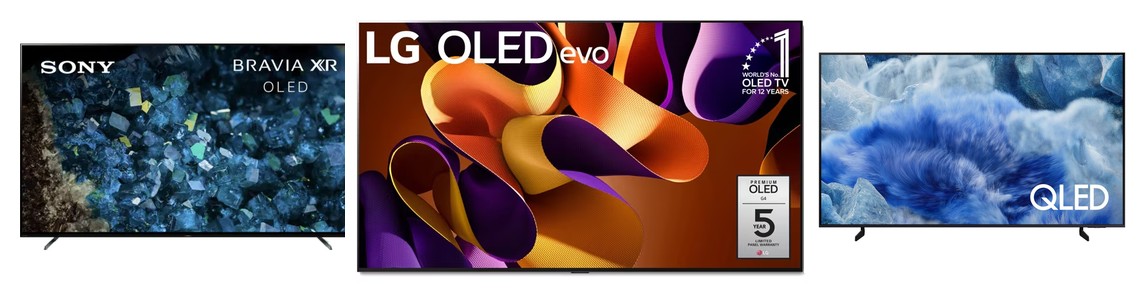
OLED has become the default recommendation for serious home theater displays over the past few years. The per-pixel dimming, near-infinite contrast ratio, and wide viewing angles make every other panel technology look like a compromise. But not all OLEDs are created equal, and picking between LG, Sony, and Samsung can be confusing when the spec sheets start blurring together.
What actually matters when choosing an OLED for your home theater in 2026: the LG G6 is the brightness leader at $3,400. The Samsung S95H leads on color saturation at $2,800. The Sony A95L is the film-accuracy pick. Every 2026 OLED ranked by room type below.
The Panel Situation
LG Display manufactures the WOLED panels used in LG and Sony TVs. Samsung Display makes the QD-OLED panels used in Samsung sets (and some Sony models). This means the "LG vs. Sony" comparison is really about processing and software, since the underlying panel is often identical.
QD-OLED panels from Samsung Display tend to produce more saturated colors and higher peak brightness, especially in HDR highlights. WOLED panels offer more uniform brightness across the full screen and have a longer track record for burn-in resistance. Both are excellent. The processing on top is where the real differences show up.
Rob's take
The panel brand debate — LG vs Sony vs Samsung — is mostly a processing argument on top of the same LG Display substrate. For 95% of what people watch, the LG C series is the honest answer. Sony's processing advantage only shows up on challenging 24fps film content in a dark room; if that describes your setup, it's worth the premium. If it doesn't, you're paying for engineering that your viewing conditions can't reveal.
LG: The Value Play
LG dominates the OLED market for one simple reason: price. The LG B series offers the cheapest entry point into OLED, and the C series hits the sweet spot of performance and value that makes it the most popular OLED TV sold worldwide.
LG B4: Entry-level OLED. Slightly dimmer than the C series with a less powerful processor, but still an OLED with all the contrast benefits that entails. Great pick if you are upgrading from an LCD and want to keep the budget reasonable.
LG C6: The default recommendation for most home theaters. Standard WOLED panel with improved brightness over prior C-series models (~1,350 nits in 10% HDR window, up from the C5's ~1,165 nits), better motion handling, and four HDMI 2.1 ports for gaming. Available in sizes from 42 to 83 inches. The 77" and 83" C6H variants get Tandem OLED for significantly higher brightness. If you are not sure which OLED to buy, the 65" C6 at $2,700 is probably it.
LG G6: Gallery series with the brightest Tandem OLED panel LG has shipped. LG Display's panel-spec peak is 4,500 nits; FlatpanelsHD measured the retail set at 2,481 nits in calibrated Filmmaker mode on a 10% HDR window, with peaks of 3,106 nits on a 2% small-highlight window. Priced at $3,400 for the 65-inch. Worth it if your room has ambient light and you need the extra punch, or if the TV is a visual centerpiece you want to mount flat against the wall.
Sony: Best Processing, Highest Price
Sony TVs use the same LG Display panels as LG TVs but pair them with Sony's own processing engine. The result is noticeably better upscaling of lower-resolution content, smoother motion handling for film and sports, and more accurate out-of-the-box color calibration.
Sony A95L: If you primarily watch movies and care about getting the most film-accurate image without manual calibration, Sony is the pick. The A95M uses QD-OLED for higher peak brightness than prior A80L/A90L WOLED models, paired with Sony's processing — which remains the best tone mapping in the industry for 24fps film content.
The trade-off is price. A Sony OLED typically costs 20 to 40 percent more than the equivalent LG model with the same panel. For dedicated cinema rooms where image accuracy is the top priority, many enthusiasts consider it worth the premium. For mixed-use living rooms, the LG C series offers 90% of the picture quality at a significantly lower price.
Samsung: Brightness King
Samsung's QD-OLED sets (S90H, S95H) take a different approach. Their panels produce the highest color saturation numbers in the OLED market, which makes them the best choice for rooms with significant ambient light. The S95H at $2,800 is the current color leader. Colors pop more aggressively, and HDR highlights hit harder than WOLED competitors.
The downsides: Samsung's smart TV platform (Tizen) is more aggressive with ads and data collection than LG's webOS or Sony's Google TV. Their lower-tier models (DU series, Q60D, Q70D, Q80D) are LCD sets that trade on the Samsung name but deliver significantly worse performance per dollar than competing brands at the same price points. Make sure you are buying their OLED lineup, not their budget LCD lineup.
Samsung QD-OLED sets have also drawn more reliability questions than LG or Sony OLEDs, with some owners reporting power board failures within the first year. The sample size is still relatively small, but it is worth factoring into a purchasing decision, especially if you are buying from a retailer with a limited return window.
Burn-In: Still a Concern?
Modern OLED panels have significantly better burn-in resistance than the sets from five or six years ago. Pixel refresher cycles, automatic brightness limiters for static content, and improved organic compounds have made burn-in a marginal concern for typical home theater use.
That said, if your TV will display static news tickers, always-on gaming HUDs, or channel logos for 8+ hours daily, an LCD panel is still the safer bet. For normal mixed-use viewing (movies, shows, gaming in sessions), burn-in on 2024+ OLED panels is unlikely to be an issue during the typical ownership period.
Size Matters More Than Brand
Here is a truth that gets overlooked in brand debates: screen size makes a bigger perceptual difference than brand or processing differences. A 77-inch LG B4 will be more immersive than a 55-inch Sony A90L, even though the Sony has objectively better processing.
The general guideline for OLED viewing distance: divide your seating distance in inches by 1.5 to get the minimum recommended screen size. Sitting 9 feet (108 inches) away? You want at least a 72-inch screen, making a 77-inch OLED ideal.
CinemaConfig's viewing distance calculator can help you find the exact right size for your room. Enter your seating distance and it will recommend the optimal screen size for both 4K and 1080p content.
What to Pair with Your OLED
An OLED is only as good as the signal chain feeding it. Make sure your AVR supports HDMI 2.1 passthrough if you want 4K/120Hz gaming, verify your HDMI cables are rated for the bandwidth you need (48Gbps for full HDMI 2.1), and confirm eARC support if you plan to use the TV's smart apps for streaming and pass audio back to your receiver.
CinemaConfig's builder checks all of this automatically. Add your TV, AVR, and source devices to a build and get instant validation of every connection in the chain. If you are pairing an OLED with an AVR for the first time, the AVR buying guide covers which receivers match best at each price point.
Rob Teller
Founder, CinemaConfig
15 years in consumer hardware and software, mostly on the product side. NZXT (cases and cooling), Asetek (liquid cooling, global sales), a short run advising on Alienware's roadmap at Dell, then four ... More about Rob · Affiliate disclosure


