Wireless Surround Sound That Actually Works? (Dolby Atmos FlexConnect)
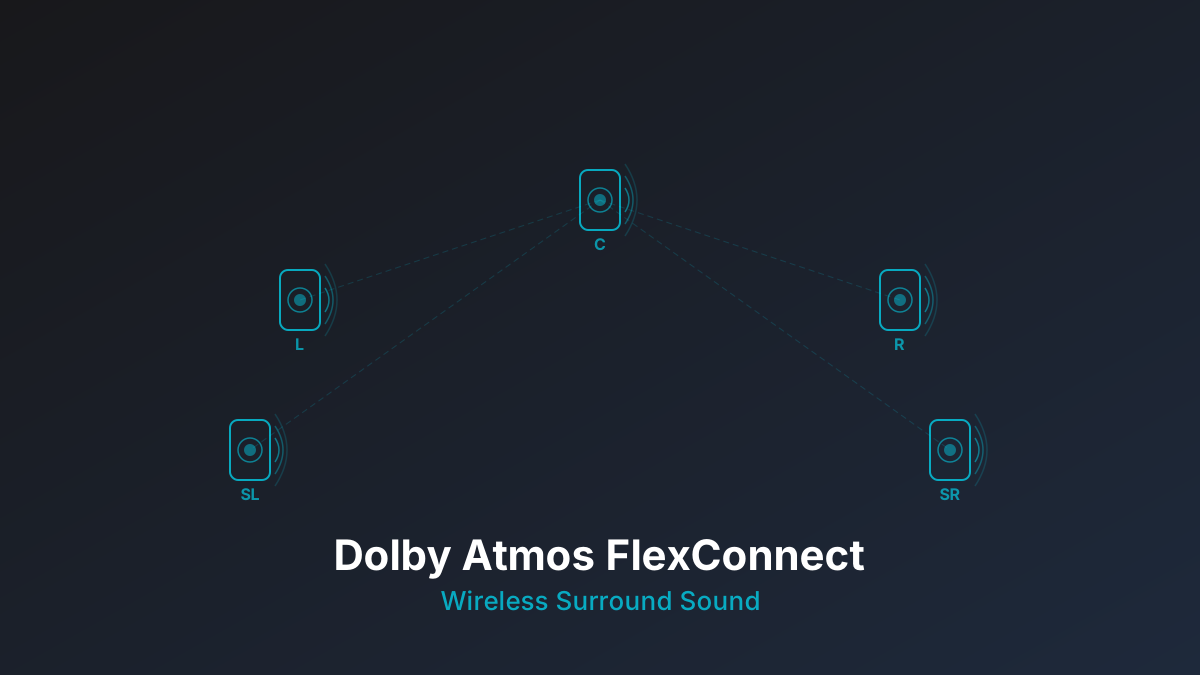
Every wireless surround sound system has promised to eliminate the cable problem and every single one has shipped with compromises that made enthusiasts stick with wires. Dolby Atmos FlexConnect, built into LG's 2026 Sound Suite hardware, is the first attempt backed by Dolby's own spatial audio engineers with auto-calibrating object rendering. It might actually work. But the ecosystem lock-in is steep and the real-world latency question still needs answers.
Here's what FlexConnect is, what it costs, and whether you should buy in or keep running speaker wire.
What FlexConnect Actually Does
FlexConnect is a Dolby-designed wireless protocol that does two things traditional wireless surround systems don't. First, each speaker reports its physical position in the room to the TV (via built-in accelerometers and time-of-flight measurement). Second, the Atmos renderer in the TV adjusts object placement in real-time based on where the speakers actually are, not where they're "supposed" to be according to the Atmos spec.
This matters because Atmos is an object-based audio format. A helicopter sound isn't assigned to "the left surround speaker." It's assigned to a coordinate in 3D space, and the renderer decides which speakers get which portion of the signal to create the illusion of that object at that position. If your surround speakers are 2 feet higher and 3 feet further back than the ideal position, a traditional system doesn't adapt. FlexConnect does.
The calibration happens automatically when you power on the system. Speakers emit test signals, the TV microphone array (on compatible LG TVs) measures arrival times, and the renderer rebuilds its speaker map. Move a speaker to a new shelf, and the system recalibrates on next power cycle. No manual configuration, no setup microphone on a tripod, no running room correction software on a laptop.
The Hardware: LG Sound Suite
FlexConnect requires LG Sound Suite hardware. No third-party speakers, no mix-and-match, no BYOD. Here's the lineup:
- LG Sound Suite H7 Soundbar (~$700): 3.1.2 channel bar with up-firing Atmos drivers. This is the hub: it connects to the TV via eARC and communicates wirelessly with all other Sound Suite components. Decent on its own, but the point is the expandability.
- LG Sound Suite M7 Rear Speakers (~$400/pair): Full-range surround speakers with up-firing Atmos drivers for height effects. These replace your surround and surround-back channels. Battery-powered with USB-C charging, rated for 8 hours of playback.
- LG Sound Suite M5 Compact Speakers (~$300/pair): Smaller rear speakers without the up-firing Atmos drivers. Good for rooms where physical size matters or where dedicated height channels aren't practical. Same battery system as the M7.
- LG Sound Suite W7 Wireless Subwoofer (~$500): 10-inch driver, 300W amplifier, wireless connection to the H7 soundbar. Connects automatically, no pairing needed.
A full 5.1.2 FlexConnect system (H7 bar + M7 rears + W7 sub) runs approximately $1,600. A 5.1.4 system with M7 rears replacing some bar channels adds another $400. For the complete 7.1.4 experience with additional side surrounds, you're looking at roughly $2,000-2,200 depending on configuration.
Compatible TVs
FlexConnect requires a 2026 LG TV with the Alpha 11 Gen 3 or newer processor. That means the LG G6, C6, and B6 lines. Older LG TVs, even 2025 models, don't have the FlexConnect firmware. Non-LG TVs are completely excluded. This is the ecosystem lock-in: you need an LG TV and LG speakers. Period.
FlexConnect vs Sony 360 SSM vs Samsung Q-Symphony
Sony 360 Spatial Sound Mapping (HT-A9 II, ~$1,800)
Sony's HT-A9 II system is the closest competitor. It uses four identical wireless speakers placed around the room, with Sony's own spatial sound mapping to calibrate phantom speaker positions. The HT-A9 II creates up to 12 phantom speakers from 4 physical units, which is clever processing but not the same as having actual speakers in surround positions. Sony's system works with any TV (not just Sony), which is a significant advantage over FlexConnect's LG-only requirement.
The HT-A9 II costs ~$1,800 for the four-speaker set plus ~$700 for the optional subwoofer. That's roughly $2,500 for a complete system, versus $1,600 for FlexConnect's 5.1.2 equivalent. Sony's system sounds excellent but creates surround effects through processing rather than dedicated physical surround speakers, which means it can't match the directional precision of speakers actually positioned behind and beside you.
Samsung Q-Symphony
Samsung's Q-Symphony syncs Samsung soundbars with Samsung TV speakers to create a wider soundstage. It's not really wireless surround in the same sense; there are no discrete rear speakers. Q-Symphony makes the front soundstage wider and taller by using the TV's own speakers alongside the soundbar. It's more of a "better front stage" feature than a surround sound solution. Not a direct FlexConnect competitor.
The Latency Question
This is the single most important unknown about FlexConnect, and Dolby's published specs don't fully answer it. Dolby specifies sub-10ms latency for the wireless link between the soundbar and the surround speakers. That's tight enough to avoid perceptible lip sync issues, since the human ear can detect audio-visual desync starting around 20-30ms.
But "sub-10ms" on a spec sheet and "sub-10ms" in a real room with Wi-Fi interference, Bluetooth devices, microwave ovens, and the neighbor's mesh network are different things. Early hands-on demos at trade shows have been controlled environments. We need independent measurements in real homes before declaring victory on latency.
For context, most wireless subwoofer connections (including those in existing LG and Samsung soundbars) operate at 15-30ms latency and compensate with delay adjustment on the wired channels. This works fine for a sub because bass is non-directional and the ear is less sensitive to timing on low frequencies. Surround channels carrying dialogue, Foley effects, and spatial cues are a different story. Even 15ms of drift between front and rear channels creates a subtle "disconnect" that your brain registers as something being wrong, even if you can't articulate what.
Rob's take
Latency is the make-or-break spec for FlexConnect and it's the one we have the least real-world data on. I'm cautiously optimistic because Dolby's engineering team isn't Samsung's marketing department: when Dolby specs sub-10ms, they tend to mean it. But I'm not recommending anyone spend $1,600 on a system until independent reviewers measure latency in actual living rooms with typical RF interference. If it holds, FlexConnect is genuinely the surround sound breakthrough renters and wire-averse homeowners have been waiting for. If it doesn't, it's an expensive soundbar with accessories.
Placement Flexibility: Marketing vs Physics
LG's marketing says "place speakers anywhere." Dolby's Atmos spec says height channels should be at least 2 feet above ear level at the listening position, and surround channels should be at ear level or slightly above, positioned 90-135 degrees to the sides and rear of the listener.
FlexConnect adapts rendering to non-ideal positions, which is genuinely useful. But there are physical limits. A surround speaker on a coffee table in front of you cannot create a convincing rear surround effect regardless of how clever the processing is. Sound comes from where the speaker is, and no amount of phase manipulation changes that fundamental fact.
What FlexConnect can do is gracefully handle speakers that are "close enough but not perfect." Surrounds on a bookshelf 4 feet above ear level instead of at ear level? The renderer adjusts. Rears that are only 100 degrees to the sides instead of the ideal 135? It compensates. This is genuinely more flexible than a traditional AVR setup where incorrect speaker placement just means incorrect sound. Use our Speaker Layout Tool to visualize ideal vs. realistic placement for your room.
The Cost Comparison That Matters
A traditional wired 5.1.2 Dolby Atmos setup with an AVR costs roughly $1,000-1,500. That buys you a Denon AVR-S670H ($250), five budget bookshelf speakers like the Sony SSCS5 ($100/pair x2 + $50 center), a decent 10" sub like the Dayton SUB-1200 ($200), and a pair of Atmos-enabled upfiring modules ($150/pair). Add $50-100 in speaker wire and banana plugs. Total: roughly $1,050-1,300.
That wired system will have zero latency issues, full AVR room correction (Audyssey or similar), the ability to upgrade individual components, and compatibility with any TV. It will also have speaker wire running across your floor or through your walls, which is the entire reason FlexConnect exists.
FlexConnect's 5.1.2 at $1,600 costs roughly $300-600 more than wired for a system that eliminates wire runs, auto-calibrates, looks cleaner, and locks you into LG's ecosystem. Whether that premium is worth it depends entirely on how much you hate wire management. For renters who can't run wires through walls, the answer is probably yes. For homeowners with a dedicated theater room, probably not.
Rob's take
FlexConnect's real audience isn't home theater enthusiasts. It's the much larger group of people who want surround sound but won't tolerate visible wires and won't hire an electrician to run them through walls. That's a huge market. If FlexConnect delivers on its latency promise, it could do for surround sound what wireless earbuds did for headphones: make the "good enough" version so convenient that most people stop caring about the wired version being technically superior. For the dedicated theater crowd, keep running wire. For everyone else, this is worth watching closely.
Who Should Buy In (And Who Should Wait)
Buy now if: You already own or are buying a 2026 LG C6/G6 TV, you refuse to run speaker wire, and you accept the ecosystem lock-in. The FlexConnect experience will be genuinely better than any soundbar-only setup, and the auto-calibration eliminates the setup complexity that keeps most people from bothering with surround at all.
Wait if: You want to see independent latency measurements in real rooms (expect these by summer 2026). Or if you're considering a Samsung or Sony TV, since FlexConnect won't work with them. Also wait if you think you might want to upgrade individual speakers later: the Sound Suite ecosystem is closed, so you upgrade by buying new LG components, not by mixing in third-party gear.
Skip entirely if: You have a dedicated theater room with in-wall wiring or are willing to run wire. A traditional AVR-based system with discrete speakers will outperform FlexConnect in sound quality, upgradeability, and long-term cost of ownership. Wireless surround sound is a convenience play, not a performance play, and that's fine as long as you know which one you're making.
Rob Teller
Founder, CinemaConfig
15 years in consumer hardware and software, mostly on the product side. NZXT (cases and cooling), Asetek (liquid cooling, global sales), a short run advising on Alienware's roadmap at Dell, then four ... More about Rob · Affiliate disclosure


