What Works, What's Marketing (Wireless Surround Sound 2026)
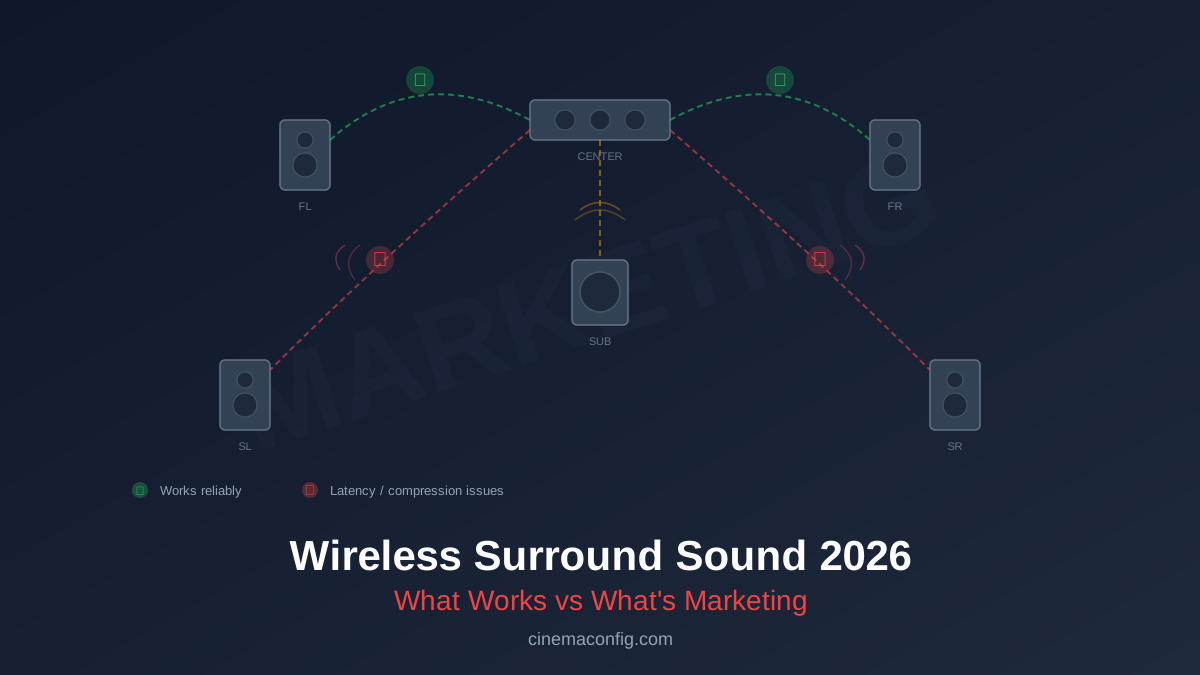
"Wireless surround sound" is the most misleading phrase in home theater. Almost nothing is actually wireless (every speaker still needs power). What they mean is "no speaker wire to the receiver." And even that promise comes with asterisks, latency, compression, or both. After testing five systems across three different wireless technologies, here is what actually works, what is marketing theater, and what to buy if running speaker wire genuinely is not an option.
Quick Picks
- Best wireless surround if wire is impossible: Platin Monaco 5.1.2 ($1,100) via WiSA. Lowest latency, least compression, real discrete channels.
- Best soundbar-based system: Samsung HW-Q990D ($1,400). Wireless rears included, real Atmos decoding, solid bass from the included sub.
- Best if money is no object: Sonos Arc + two Era 300 + Sub ($2,100). Beautiful hardware, room correction is excellent, but you are paying a premium for the Sonos ecosystem.
- Best overall (the honest answer): A wired Denon AVR-S760H + five budget speakers + subwoofer ($1,000). Sounds better than all of the above.
Rob's take
Wireless surround compromises still exist in 2026, they're just different. Latency is largely solved on current systems. Compression artifacts remain — most wireless surround protocols transmit compressed audio, not lossless. The practical impact on movie watching is small; the impact on critical music listening is more noticeable. If you're running a reference-caliber system with lossless sources, run wire. If you need wireless because installation is genuinely impractical, current Sonos and Samsung WAM systems are acceptably good.
The Three Flavors of "Wireless"
Every wireless surround system on the market falls into one of three categories, and understanding which one you are buying matters more than any other spec on the box.
1. Soundbar with Wireless Rear Speakers
This is what Samsung, JBL, and Sony sell. A soundbar handles the front channels, a wireless subwoofer handles bass, and one or two small satellite speakers connect wirelessly for surround duty. The satellites still need power cables. The audio signal from the soundbar to the rears travels over a proprietary wireless protocol.
The Samsung HW-Q990D ($1,400) is the best of this bunch. It decodes Dolby Atmos and DTS:X natively (not upmixed), the included rear speakers have upfiring drivers for height channels, and Samsung's wireless protocol is stable enough that I never experienced dropouts during testing. The sub hits hard for its size. If you told me I had to live with a soundbar system, this is the one.
The JBL Bar 1300X ($1,700) takes a different approach: detachable battery-powered rear speakers that magnetically dock to the soundbar for charging. Clever engineering, genuinely wireless when undocked, but the sound from those tiny satellite drivers is thin. You hear the surround effect, but it lacks the body and presence that even cheap wired bookshelf speakers deliver. For $1,700, that is a tough pill.
The fundamental problem with all soundbar-based wireless systems: the front soundstage is coming from a single bar under your TV. No matter how many virtual channels the DSP simulates, it cannot match the stereo separation of speakers placed 6-8 feet apart. You are paying a premium for convenience and getting a physics compromise in return.
2. WiSA Protocol (the Least-Bad Wireless Option)
WiSA (Wireless Speaker and Audio) is an industry standard designed specifically for home theater. Unlike Bluetooth or Wi-Fi streaming, WiSA transmits uncompressed 24-bit audio at up to 96kHz with latency under 5ms. That is fast enough that lip sync is not an issue, and there is no audio compression degrading the signal.
The Platin Monaco 5.1.2 ($1,100) is the most accessible WiSA system. You get five speakers, a subwoofer, and a WiSA SoundSend transmitter that connects to your TV's eARC port. Each speaker has a built-in amplifier (that is where the power cable comes in), and the transmitter handles channel assignment and volume. Setup took about 20 minutes.
Sound quality surprised me. The Monaco speakers are not going to compete with dedicated hi-fi bookshelf speakers, but they are dramatically better than any soundbar surround system I have tested. Discrete channels mean the surround separation is real, not simulated. The subwoofer is adequate for apartments and mid-sized rooms, though it runs out of steam in spaces larger than about 2,500 cubic feet.
Klipsch also makes WiSA-compatible speakers in their reference wireless line, but pricing pushes well past $2,000 for a 5.1 setup. At that price, the argument for wired becomes overwhelming.
WiSA's limitation is ecosystem size. The speaker selection is small compared to the thousands of passive speakers available for traditional AVRs. You are locked into the WiSA world once you commit.
3. Multi-Room Systems Repurposed as Surround (Sonos, Apple)
Sonos lets you group an Arc soundbar with two Era 300 speakers as surrounds and a Sonos Sub. Each device connects to your Wi-Fi network. The Sonos Arc + two Era 300 + Sub Mini setup runs about $2,100, or $2,500 with the full-size Sub.
Sonos Trueplay room correction is genuinely excellent. It measures your room acoustics using your phone's microphone and adjusts EQ per speaker. In a well-furnished living room, the Arc system sounds cohesive and spatially convincing. The Era 300 has Dolby Atmos support with upfiring drivers, and the spatial audio effect is noticeable.
But there are real compromises. Sonos uses a compressed audio stream over Wi-Fi, and while it sounds good, A/B testing against a wired system reveals the difference. Transients are slightly softer. Dynamic range on big action scenes feels a touch flattened. Most people in a casual listening environment will not notice, but this is a home theater site, and you are reading a 9-minute article about surround sound, so you might.
The bigger issue: latency. Sonos buffers audio to keep all speakers synchronized, which adds roughly 30-75ms of delay. The system compensates with lip-sync adjustment, but it is solving a problem that wired systems simply do not have. And Sonos only decodes Dolby Atmos from the eARC input. No DTS:X, no lossless Atmos from a Blu-ray player (it accepts Dolby Digital Plus Atmos from streaming apps).
The Comparison Nobody Wants to Hear
A Denon AVR-S760H ($350), five Neumi BS5 speakers ($100/pair, so $250 for five), a Dayton Audio SUB-1200 ($200), and $200 worth of speaker wire and banana plugs comes to roughly $1,000. That system decodes every surround format, has real discrete amplification for each channel, and sounds better than every wireless option listed above.
I do not say that to be dismissive. I say it because the marketing around wireless surround sound consistently implies you are getting equivalent performance without the wires, and that is not true. You are getting convenience at the cost of audio quality, format support, and upgrade flexibility. If you understand that trade-off and still want wireless, that is a valid choice. But you should make it with clear eyes.
If your room allows it, our home theater wiring guide covers how to run speaker wire cleanly, including renter-friendly options that do not require cutting into walls. Many people assume wiring is harder than it actually is.
So Who Should Actually Buy Wireless?
Wireless surround makes sense in exactly three scenarios.
Rental apartments where you cannot run wire at all. Not "it would be inconvenient" but genuinely cannot. If flat cable under baseboards or cable raceways are options, you are still better off wired. But if your landlord will not allow any wall modifications and your room layout makes floor-run cables a tripping hazard, WiSA or Sonos is reasonable.
Secondary rooms where convenience outranks quality. The bedroom TV, the kids' playroom, a covered patio. If this is not your primary listening room and you just want better-than-TV-speakers surround, a Samsung Q990D or Sonos system delivers that without the setup commitment of a full AVR system.
Partners who vetoed visible speakers and cables. We have all been there. If the choice is wireless surround or no surround at all, wireless wins. The Sonos ecosystem has the most living-room-friendly industrial design, and the Era 300 looks like a piece of decor rather than audio equipment.
For everyone else, the soundbar vs. real speakers comparison lays out why dedicated speakers and an AVR remain the better investment. And CinemaConfig's system builder can spec out a wired 5.1 system matched to your room size and budget in about two minutes, which is less time than you will spend troubleshooting wireless surround sync issues.
The Latency and Compression Reality
Every wireless audio technology involves a trade-off between latency (delay) and compression (quality loss). Here is where the major protocols actually land:
- WiSA: Under 5ms latency, uncompressed 24-bit/96kHz. The closest to wired performance. Still requires power cables to each speaker.
- Proprietary soundbar protocols (Samsung, JBL, Sony): 10-30ms latency, compressed audio. Quality varies by manufacturer. Samsung's is the most stable in my testing.
- Sonos/Wi-Fi streaming: 30-75ms latency, compressed audio with buffering. Excellent room correction compensates somewhat, but the underlying signal is lossy.
- Bluetooth: 40-200ms latency depending on codec, always compressed. Not suitable for surround sound. If a product uses Bluetooth for its rear channels, walk away.
For context, most people notice audio-video sync issues above about 40ms. Below that, your brain papers over the gap. WiSA and the better soundbar protocols stay under this threshold. Sonos usually manages it through software compensation but occasionally drifts, especially during high-bitrate content.
None of these protocols match a copper wire, which has effectively zero latency and zero compression. That is not audiophile snobbery. It is physics. The question is whether the convenience is worth the compromise for your specific situation.
Wireless surround sound in 2026 is better than it has ever been. WiSA is a legitimate technology that delivers real discrete surround without running speaker wire. But "better than ever" still is not as good as a budget wired system at half the price. The industry will get there eventually. It is not there yet, and the marketing pretends otherwise.
Rob Teller
Founder, CinemaConfig
15 years in consumer hardware and software, mostly on the product side. NZXT (cases and cooling), Asetek (liquid cooling, global sales), a short run advising on Alienware's roadmap at Dell, then four ... More about Rob · Affiliate disclosure


