Sony HT-A9 II vs Traditional 5.1 - When Sony's Wireless Magic Actually Works
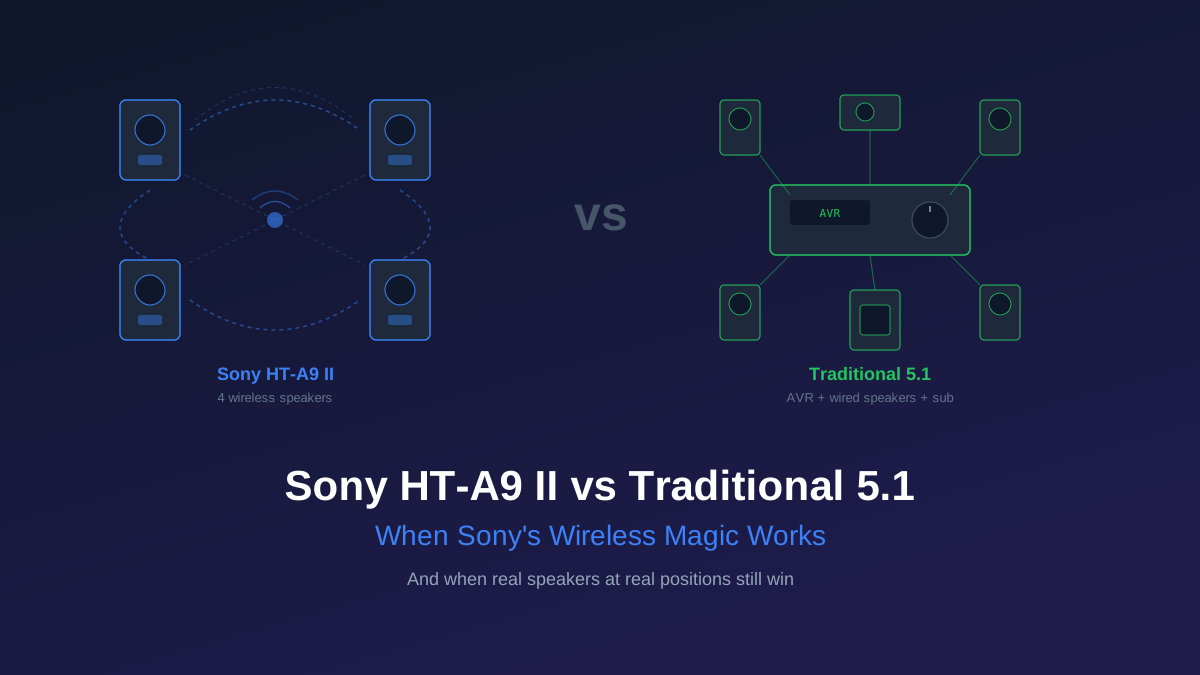
The Sony HT-A9 II does something no other wireless system attempts: it takes four identical speakers, lets you place them essentially anywhere in your room, then uses 360 Spatial Sound Mapping to calibrate each one and create phantom surround channels from non-ideal positions. No receiver. No speaker wire. No precise placement angles. Just four boxes, a control unit, and Sony's bet that DSP can outrun physics.
At $2,000 (before adding the optional subwoofer), it costs more than a proper wired 5.1 system. The question is whether Sony's room-mapping magic closes the gap enough to justify the premium.
Quick Verdict
- Buy the HT-A9 II if: Your room makes traditional speaker placement impossible (odd shapes, no back wall, open floor plans), you rent and can't run wire, or your partner has vetoed visible speakers and an AVR.
- Buy traditional 5.1 if: You can place speakers at or near correct angles, you want a real subwoofer included in the budget, or you plan to upgrade over time.
Rob's take
The Sony HT-A9 II is technically impressive and practically limited by the physics of its driver count. Four compact satellites processing a 360 Reality Audio signal is a different proposition from five dedicated speakers with matched drivers and proper placement. For a living room where installing a traditional surround system is genuinely impossible, it's the best wireless option. For anyone who can run cable, traditional 5.1 beats it at a lower price.
How the HT-A9 II Actually Works
The system ships with four identical speakers and a control box that handles all the processing. You place the speakers in your room (on stands, shelves, wherever fits), run the calibration, and the system measures the room acoustics using built-in microphones in each speaker. Sony's 360 Spatial Sound Mapping then calculates how to adjust timing, level, and frequency response for each speaker to simulate proper surround placement.
It supports Dolby Atmos and DTS:X decoding natively. The control box has HDMI eARC, optical input, and Bluetooth. It is essentially an AVR and four speakers in one package, minus the amplifier bulk.
The calibration process takes about three minutes and it is genuinely impressive. In a room where the speakers were placed asymmetrically (two on a bookshelf at ear level, two on stands behind the couch at different heights), the system created a convincing surround field. Sounds panned smoothly across channels. Height effects were perceptible, though not as precise as dedicated ceiling or upfiring Atmos speakers.
Where Sony's DSP Magic Works
Oddly shaped rooms are where the HT-A9 II earns its price. In an L-shaped living room where traditional surround placement would put speakers around a corner and out of the line of sight, the four-speaker system adapted well. The room mapping compensated for the asymmetry in ways that no fixed surround layout could.
Open floor plans are the other obvious win. If your living room flows into a kitchen and dining area with no back wall for surround speakers, the HT-A9 II's flexible placement fills the space in a way that a soundbar never could and wired surrounds would require creative mounting solutions.
For renters who cannot drill into walls or run speaker wire under baseboards, this system is the least compromised wireless option available. The Platin Monaco WiSA system ($1,100) comes close, but the Sony's room mapping gives it an edge in non-ideal rooms.
Where Traditional Still Wins
In a room where you can place five speakers at correct angles and distances, a traditional AVR-based system sounds better. This is not surprising. Actual speakers at actual positions producing actual discrete channels will always beat DSP simulation of those channels from non-ideal positions.
The gap is most noticeable in two areas. First, surround precision. With wired surrounds placed at the correct 110-120 degree angles, effects that pan from front to rear have a tangible "there" quality. The HT-A9 II creates a convincing surround field, but individual sound objects are less pinpoint. Second, bass. The HT-A9 II needs Sony's optional SA-SW5 subwoofer ($700) or SA-SW3 ($400) to produce real low-end. Without it, the four speakers roll off around 50Hz, which is fine for dialogue and music but misses the physical impact of movie explosions and music bass lines.
The Price Math
This is where the traditional route gets compelling.
Sony HT-A9 II full system: $2,000 (speakers + control box) plus $700 for the SA-SW5 subwoofer. Total: $2,700.
Equivalent wired system: Denon AVR-X1800H ($500) plus five Emotiva B1+ speakers ($575 for a pair of fronts and three singles) plus SVS PB-1000 Pro subwoofer ($550). Total: $1,625. You get a better subwoofer, proper discrete channels, and $1,075 left over.
That $1,075 difference could buy acoustic treatment panels, better speaker stands, or an upgrade to tower fronts. The traditional route gives you more audio per dollar and an upgrade path. The Sony system is a closed ecosystem: if you want better bass, you buy Sony's sub. If you want more channels, you cannot add them.
Sound Quality Head to Head
Playing the Dune: Part Two Blu-ray with Dolby Atmos, the traditional 5.1 setup was noticeably better in the sandworm scenes where bass extension and surround precision both matter. The SVS sub delivered chest-thumping low-frequency effects that the Sony sub (even the SW5) could not match.
For dialogue-heavy content (Netflix dramas, news, podcasts), the Sony system sounded excellent. The center channel phantom image was stable and clear. This is where Sony's processing really shines: voice reproduction is natural and well-separated from effects.
Music was a mixed bag. In stereo mode, the four speakers created a wide soundstage, but the imaging was not as precise as a proper two-channel setup. If critical music listening matters to you, neither system is ideal. You want dedicated stereo speakers for that.
Who Should Buy This
The Sony HT-A9 II is the best wireless surround system money can buy. It is also more expensive and less capable than a traditional wired system in a room that supports one. The magic is real, but it is not free. If your room or your living situation makes wired speakers impractical, this is the system to get. If you can run wire, the math says you should. For more on the full landscape of wireless options, see our wireless surround sound guide. For the traditional setup path, our Dolby Atmos setup guide walks through placement for every layout from 5.1.2 to 7.1.4.
Rob Teller
Founder, CinemaConfig
15 years in consumer hardware and software, mostly on the product side. NZXT (cases and cooling), Asetek (liquid cooling, global sales), a short run advising on Alienware's roadmap at Dell, then four ... More about Rob · Affiliate disclosure


