Infinity Vision vs IMAX vs Dolby Cinema - Which Wins 2026?
Quick Verdict
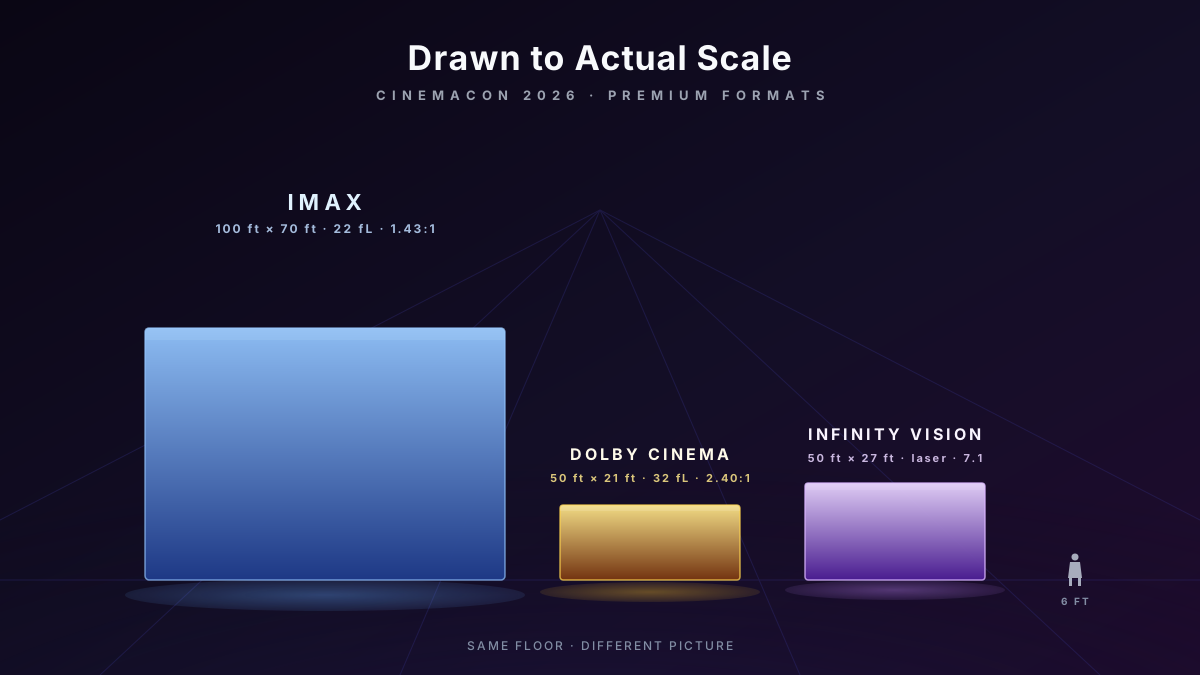
- Biggest screen: IMAX Laser -- up to 100 ft wide, 1.43:1 aspect at flagship venues. Nothing else competes on sheer scale.
- Best picture: Dolby Cinema -- 32 fL brightness, up to 1,000,000:1 contrast, dual 4K laser projection, Dolby Vision grade.
- Broadest access: Infinity Vision -- Disney projects ~5,500 qualifying screens globally vs IMAX's 1,800. 50-ft minimum screen, laser, Dolby 7.1 audio.
Disney announced Infinity Vision at CinemaCon 2026 on April 16, a new premium large format certification pitched directly at IMAX and Dolby Cinema. This was the first CinemaCon where the venue itself was renamed. Caesars Palace became the Dolby Colosseum for the week, per The Hollywood Reporter. The format war that has been quiet for a decade is suddenly a three-way race.
If you care about where you see Avengers: Doomsday in December, or you are trying to decide which premium format ticket is worth the $5-10 upcharge, the real differences are not in the marketing. They are in the spec sheets.
Rob's Take
Disney invented Infinity Vision because IMAX wouldn't give them the screens. IMAX reportedly backed Dune: Part Three over Avengers: Doomsday for its December 2026 slate, which left Disney's tentpole with nowhere premium to land. The spec floor Disney set (50 ft screen, laser, Dolby 7.1) is carefully chosen to be the most inclusive of the three formats, and it is a clever business move. But "inclusive" also means it is the least demanding technical standard. If you are choosing between a Dolby Cinema and an Infinity Vision screening of the same film, Dolby Cinema still wins on image quality. Infinity Vision's advantage is that it exists near you.
Infinity Vision: What Disney Specified
Infinity Vision is a certification program, not a proprietary technology stack. Disney does not build the projectors, design the speakers, or own the audio format. They wrote a requirements list, and any PLF (premium large format) auditorium that hits the spec gets the label.
The requirements, per Bloomberg's April 17 report, are a 50-foot minimum screen width, laser projection, and Dolby 7.1 surround sound. That is the floor. Disney projects around 5,500 screens globally will clear it. For context, IMAX has roughly 1,800 systems worldwide.
The launch slate is aggressive. Infinity Vision debuts in September 2026 with a theatrical re-release of Avengers: Endgame, followed by Avengers: Doomsday in December. Marvel's other 2027 releases will roll through the program. Disney is committing its biggest IP to the format, which means exhibitors have a real business reason to get certified.
Notice what is missing from the spec: no HDR requirement, no brightness floor in foot-lamberts, no specified aspect ratio, no object-based audio mandate. Dolby 7.1 is a channel-based format that predates Atmos by about two years. An Infinity Vision auditorium could theoretically be a decade-old 7.1 Dolby house with a new laser projector and a 50-ft screen. That is both the program's strength (broad qualifying pool) and its weakness (inconsistent experience).
IMAX Laser: Still the Scale King
IMAX has been the premium format default since 2015 when they started deploying laser systems in earnest. The technical ceiling is unmatched: per the IMAX spec history, flagship IMAX auditoriums run up to roughly 97 feet wide (AMC Lincoln Square) and 72 feet tall (Leonberg, Germany), which is more than four times the total screen area of the largest Dolby Cinema auditorium.
Brightness lands around 22 foot-Lamberts, higher than the 16 fL industry standard, though meaningfully below Dolby Cinema's 32 fL. Resolution at laser venues is 4K (the remaining dual-xenon IMAX houses run at 2.7K, which is not what you want). The standout is IMAX's aspect ratio flexibility: true IMAX-filmed content can project at 1.43:1 in flagship auditoriums, which fills the full screen vertically and creates the "immersive wall of image" experience that defines the format. Most modern Hollywood releases use 1.90:1 "IMAX Digital" aspect.
Audio is IMAX's proprietary 12-channel immersive system. Not Dolby Atmos, not Dolby 7.1, not object-based in the same way Atmos is. IMAX argues their channel layout is tuned specifically for their room geometry, which is a defensible technical claim. Some Atmos-obsessed enthusiasts prefer Dolby's object precision. Most audiences never notice the difference, because the two systems do similar things through different means.
The catch with IMAX is that the experience varies wildly. A 1.43:1 flagship screening at the Lincoln Square is a different film than the same title in a 1.90:1 "LieMAX" suburban multiplex with a 45-foot screen. Both carry the IMAX logo. Only one delivers what the format is famous for.
Dolby Cinema: The Picture Wins
Dolby Cinema is the smallest format of the three by screen size, typically capped around 50 feet wide, but the only one engineered from the ground up around HDR. The Dolby Vision projection system pushes 32 fL peak brightness and up to 1,000,000:1 contrast on Dolby Vision-graded content. That is roughly 45% brighter than IMAX Laser and an order of magnitude beyond standard cinema projection.
The audio side is where Dolby still leads outright. Every Dolby Cinema auditorium runs Dolby Atmos (object-based, not channel-based) with a ceiling-speaker array that places height sources independently. If a helicopter flies across the top of the frame, an Atmos mix sends that sound as an object with a 3D coordinate, and the renderer figures out which specific ceiling speaker to drive. IMAX's 12-channel system and Infinity Vision's required Dolby 7.1 both approximate this through fixed channel assignments.
The aspect ratio is Dolby's one real compromise. Films play at 2.40:1 widescreen, matching the theatrical master most directors grade to. No 1.43:1 vertical expansion, no IMAX-only scenes. If you are watching a Christopher Nolan film where half the running time was shot on IMAX cameras, Dolby Cinema presents the letterboxed theatrical version, not the expanded IMAX ratio.
Rob's Take
I keep coming back to this: if the film you want to see was graded for HDR and you care about picture quality above all else, Dolby Cinema is the answer. If the film was shot on IMAX cameras and you want the expanded ratio scenes, IMAX Laser is the answer. Infinity Vision is the answer if the nearest Dolby Cinema is two hours away and the nearest IMAX only has a LieMAX installation. It is not that Infinity Vision is worse. It is that its floor is lower, so the variance is higher.
Head-to-Head: Image Quality
Dolby Cinema
- Best for: HDR-graded blockbusters, picture-quality purists, Dolby Vision-mastered content
- Key advantage: 32 fL peak, 1M:1 contrast with Dolby Vision grade, dual 4K laser
- Key weakness: 2.40:1 only, screen capped around 50 ft, fewer venues than IMAX
IMAX Laser
- Best for: Films shot on IMAX cameras, scale and immersion, 1.43:1 expanded content
- Key advantage: Up to 100 ft screens, 1.43:1 aspect at flagship venues, the tallest screens in commercial cinema
- Key weakness: 22 fL brightness trails Dolby, huge variance between flagship and LieMAX installations
Infinity Vision
- Best for: Disney and Marvel releases, easy access (5,500+ screens projected), consistent baseline
- Key advantage: Biggest qualifying screen pool of any premium format, mandatory laser and 7.1 audio
- Key weakness: Spec floor sets no brightness minimum, no HDR mandate, no Atmos requirement
Head-to-Head: Audio
Dolby Cinema ships Dolby Atmos as standard. Every auditorium has a full object-based renderer, ceiling speakers, and a calibrated room. If you have heard Atmos in a home theater soundbar, understand that the cinema version runs on dozens of channels with individually addressable speakers and audio objects with sub-millisecond timing. It is the reference for what the format is supposed to sound like.
IMAX runs their proprietary 12-channel system tuned to their specific room geometry. Different approach, similar outcome for most content. The argument most commonly raised against IMAX audio is that the channel-based approach does not adapt to mixes designed around Atmos objects. Hollywood has been authoring for Atmos first for five years, with IMAX mixes as a secondary down-mix.
Infinity Vision's Dolby 7.1 floor is the oldest standard of the three. Seven discrete channels plus an LFE, no height layer required, no object rendering. If a given Infinity Vision auditorium happens to also be an Atmos house, the experience tiers up. If it is a bare-minimum 7.1 room, the height information from the original mix simply is not played back.
How to Know Which You Are Getting
Not every IMAX screen is a laser installation. Not every Dolby Cinema gets the full-size screen. Before buying premium-format tickets, verify the specific auditorium:
- For IMAX: look for "IMAX with Laser" or "IMAX Laser" in the listing. Dual-xenon IMAX houses are dimmer and lower-resolution. The 1.43:1 aspect is only available at a handful of flagship venues (Lincoln Square, AMC Metreon, TCL Chinese, Melbourne IMAX).
- For Dolby Cinema: the branding is consistent. Dolby Cinema auditoriums are all certified to the same spec, though screen size varies 40-50 feet. AMC runs the largest network in North America.
- For Infinity Vision: the program launches with branding in September 2026. Until then, the 5,500 qualifying screens are unlabeled. Once launched, Disney has committed to both online and in-theater signage so audiences can identify certified venues.
What This Means for Home Theater
Infinity Vision is a commercial-cinema certification. It has no direct home theater product. But the underlying tech floor (4K laser projection, Dolby 7.1 minimum, immersive audio) maps almost perfectly onto what an enthusiast home theater should target in 2026. Our Dolby Atmos setup guide walks through the home-tier equivalent of the cinema-tier spec.
Peak brightness is where home displays have quietly overtaken cinema. Dolby Cinema's 32 fL works out to roughly 106 nits. A 2026 OLED like the LG G6 peaks around 4,500 nits on small HDR windows, with the Sony Bravia 9 II's True RGB Mini LED also in the multi-thousand-nit territory (see our 2026 flagship matchup). The catch is that cinema brightness is measured at reflective screens at a specific viewing distance, not at peak HDR window. It is a scene-average spec, not a peak spec. Your TV crushes a cinema screen on peak output. A cinema crushes your TV on image scale.
For the home theater audience, the real lesson of CinemaCon 2026 is what does NOT translate. Infinity Vision's 50-ft screen minimum is impossible at home. Dolby Cinema's 4K laser with a full Atmos ceiling is buildable but expensive. The IMAX 1.43:1 aspect is content-specific and needs a projector setup most rooms cannot accommodate. What you can replicate in your living room is the audio stack and the HDR image, both of which have quietly gotten better than the corresponding cinema-tier tech.
The format war at CinemaCon 2026 looked like marketing. But it set three different floors for what "premium" means in theaters, and Disney's floor is conspicuously the most inclusive. If the program sticks and exhibitors certify screens at scale, Infinity Vision will be the most common premium-format label in the US by the end of 2027. Dolby Cinema will still win on picture. IMAX will still win on scale. Disney will win on distribution.
Rob Teller
Founder, CinemaConfig
15 years in consumer hardware and software, mostly on the product side. NZXT (cases and cooling), Asetek (liquid cooling, global sales), a short run advising on Alienware's roadmap at Dell, then four ... More about Rob · Affiliate disclosure


