CinemaCon 2026: 5 Theater Tech Trends Coming to Your Home, what we recommend
The Short Version
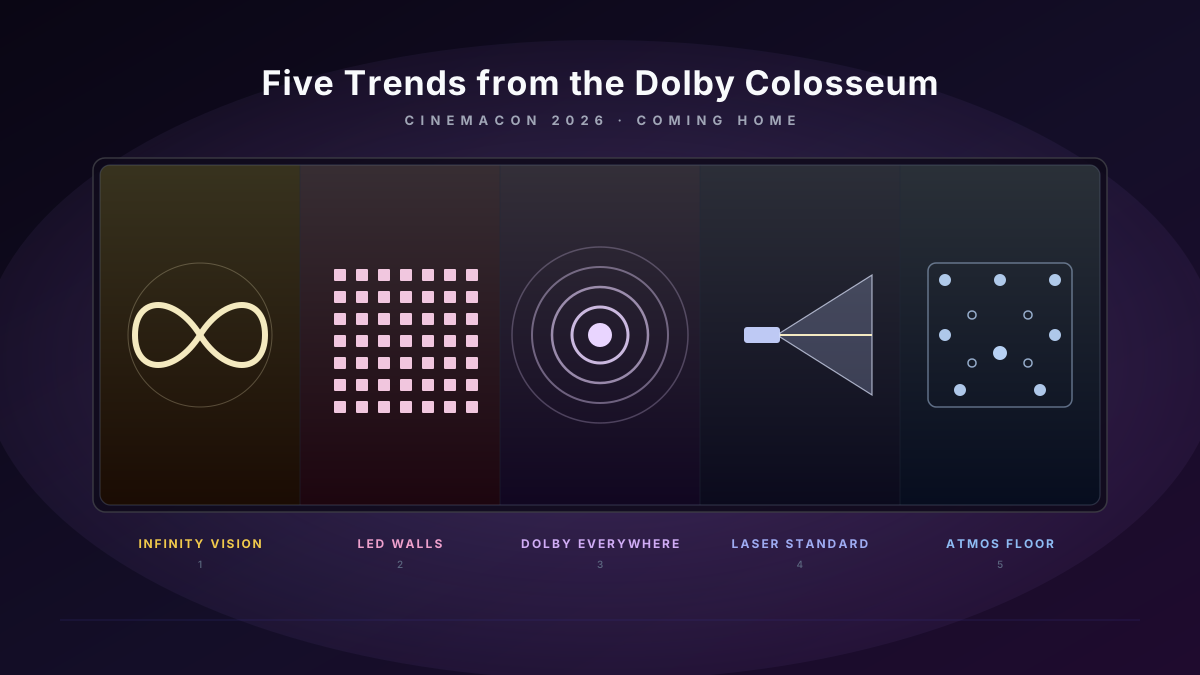
CinemaCon 2026 (April 14-17, Las Vegas) made it clear where commercial theater tech is heading: premium-format proliferation, acoustically transparent LED walls, and Dolby pushing branding and footprint simultaneously. Three of the five trends below map directly onto home theater upgrades you can make this year. Two are forecasts for 2027-2028.
Every spring, commercial cinema shows off the tech that will slowly trickle into home theater over the next five years. CinemaCon 2026 wrapped on April 17 with Disney launching Infinity Vision, Dolby renaming Caesars Palace "the Dolby Colosseum" for the week, and Digital Light Sources showing their Cine LEDMAX acoustically transparent LED screens. Not every trend here turns into a living-room product. But some already have.
Rob's Take
The weird thing about this CinemaCon is that home theater has, for the first time in my memory, surpassed commercial cinema on a couple of specs that used to define the theatrical gap. A 2026 OLED like the LG G6 outputs more peak nits than a Dolby Cinema projector. Your living room Atmos setup, if calibrated well, can render object positions more precisely than a generic multiplex 7.1 house. That does not make the theater obsolete. Scale still matters, and a 50-ft screen creates a completely different experience from a 77-inch panel. But the days when "theater quality at home" was aspirational are over for the picture side of things. It is now achievable.
1. Premium Format Certification Is Now a Three-Way Race
Disney's Infinity Vision certification sets a spec floor of 50-ft screen, laser projection, and Dolby 7.1 audio. Per Bloomberg's reporting, Disney projects ~5,500 global screens will qualify, which dwarfs IMAX's ~1,800. The underlying hardware stack (4K laser, 7.1 immersive audio) is the exact spec enthusiasts have been building toward at home for a decade.
What this means at home: The 7.1.4 Atmos setup is no longer overkill. It is the minimum that meets the premium-theater floor Disney just ratified. If you have been running a 5.1 setup and debating whether to add rear surrounds and height channels, Infinity Vision's requirements settle the question. 7.1 with a height layer is the new baseline for premium immersive audio, both commercially and at home. Our 5.1.2 to 7.1.4 upgrade guide walks through the add-ins.
2. Acoustically Transparent LED Walls Are Coming
Digital Light Sources demoed the Cine LEDMAX system at CinemaCon 2026: LED video walls engineered so sound passes through the panel without degradation, letting the center-channel speaker sit directly behind the screen the way it always has in cinema. That sounds trivial. It is the single hardest problem in LED cinema to solve.
Traditional LED walls are opaque. Putting them in a cinema meant moving the center speaker to the side, which breaks dialogue imaging, or running speakers below the screen, which compromises sound staging. Acoustically transparent LED fixes this. It also matters for home theater because the same technology will eventually scale down into consumer-grade "whole wall" displays, the holy grail for enthusiasts who want a cinema-scale image without projection.
What this means at home: Not much in 2026, a lot by 2028. Consumer-grade micro-LED walls from Samsung and LG currently run six figures for room-sized installations and do not yet ship in acoustically transparent variants. The tech is tracking toward the home market. Samsung's Micro RGB lineup at CES 2026 and related RGB Mini LED developments are the consumer-side parallel. Read our RGB Mini LED explainer for the current state of the art in home TVs, which borrows more from cinema LED R&D than most buyers realize.
3. Dolby Doubles Down on Branding and Footprint
For the first time in CinemaCon's history, Dolby bought naming rights to the main venue. Caesars Palace became "the Dolby Colosseum" for the week, per The Hollywood Reporter. Outside the branding deal, Dolby announced it is expanding access to its combined Dolby Vision + Dolby Atmos offering beyond full Dolby Cinema certification. Theaters that cannot meet the full Dolby Cinema spec can still license the dual format bundle.
Translation: Dolby wants to show up on more screens, even if those screens are not full Dolby Cinemas. They are also pushing harder on partnerships with broader premium-format programs (Infinity Vision's required audio codec is Dolby 7.1; the expanded Dolby Vision + Atmos bundle can be added on top).
What this means at home: More content will be mastered for both Dolby Vision and Dolby Atmos, and streaming platforms already favor the Dolby stack. If you are building a home theater in 2026, support for Dolby Vision on the display side and Dolby Atmos on the audio side is functionally mandatory. HDR10+ and DTS:X remain secondary. Samsung's continued refusal to support Dolby Vision on its TVs is a bigger problem in 2026 than it was in 2023, because the Dolby ecosystem keeps growing (see our Dolby Vision 2 explainer).
4. Laser Projection Becomes the New Minimum
Every premium format announced or reinforced at CinemaCon 2026 requires laser projection. Not xenon, not dual lamp, laser. Infinity Vision requires it. Dolby Cinema runs dual 4K laser standard. IMAX with Laser is the upgrade path away from dual-xenon. The industry is unifying around laser as the minimum viable projection technology for premium cinema, which reflects both image-quality improvements (higher contrast, wider color gamut, longer light-source life) and operational advantages (no lamp replacement, more consistent output over time).
What this means at home: Consumer laser projectors (JVC's RS-series, Sony's VPL-XW7000ES, Epson's LS-series) have been slowly displacing lamp-based projectors in the enthusiast market for five years. CinemaCon 2026 is the point where you can say with a straight face that "laser projection" is no longer a premium upsell at any tier of home projector worth owning. If you are buying a projector for a dedicated theater room in 2026, laser is the default. Lamp-based projectors remain cheaper up front but lose on cost-per-hour over the projector's lifespan.
5. Premium Audio Formats Keep Fragmenting
CinemaCon 2026 highlighted several competing immersive audio stories. Dolby Atmos remains the dominant format, but IMAX's 12-channel proprietary system holds its niche, and Samsung and Google's Eclipsa Audio continues its push as an Atmos competitor for consumer displays. Infinity Vision's required Dolby 7.1 is a fourth channel spec. The format story is not getting simpler.
What this means at home: Pick Dolby Atmos and stop worrying. Every streaming platform supports it, every AVR decodes it, most recent soundbars render a convincing version of it, and it is the lingua franca of both cinema and home. IMAX's channel system does not exist as a home format. IMAX Enhanced on streaming is effectively a DTS:X variant, which is a different thing entirely (see our Atmos vs DTS:X vs IMAX Enhanced comparison). Eclipsa is too new to bet on yet. Build the Atmos stack first; upgrade to whatever wins the second-format war later.
What Is NOT Coming Home
One important thing about CinemaCon: not every trend scales down. The 50-foot Infinity Vision screen floor is not a home theater spec. It is roughly 6x the diagonal of a 100-inch TV, and over 30x the screen area. IMAX's 1.43:1 expanded aspect ratio does not exist in consumer content. The specific commercial LED installations unveiled this year cost six to seven figures. These things will not reach your living room in 2026, 2027, or probably 2028.
What does reach home, and is affordable this year, is the audio stack (Atmos + Dolby Vision on the display side), laser projection for dedicated rooms, and the steady trickle of consumer RGB Mini LED and Tandem OLED panels that keep closing the picture-quality gap with cinema projection. The CinemaConfig builder will map your room and budget to the specific components that hit the home-tier equivalent of the new premium-format spec. You will not match a flagship IMAX Laser auditorium. You will match or exceed a bog-standard Dolby Cinema on peak picture quality, which is something you could not have said five years ago.
The format war CinemaCon kicked off this year was pitched at exhibitors. Its quiet conclusion is that the home theater you built last year already clears the spec for most of it.
Rob Teller
Founder, CinemaConfig
15 years in consumer hardware and software, mostly on the product side. NZXT (cases and cooling), Asetek (liquid cooling, global sales), a short run advising on Alienware's roadmap at Dell, then four ... More about Rob · Affiliate disclosure


