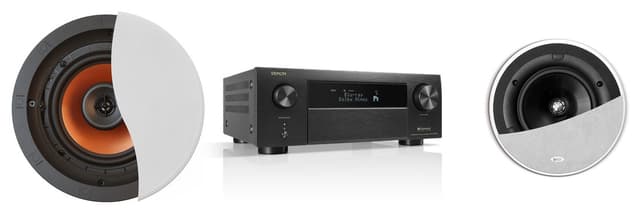
Get Real Dolby Atmos Height Speakers in a Rental Without Drilling, step by step
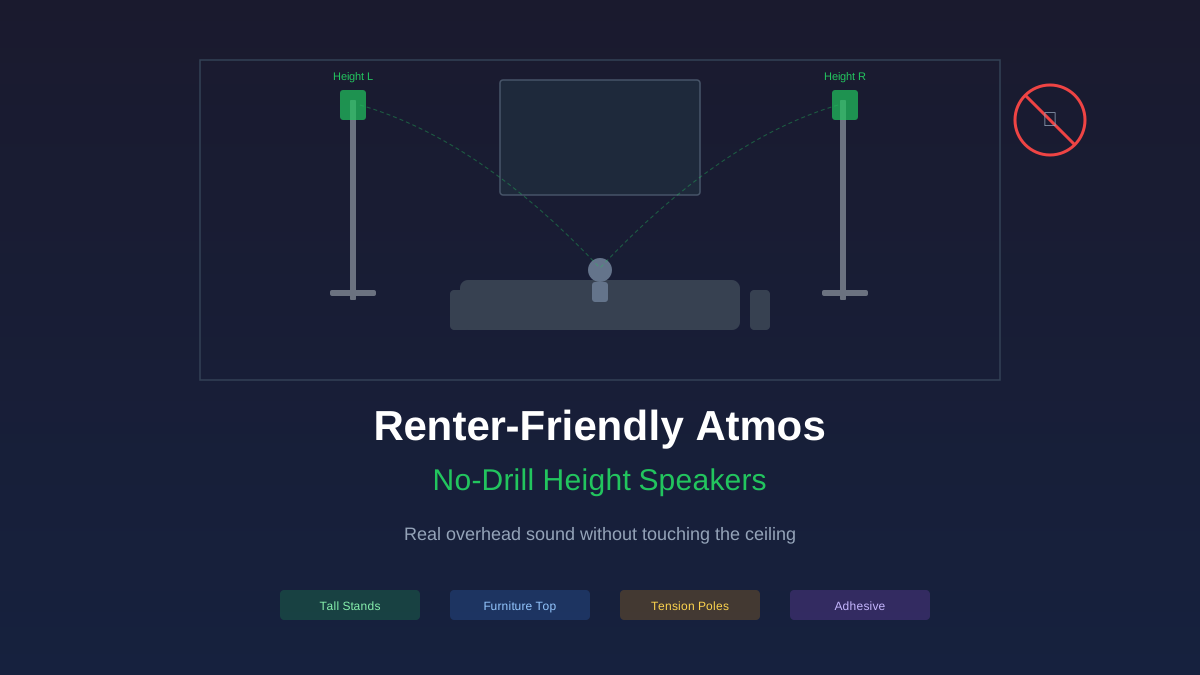
You can get legitimate Atmos height channels in a rental without touching the ceiling. It takes some creativity with stands and placement, but the result is real overhead sound, not the fake bounce effect from upfiring modules.
Why Upfiring Modules Are a Compromise
Upfiring Atmos modules sit on top of your front speakers and bounce sound off the ceiling to simulate height. If you have a flat, smooth, hard ceiling at a standard 8-foot height, they can produce a passable height effect. That is a narrow set of conditions. Textured or popcorn ceilings scatter the reflected sound. Vaulted ceilings send reflections at wrong angles. Ceiling fans break up the sound path entirely.
Real height channels pointed down from above are always better. Every Dolby Atmos mixing studio uses discrete overhead speakers, not bounce modules.
Rob's take
On-wall height speakers at ceiling height, angled 30-45 degrees downward, are genuinely underrated for renters. Mounting a speaker on a wall with two small screws is something virtually any landlord will accept; cutting ceiling holes is not. The on-wall approach adds real height localization without touching the ceiling and sounds meaningfully better than upfiring modules in the 90% of rooms where upfiring fails.
Tall Speaker Stands: The Most Popular Approach
Floor-standing speaker stands at 6 to 7 feet height are the go-to solution. The Monoprice Adjustable Height Speaker Stands ($30 to $50 each) extend to about 6.5 feet and hold speakers up to 11 pounds. The Atlantic Adjustable Height Speaker Stands ($25 to $40 each) are a similar design. The VideoSecu Adjustable Height Satellite Speaker Stands ($40 for a pair) extend to around 47 inches.
Position the stands slightly in front of and to the sides of your main listening position. Angle the speakers down about 30 to 45 degrees toward where your head will be. Our speaker layout planner can help you visualize the angles for your specific room.
Bookshelf Speakers on Tall Furniture
The Polk OWM3 ($100/pair) is the favorite for this approach. It weighs 1.8 pounds, has a flat back for stable surface placement, and includes keyhole mounts. The Micca RB42 ($80/pair) is heavier at about 5 pounds each, but the sound quality is a step up.
The trick is angling. Wedge-shaped speaker isolation pads (like the Auralex MoPAD, $30/pair) with the thick end toward the wall tilt the speaker forward and down.
Tension Pole Mounts and Adhesive Options
Floor-to-ceiling tension poles ($30 to $60) support speakers up to about 5 pounds with no screws or adhesive. They work best in corners. For very light speakers under 3 pounds, heavy-duty Command strips are an option, but adhesive degrades over time. We recommend this only as a last resort.
The 5.1.2 Sweet Spot for Renters
Do not try to build a 7.1.4 system in a rental. 5.1.2 with proper placement beats 7.1.4 with compromised placement every single time. Two well-placed height speakers give you the overhead panning and rain/helicopter effects that make Atmos worth having. Check our Atmos setup guide for the full layout details.
AVR Requirements for 5.1.2
You need at least a 7-channel AVR. The Denon AVR-S760H ($350) and Yamaha RX-V6A ($400) are the entry points we recommend. Both decode Dolby Atmos and DTS:X natively. If you already own a 5.1-channel AVR, there is no way to add height channels.
Calibration Matters More with Compromised Placement
After setup, run your AVR's room correction (Audyssey on Denon, YPAO on Yamaha). The system measures arrival time, frequency response, and level from each speaker, then corrects for placement errors. For the 10 to 20 degree deviations that rental-friendly mounting creates, room correction closes most of the gap.
The CinemaConfig builder can verify that your AVR, speakers, and channel configuration are all compatible before you buy anything.
Real Atmos in a rental is a solved problem. Start with two good height speakers and a 7-channel AVR, get the placement close, and let the room correction handle the rest.
Rob Teller
Founder, CinemaConfig
15 years in consumer hardware and software, mostly on the product side. NZXT (cases and cooling), Asetek (liquid cooling, global sales), a short run advising on Alienware's roadmap at Dell, then four ... More about Rob · Affiliate disclosure