How to Get Two-Channel Quality in a 7.1.4 System (Audiophile Home Theater)
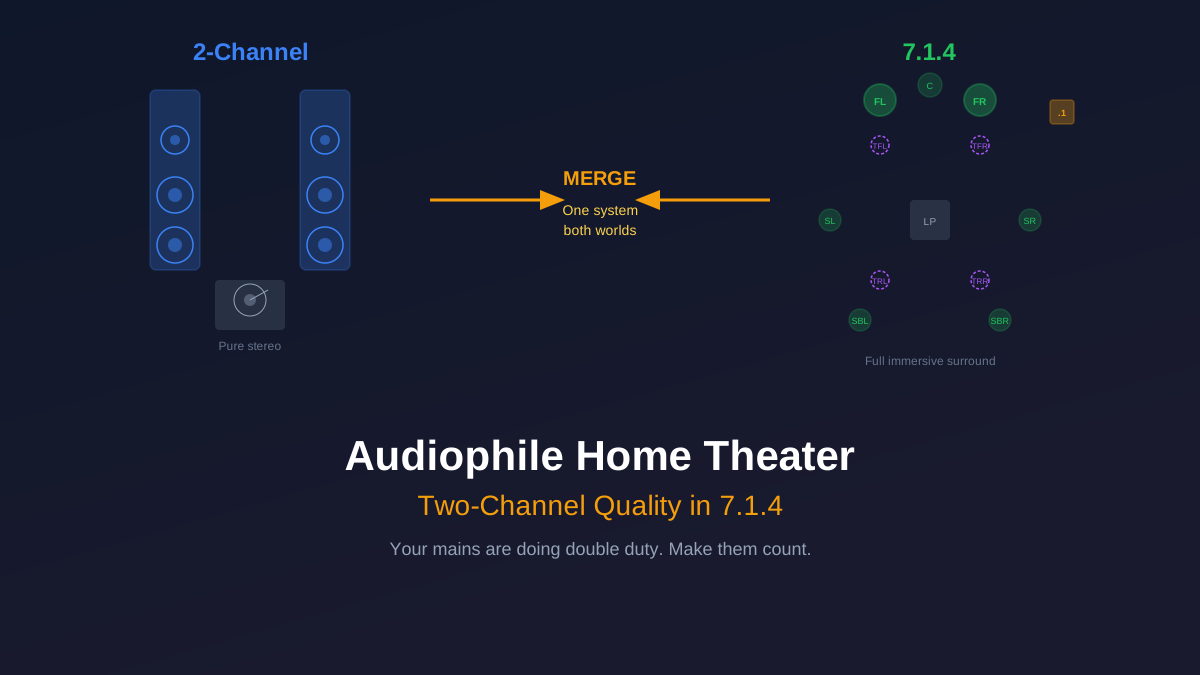
The r/audiophile vs r/hometheater war is based on a false premise. You don't have to choose.
Spend five minutes in either subreddit and you will find someone insisting that AVRs ruin music, that surround sound is a gimmick for people who don't care about imaging, or that "real" listening requires a dedicated two-channel chain with a tube preamp and zero DSP. On the other side, you will find home theater builders who treat their front left and right speakers as afterthoughts, spending more on rear surrounds than on the mains that carry 80% of the content in every movie mix.
Both camps are wrong, and the argument is costing people money.
The AVR Preamp Myth
The core audiophile objection to AVRs goes like this: a $1,500 receiver cannot match a $1,500 dedicated stereo amplifier because the receiver is doing too many things at once. DAC, DSP, room correction, HDMI switching, amplification for 7+ channels. Something has to give.
Ten years ago, that argument had teeth. Today, it doesn't hold up for 99% of listeners in 99% of rooms.
The Marantz Cinema 50 ($1,500) uses the same HDAM (Hyper Dynamic Amplifier Module) topology Marantz puts in their dedicated stereo units. Its preamp outputs measure flat to within 0.5dB across the audible range, with a signal-to-noise ratio above 100dB. The Denon AVR-X3800H ($1,300) shares the same Audyssey MultEQ XT32 room correction platform and posts nearly identical bench numbers. In a blind ABX test at matched volume, vanishingly few people can distinguish either of these from a $2,000 Parasound Hint 6 driving the same speakers.
The speakers are the bottleneck. The room is the bottleneck. The amp almost never is.
Rob's take
The AVR-kills-the-music-signal argument is wrong in 2026 in a way it wasn't wrong in 2016. The preamp sections in current Marantz and Denon AVRs measure cleanly at levels that exceed what speaker and room performance can resolve. If you want a two-channel experience through your AVR mains, set everything to 'direct' mode, disable DSP, and let the front channels run full-range. It sounds good because the electronics are good.
Choosing Mains That Do Both Jobs
This is where the money actually matters. Your front left and right speakers carry the full stereo image for music and handle 60-70% of the workload in a movie mix. Skimp here and no amount of Atmos height channels will save you.
What makes a speaker work for both music and movies? Wide, even dispersion (so the surround sweet spot and the stereo imaging zone overlap), low distortion at volume (movies are dynamic), and extension down to at least 45Hz so the crossover to your subwoofer stays clean.
Three picks at different price points:
- KEF R3 Meta ($2,200/pair) - The Uni-Q driver is a genuine technical advantage for dual-use systems. Because the tweeter sits at the acoustic center of the midrange cone, vertical and horizontal dispersion are nearly identical. That means your stereo image stays locked whether you are sitting bolt upright or slouched on the couch, and off-axis response for surround listeners is excellent. Neutral, detailed, slightly lean in the bass (cross at 80Hz to your sub).
- Bowers & Wilkins 603 S3 ($1,800/pair) - More forward in the upper mids than the KEFs, which some listeners prefer for vocal-heavy music. The Continuum cone midrange is smooth, and the 6.5" bass driver gets you genuine output into the low 40s before you need the sub. Slightly wider than the R3 Meta, which matters if your rack space is tight.
- Revel F36 ($2,000/pair) - The audiophile's home theater speaker, if such a thing exists. Revel designs to an anechoic target curve backed by decades of Harman research. Extraordinarily flat on-axis and smooth off-axis. Less "exciting" than the B&W, more precise than the KEF. If you trust the measurements more than your mood, these are the pick.
All three of these will reveal flaws in bad recordings and reward you with great ones. That is the baseline for any speaker earning the "audiophile" label in a surround system.
Pure Direct Mode: Your Two-Channel Switch
Every modern mid-to-high-end AVR includes a Pure Direct or Direct mode. On the Marantz Cinema 50, pressing the Pure Direct button does the following: disables all DSP and room correction, bypasses the tone controls and EQ, shuts off the video processing circuits (and usually the front display), and sends the analog or decoded digital signal straight to the amplifier stage with minimal processing.
The result is a signal path that is functionally identical to a dedicated stereo integrated amp. Your 7.1.4 system becomes a two-channel system at the press of a button.
One caveat. Pure Direct also disables room correction, which means your carefully tuned Audyssey or Dirac Live curve goes away. If your room has significant acoustic problems (and most do), you might actually prefer the "Stereo" listening mode with room correction active over Pure Direct without it. Try both. The "correct" answer is whichever sounds better in your room, not whichever is more ideologically pure.
The External Amp Option
If you want to go further, the cleanest upgrade path is using your AVR as a preamp/processor and adding a dedicated stereo amplifier for the front two channels. The Marantz Cinema 50 and Denon X3800H both have pre-outs for every channel.
A Parasound A23+ ($1,500) or Emotiva XPA-2 Gen4 ($700) on your front left and right gives you a dedicated power supply for the speakers that matter most, and frees up the AVR's internal amplifier to handle the remaining surround channels with less strain. This is the approach most high-end home theater installers use, and it is the one that actually makes an audible difference (unlike swapping $200 power cables).
The honest take: below $5,000 in total system cost, an external amp is not where your money should go. Put it into better speakers or room treatment first. Above $5,000, the external amp becomes the next logical step.
The Real Compromises Nobody Talks About
Room Treatment: Music Demands More
A surround system can partially mask room problems because content is coming from multiple directions and your brain is tracking movement, not analyzing a stereo image. Music playback is less forgiving. First reflections from side walls smear the stereo image. Bass modes in an untreated room create 10-15dB nulls and peaks that no amount of EQ can fully fix.
If you are serious about two-channel performance in your theater room, budget for at least first-reflection absorption panels and two bass traps in the front corners. This matters more than any amplifier upgrade. Our acoustic treatment guide covers placement in detail.
Subwoofer Integration: Two Different Goals
For movies, you want maximum output and extension below 20Hz. You want to feel the T-Rex footstep. For music, you want seamless integration with your mains so the bass guitar sounds like it is coming from the speakers, not from a box in the corner.
The fix is dual subwoofers placed to smooth room modes (one front, one rear is a common starting point), crossed over at 80Hz using your AVR's bass management, and calibrated with room correction active. Two SVS PB-2000 Pro subs ($1,700 total) in a treated room will outperform a single $3,000 sub for both music and movies because room mode cancellation matters more than driver quality past a certain point.
Speaker Toe-In: The Geometry Problem
For stereo imaging, you want your mains toed in so the tweeters cross just behind your head, forming a tight equilateral triangle. For surround, a wider dispersion pattern serves more seats. The KEF Uni-Q drivers handle this best because their dispersion is wide enough that moderate toe-in gives you both a focused stereo image and good off-axis surround coverage. With more directional speakers, you may need to compromise. I keep mine toed in for stereo and accept slightly less uniform surround coverage at the extreme sides. Music wins that fight in my room.
Build Tiers: What to Spend Where
$3,000: Stereo-first with surround potential. Denon AVR-S770H ($400) + KEF Q350 bookshelves ($600/pair) + SVS PB-1000 Pro sub ($600) + basic 5.1 surround package with matching KEF Q150 center and surrounds ($800). This sounds genuinely good for music in stereo mode, and the surround channels give you real Atmos/DTS:X decoding. The Q350s punch well above their price for two-channel listening.
$6,000: The sweet spot. Marantz Cinema 50 ($1,500) + KEF R3 Meta towers ($2,200/pair) + dual SVS PB-1000 Pro subs ($1,200) + KEF R2c center ($600) + budget surrounds ($500). This is the tier where the "audiophile" label starts being honest. The R3 Metas in Pure Direct mode, fed by a quality turntable or streamer, will satisfy anyone who is not specifically chasing the last 2% with $10,000 separates. CinemaConfig's builder can spec the full surround package around your chosen mains.
$10,000+: The separates path. Use the AVR as a processor only. Marantz Cinema 50 as preamp/processor + Parasound A23+ ($1,500) on the front L/R + Revel F36 towers ($2,000/pair) or KEF R5 Meta ($2,800/pair) + dual SVS PB-2000 Pro subs ($1,700) + matching center and surrounds ($2,000). Add room treatment ($500-1,000). This is a system that competes with dedicated $5,000 stereo setups while also delivering reference-grade 7.1.4 surround. The external amp on the fronts gives you headroom and current delivery that the AVR alone cannot match at sustained high volumes.
Stop Picking Sides
The tribalism between audiophile and home theater communities persists because it flatters both sides. Audiophiles get to feel superior about their "pure" signal path. Home theater builders get to dismiss two-channel as a boomer hobby. Neither group has to confront the possibility that the other side has a point.
Your front left and right speakers do not care whether the signal is stereo vinyl or a Dolby Atmos bed. They reproduce what they are fed. If those speakers are good enough for critical music listening, they are more than good enough for movies. And if your AVR has clean pre-outs and a competent DAC section (and anything above $1,000 does in 2026), the electronics are not the weak link.
Build one great system. Use it for everything.
Rob Teller
Founder, CinemaConfig
15 years in consumer hardware and software, mostly on the product side. NZXT (cases and cooling), Asetek (liquid cooling, global sales), a short run advising on Alienware's roadmap at Dell, then four ... More about Rob · Affiliate disclosure

![Klipsch Reference vs Premiere: Differences and Picks [2026]](/images/blog/klipsch-speakers-guide.svg?dpl=dpl_A7yvEusbtVmAimLWJZTA31x7Ag82)
