What Actually Works (Subwoofer Crawl Tested in 5 Rooms)
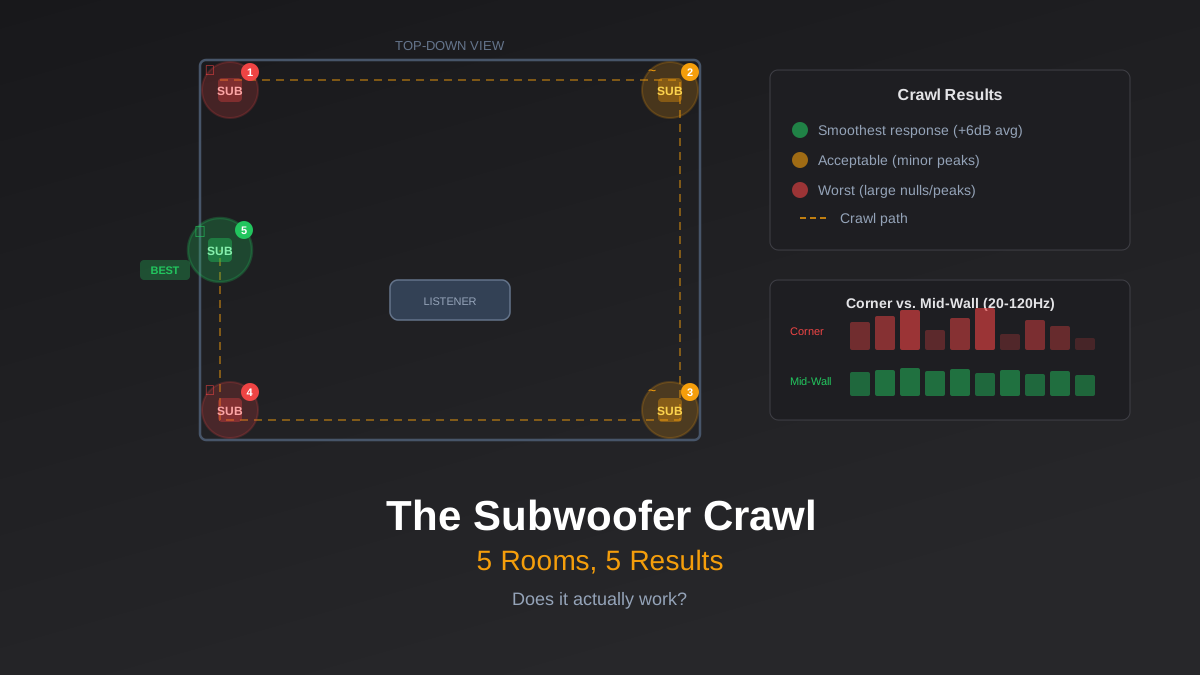
Everyone recommends the subwoofer crawl. Almost nobody actually does it. I did it in 5 rooms with REW measurements at each position. The results were eye-opening.
The short version: corner placement (the thing most people default to because the sub fits there) was the best position in only 1 out of 5 rooms. Mid-wall placements won three times. And one room's optimal spot was so counterintuitive that I measured it twice because I thought I had made an error.
What the Subwoofer Crawl Actually Is
The technique is simple and sounds ridiculous. You put your subwoofer at your listening position (yes, on the couch or right next to your head at ear level). You play a bass sweep or pink noise through it. Then you literally crawl around the room on your hands and knees, listening at each potential subwoofer location for the smoothest, most even bass response. When you find the spot where bass sounds the most balanced, that is where your sub goes.
The physics behind it are sound. Bass frequencies interact with room boundaries to create standing waves: spots where certain frequencies cancel out (nulls) and spots where they reinforce (peaks). Because of acoustic reciprocity, swapping the positions of the source and the listener produces an identical frequency response. So listening at potential sub positions while the sub sits at your seat is acoustically equivalent to the sub being in those positions while you sit in your seat.
I used an SVS PB-2000 Pro ($900) for all five rooms, measured with a calibrated UMIK-1 microphone and REW (Room EQ Wizard). Every position got a full 20-200Hz sweep, three measurements averaged. No EQ applied. Raw room response only.
Rob's take
I was skeptical of the subwoofer crawl until I did it in a room where I'd been accepting bass response I thought was unavoidable. Moving the sub 18 inches from where I'd originally placed it reduced a 45Hz peak by 8dB at the listening position. That's the kind of improvement a $500 DSP processor would struggle to match. The crawl costs nothing and works.
Room 1: Small Bedroom (10 x 12 ft, 8 ft ceiling)
This was the room where I expected the crawl to matter least. Small rooms have fewer modal issues, right? Wrong.
The front-left corner (the default "shove it where it fits" position) showed a massive 14dB peak at 56Hz and a 10dB null at 80Hz. That is not a minor bump. That is a one-note boom where every kick drum and bass line hits the same resonant frequency, with a hole right in the crossover region where the sub hands off to the mains.
The crawl winner: mid-point of the front wall, pulled about 6 inches away from the wall. The 56Hz peak dropped to +4dB, the 80Hz null filled in to only -3dB, and the overall 30-100Hz response was within +/-5dB. That is a 6dB variance window compared to 24dB in the corner. Night and day.
The catch? Mid-front-wall placement means the sub sits right below the TV. Not every living arrangement can accommodate that. But the acoustic difference was not subtle.
Room 2: Medium Living Room (14 x 20 ft, 9 ft ceiling)
This room had the most conventional layout: couch against the back wall, TV on the front wall, sub in the front-right corner. Classic.
Corner response showed the typical pattern: huge output below 40Hz (room gain stacking with corner loading gives you "free" SPL that you did not ask for), a nasty 12dB null at 62Hz from the room's primary axial mode, and a broad +8dB hump from 80-100Hz. Music sounded boomy. Movie explosions had impact but dialogue scenes with background score felt thick and muddy.
The crawl found the winner at the mid-point of the long wall (the 20ft dimension), about 8 inches from the wall. The 62Hz null improved from -12dB to -4dB. The room gain below 40Hz was reduced (less free SPL, but who needs +18dB at 25Hz in a living room?), and the 80-100Hz region flattened to within +/-3dB.
I was starting to see a pattern. Corners excite every room mode simultaneously. Mid-wall positions excite fewer modes, and the ones they do excite tend to be less severe.
Room 3: Open-Concept Main Floor (20 x 30 ft, 10 ft ceiling)
This was the wild card. Open-concept spaces with connected kitchens and dining areas do not behave like enclosed rectangles. The "room" does not really have four walls because one side opens into the kitchen, and there is a partial wall separating the dining area.
And here is where the crawl produced its most surprising result. The best position was behind the couch.
Not next to it. Not near it. Directly behind the listening position, tucked against the back of the sofa on the floor. I measured it three times because the numbers seemed wrong. But the response at the listening position was remarkably flat: +/-4dB from 25 to 100Hz with no single-frequency peak exceeding +5dB. For a room this large with irregular boundaries, that is exceptional.
The physics make sense in hindsight. In an open-concept space, the lack of nearby parallel walls means fewer strong standing waves. Placing the sub close to the listener minimizes the path-length differences that create comb filtering. The couch itself acts as a mild diffuser. It is not a setup that looks elegant, but it sounded better than anything else I tried in that room by a wide margin.
For anyone dealing with open-concept bass problems, the room acoustics guide covers why irregular rooms behave so differently from rectangular ones.
Room 4: Dedicated Home Theater (12 x 18 ft, 8 ft ceiling)
This was the one room where the corner actually won. Kind of.
The room had proper acoustic treatment: two bass traps in the front corners, absorption panels at first reflection points, and a thick carpet. That treatment changed the game. With the bass traps taming the worst corner-loaded modes, the front-right corner position measured +/-5dB from 25 to 100Hz. That is very good for a raw (non-EQ'd) measurement.
The crawl found a marginally better position at the 1/4 point of the front wall (about 3 feet from the corner). The improvement was only about 1.5dB smoother overall. In a blind test, I genuinely could not tell the difference. So for practical purposes, the corner placement was fine here, but only because the bass traps were doing the heavy lifting that the crawl does in untreated rooms.
This is a key finding. If you have invested in proper room treatment, the subwoofer crawl still helps, but the gains are smaller because the treatment has already addressed the worst modal problems. If your room is untreated (which is most rooms), the crawl matters a lot more.
Room 5: Basement (16 x 24 ft, 7 ft ceiling)
Basements are notorious for bass problems. Low ceilings create a strong vertical mode, concrete walls and floors are perfectly reflective at low frequencies, and the rooms tend to be rectangular with parallel surfaces everywhere. This basement was all of the above.
Corner placement was genuinely bad. A 16dB peak at 47Hz (the room's primary lengthwise mode) made action movies unbearable. Every explosion, every LFE hit, every low synth note triggered the same resonance. It was not "extra bass." It was one frequency dominating everything else.
The crawl found two good positions. The first was mid-point of the short wall (16ft dimension), which reduced the 47Hz peak to +6dB and smoothed the overall response significantly. The second, and the one I ultimately chose, was the mid-point of the long wall. It measured slightly worse on paper (+/-6dB vs +/-5dB) but subjectively sounded better because the remaining peaks were at less audibly offensive frequencies.
This is where REW measurements and your ears can disagree. A measurement tells you the magnitude of peaks and nulls across the spectrum. Your ears weight certain frequencies as more objectionable than others. A +6dB peak at 47Hz is far more annoying than a +6dB peak at 90Hz because 47Hz is right in the kick drum and bass guitar fundamental range. Trust the measurements as a starting point, then fine-tune with your ears.
What I Learned Across All 5 Rooms
The numbers paint a clear picture. Corner placement was optimal in only 1 out of 5 rooms, and that room had bass traps specifically designed to fix corner problems. In the 4 untreated rooms, the crawl found a position that measured an average of 6dB smoother across the 25-100Hz range. That is the difference between "my sub sounds boomy" and "my sub sounds right."
Mid-wall placements won 3 out of 5 times. This aligns with acoustics theory: a position centered on one wall excites half the modes that a corner does (a corner is the intersection of three boundaries, mid-wall is one boundary). Fewer excited modes means fewer peaks and nulls at the listening position.
The open-concept room was the outlier, with the behind-the-couch placement winning handily. That is not a universal recommendation, but if you have an irregular room and nothing seems to work, try positions closer to the listening position rather than farther away.
If you are considering whether your sub placement is the real problem or whether you need a second sub to smooth things out, the dual subwoofers guide breaks down when one sub in the right spot is enough and when you genuinely need two.
How to Do the Crawl Yourself
- Place the sub at your listening position. On the seat, at ear height if possible. If it is too heavy, the floor directly in front of or below your head works.
- Play a bass sweep or pink noise. REW can generate test tones. Alternatively, a bass-heavy music track you know well works. The key is consistent source material.
- Crawl to each candidate position. Corners, mid-wall points, quarter points. Get your ear within 6 inches of where the sub's driver would sit. Listen for 15-20 seconds at each spot.
- Listen for evenness, not volume. The corner will almost always sound loudest. That does not make it best. You want the position where bass sounds the most consistent across different notes, with no single frequency jumping out or disappearing.
- Verify with measurements if possible. A UMIK-1 ($99) and REW (free) turn subjective impressions into objective data. Not required, but it removes the guesswork.
The whole process takes about 30 minutes per room. For the improvement it delivers, that is one of the best time investments in home theater. Better sub selection matters, but a $900 sub in the right spot will outperform a $2,000 sub in the wrong one every single time.
The crawl works. It just requires you to look a little silly for half an hour. Worth it.
Rob Teller
Founder, CinemaConfig
15 years in consumer hardware and software, mostly on the product side. NZXT (cases and cooling), Asetek (liquid cooling, global sales), a short run advising on Alienware's roadmap at Dell, then four ... More about Rob · Affiliate disclosure


