Powered vs Passive Speakers - The Fight Splitting Home Audio
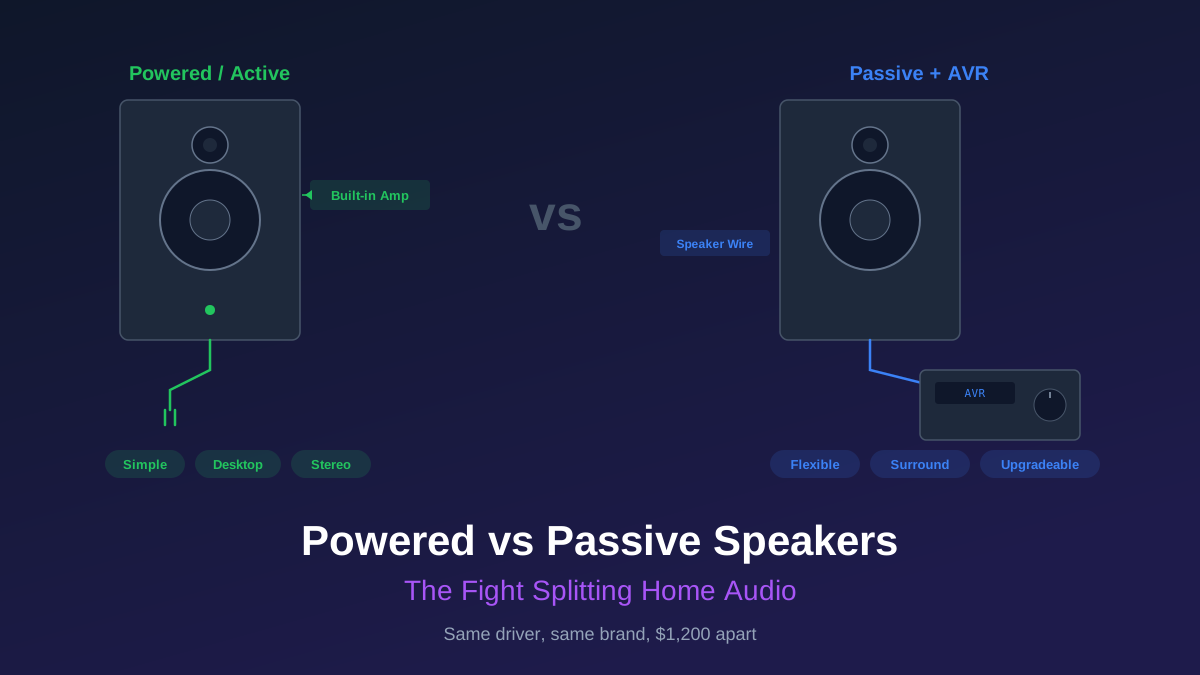
KEF makes a speaker called the LS50. It comes in two versions: the LS50 Wireless II (powered, $2,800/pair) and the LS50 Meta (passive, $1,600/pair). Same Uni-Q driver. Same brand. Same basic enclosure geometry. The powered version costs $1,200 more and needs zero external equipment. The passive version costs $1,200 less and needs an amplifier to make any sound at all. That price gap tells you everything about the real debate between powered and passive speakers.
This is not a subtle technical difference. It is a fundamentally different approach to building a system, and picking the wrong side for your situation will cost you money, flexibility, or both.
What "Powered" Actually Means
A powered (or active) speaker has its own amplifier built into the cabinet. Plug in a source, press play. No receiver, no external amp, no speaker wire. The signal chain is shorter and the manufacturer controls every link in it.
The better powered speakers go further than just stuffing an amp inside. The KEF LS50 Wireless II runs DSP (digital signal processing) between the input and the drivers, correcting for crossover behavior, phase alignment, and room interaction before the signal ever reaches the amplifier stage. The amp modules are matched to the specific drivers at the factory. There is no guessing about whether your amp has enough current for your tweeters or enough damping factor for your woofers. KEF already solved that equation.
Other strong powered options: the Klipsch The Fives ($799/pair) deliver surprisingly big sound from a compact footprint with HDMI ARC input, making them a legitimate TV audio upgrade. The Edifier S3000Pro ($699/pair) offer planar magnetic tweeters and Bluetooth 5.0 at a price that undercuts most passive-plus-amp combos.
Rob's take
Powered speakers simplify the system for music but create a problem for home theater: you can't easily integrate them with an AVR for multi-channel audio. For a dedicated music system that occasionally does movies, powered monitors with a stereo receiver and a separate subwoofer is a clean solution. For a proper home theater where the AVR is the center of everything, passive speakers give you flexibility that powered designs don't.
What Passive Gets You
A passive speaker is a box with drivers, a crossover, and binding posts. It does nothing without external amplification. That sounds like a disadvantage until you realize what it unlocks.
With passive speakers, you choose the amplifier. You choose how many channels. You choose when to upgrade each piece. A $1,600 pair of KEF LS50 Meta speakers paired with a $350 Denon AVR-S760H gives you 5.2 channel processing, room correction (Audyssey), HDMI switching, and the ability to add a center channel, surrounds, and subwoofer whenever you want. Total entry cost: $1,950 for a system that can grow into a full 5.1.4 Atmos rig over time.
The Emotiva B1+ ($299/pair) are a budget powerhouse with a ribbon tweeter that punches well above its price. The Klipsch RP-600M II ($599/pair) are efficient enough to sing with modest receivers and loud enough for medium-sized rooms. Both of these passive options leave you hundreds of dollars to spend on a subwoofer or center channel.
The Real Advantages of Powered Speakers
Simplicity
One power cable per speaker, one source connection, done. No receiver taking up shelf space. No speaker wire runs. For a desktop setup, a bedroom system, or a small apartment where a full rack of components is impractical, this matters enormously.
DSP and Amp Matching
The manufacturer knows exactly what amplifier module is driving exactly which driver. The crossover can be handled in DSP before amplification rather than with passive components after it. This means better phase coherence, tighter bass control, and more predictable performance across different rooms. The KEF LS50 Wireless II and the Buchardt A500 are poster children for what DSP-active designs can achieve.
Fewer Failure Points in the Signal Chain
No impedance mismatches. No underpowered amplifier clipping into a demanding load. No cheap speaker wire bottlenecking a good amp. The manufacturer tested the complete system as a unit. What you hear in the reviews is what you get in your room (minus room acoustics, which affect everything equally).
The Real Advantages of Passive Speakers
Multi-Channel Expansion
This is the knockout punch. If you want surround sound, you need five or more speakers, a subwoofer, and something to decode Dolby Atmos or DTS:X. An AVR handles all of that for $350-$700. Trying to build a 5.1 system from powered speakers means five separate powered units, each with its own volume control and input management, plus a standalone surround processor ($2,000+). The economics collapse immediately.
A passive 5.1 system using Emotiva B1+ all around ($299 x 3 pairs = $897) plus a Denon AVR-S760H ($350) plus a decent subwoofer ($500) comes in around $1,750 for legitimate surround sound. A comparable powered setup would cost north of $5,000 and involve far more complexity.
The Upgrade Path
Start with a stereo pair. Add a center channel in three months. Add surrounds next year. Swap the receiver for a better one when Dirac Live support matters to you. Upgrade the front left and right to towers and move the bookshelf speakers to surround duty. Every piece is independent. Nothing is wasted. With powered speakers, upgrading means replacing entire units.
Cost Per Channel
For a stereo desk setup, powered speakers are often cheaper than passive-plus-amp. But the math inverts at three channels and beyond. A 7-channel AVR costs about the same as a 2-channel AVR. Adding a $150 center channel to a passive system costs $150. Adding a center to a powered system means another powered speaker with its own amplification, DSP, and connectivity, often $500+.
Where the Line Falls
The dividing line is not about sound quality. At equivalent price points, powered and passive speakers can sound equally good. The line is about use case.
Powered wins when: you want stereo only, your source is a computer or phone or turntable, your room is small to medium, you value simplicity over expansion, and you are not planning to add surround channels. Desktop listening, bedroom HiFi, a den system that will never grow beyond two speakers and a sub.
Passive wins when: you want surround sound now or later, you care about the upgrade path, you are building a dedicated home theater, your room is large, or you want to mix and match components from different manufacturers. Basically, any scenario where "more than two channels" is on the roadmap.
If you are reading this on a site called CinemaConfig, there is a good chance you care about home theater. And home theater, for now, still belongs to passive speakers and AVRs. The surround processing, the channel management, the bass management, the room correction across seven or more speakers and multiple subwoofers: all of that lives in the receiver. Powered speakers have no answer for it at a reasonable price.
The Hybrid Approach
Some people run powered speakers as their front left and right, connected to the pre-outs of an AVR, while using passive speakers for center and surround channels. This gives you the DSP advantages of powered fronts with the flexibility of an AVR for everything else. It works, but it adds complexity and you lose some of the simplicity that makes powered speakers appealing in the first place.
A cleaner version: keep a powered stereo pair on your desk for music and nearfield listening, and build a separate passive surround system in the living room. Two systems, each optimized for its job, often costs less than one compromised system trying to do both.
What to Buy Right Now
Best powered for desktop/small room: KEF LS50 Wireless II ($2,800) if budget allows, Klipsch The Fives ($799) for a more practical spend, Edifier S3000Pro ($699) for value.
Best passive for home theater starter: KEF LS50 Meta ($1,600/pair) for premium, Klipsch RP-600M II ($599/pair) for mid-range, Emotiva B1+ ($299/pair) for budget. Pair any of them with a Denon AVR-S760H or similar and you have a foundation that grows with you.
If you are leaning toward the audiophile path, read our audiophile home theater setup guide for a deeper look at building a two-channel system that also handles movies. And if passive speakers are calling your name, our receiver-to-speaker matching guide will help you avoid the most common pairing mistakes.
The technology is not the hard decision. The hard decision is being honest about what you will actually build. If the answer is "just two speakers on a desk," go powered and never look back. If the answer involves the word "surround" or "someday," start passive. The upgrade path will thank you.
Rob Teller
Founder, CinemaConfig
15 years in consumer hardware and software, mostly on the product side. NZXT (cases and cooling), Asetek (liquid cooling, global sales), a short run advising on Alienware's roadmap at Dell, then four ... More about Rob · Affiliate disclosure
![Klipsch Reference vs Premiere: Differences and Picks [2026]](/images/blog/klipsch-speakers-guide.svg?dpl=dpl_A7yvEusbtVmAimLWJZTA31x7Ag82)

