Klipsch Reference vs Premiere - Differences and Picks
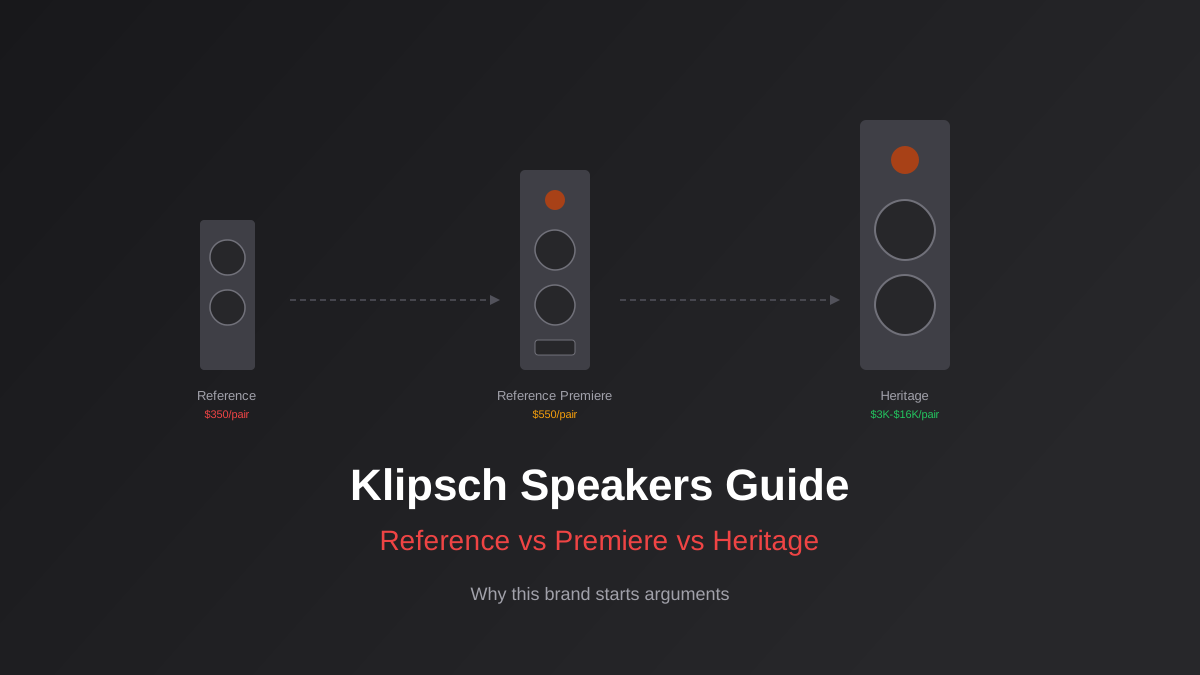
Klipsch is the most argued-about speaker brand in home theater, and both sides have a point. A post titled "Why do people hate on Klipsch?" pulled 950 upvotes on r/hometheater, and the comments split almost exactly down the middle: half calling them the best dynamics you can buy, half calling them bright, fatiguing, and overhyped. The truth is that Klipsch makes three very different product lines at three very different price points, and lumping them together is where most of the confusion starts.
Here is the short version before we get into it:
- Reference (R series): Budget. The R-600F ($350/pair) is a decent entry point, but you are competing with Polk and JBL Stage at this price. Corners are cut.
- Reference Premiere II (RP series): The sweet spot. The RP-6000F II ($550/pair) and RP-504C II center ($400) are genuinely competitive speakers. This is where most home theater buyers should look.
- Heritage: Premium. The Forte IV ($4,500/pair), Cornwall IV ($6,500/pair), and Heresy IV ($3,000/pair) are not just speakers, they are furniture. 96 to 99dB sensitivity means a $250 AVR drives them to reference level without breaking a sweat.
The Horn-Loaded Thing (And Why People Get Mad)
Every Klipsch speaker uses a horn-loaded tweeter. This is the single design choice that makes people love or hate the brand. A horn acts as an acoustic amplifier for the tweeter, increasing sensitivity (how loud the speaker plays per watt of input) and controlling where the sound goes. The result is a speaker that sounds more forward, more dynamic, and more "in your face" than a typical dome-tweeter design from KEF, ELAC, or Revel.
Some people call this exciting. Some people call this bright.
Both are right, depending on the room and the content. If you are watching action movies with explosions, gunfire, and dialogue that needs to cut through a loud mix, that forward presentation is a genuine advantage. Dialogue clarity on a Klipsch system in a large room is hard to beat. But if you are sitting six feet away in a small office listening to acoustic guitar recordings, that same energy in the 2kHz to 6kHz range can become fatiguing over long sessions.
The brightness complaint is real, but it is also fixable. Toeing the speakers outward so the horn is not aimed directly at your ears tames the top end significantly. A basic set of absorption panels at the first reflection points does the rest. Klipsch speakers are more room-dependent than neutral-signature brands, and people who skip the setup step often blame the speaker for a problem the room is causing.
Rob's take
Klipsch Heritage speakers are not for every room or every listener. The sensitivity runs so high (99-104 dB/W/m on horn-loaded Heritage models) that a typical AVR's volume pot is nearly useless — you're running at -40dB to -50dB on a Denon where most speakers live at -20dB to -30dB. That dynamic range compression is audible. Heritage speakers are genuinely excellent, but they reward matching with amplification designed for that sensitivity range.
Reference (R Series): Honest Budget, Honest Compromises
The Reference line is Klipsch's entry-level offering, and it is priced to compete with Polk Audio, JBL Stage, and Sony Core. The R-600F ($350/pair) is the most popular floorstander in the lineup, and it delivers the signature Klipsch sound at a price point that gets a lot of first-time buyers through the door.
What you get: an injection-molded Tractrix horn tweeter, decent sensitivity around 97dB (on paper), and a big, bold sound that fills a room. What you give up: crossover design is basic, the cabinets feel hollow compared to the RP series, and the woofer cones are standard spun copper rather than the cerametallic drivers in the higher lines. Bass extension is modest for the cabinet size.
We think the R series is fine for a first system, especially for movies in a medium to large room. But at $350/pair, you should also be looking at the JBL Stage A180 and the Polk Reserve R200. The competition at this price has gotten much better in the last two years, and the Klipsch name alone does not automatically win the tier anymore.
Reference Premiere II (RP Series): Where Klipsch Gets Serious
This is the line we actually recommend for most home theater builds. The RP series uses cerametallic woofer cones (a proprietary blend of ceramic and aluminum), a redesigned Tractrix horn with a more refined high-frequency response, and meaningfully better crossover networks. The difference between an R-600F and an RP-6000F II ($550/pair) is not subtle. It sounds like a different company made them.
The RP-6000F II is a 6.5-inch dual-woofer floorstander that hits 97dB sensitivity and extends down to about 34Hz before rolling off. In a proper home theater with a subwoofer handling the bottom octave, that is more than enough. The midrange is cleaner, the treble is less aggressive, and the overall coherence of the sound is a significant step up.
The real star of the RP line for home theater might be the RP-504C II center channel ($400). Center channels handle 60 to 70 percent of a movie's audio (all dialogue, most foley), and the RP-504C II is one of the best values in the category. Four 4-inch cerametallic woofers in a dedicated horizontal array, good off-axis response for wider seating, and enough output to keep up with the RP floorstanders without strain.
If you are building a 5.1 or 7.1 system and your budget is in the $1,500 to $2,500 range for all speakers, the RP-6000F II fronts with an RP-504C II center is the combination we keep coming back to. Pair it with any decent subwoofer and you have a system that genuinely competes with setups costing twice as much. CinemaConfig's builder can spec the full system with matching surrounds and a sub if you want to see what the complete picture looks like.
Heritage: Speakers That Double as Heirlooms
The Heritage line is where Klipsch stops being a mass-market speaker company and starts being something closer to a boutique. The Cornwall IV ($6,500/pair), Forte IV ($4,500/pair), Heresy IV ($3,000/pair), and the legendary Klipschorn AK7 ($16,000/pair) are speakers built the way Paul Klipsch designed them in the 1940s and 1950s: massive cabinets, high-efficiency drivers, and sensitivity numbers that make amplifier shopping trivially easy.
The Cornwall IV is rated at 102dB sensitivity. The Klipschorn hits 105dB. To put that in context: a typical bookshelf speaker at 85dB sensitivity needs 100 watts to reach a given volume. The Cornwall IV reaches the same volume with 2 watts. This is not a rounding error. This is a fundamentally different relationship between speaker and amplifier.
What does that mean in practice? It means a Denon AVR-S670H ($250) can drive Heritage speakers to THX reference level (105dB peaks at the listening position) without clipping. You do not need a $2,000 amplifier. You do not need a separate power amp. The speaker does the work. Our receiver matcher will confirm this: Heritage speakers make almost any AVR look overpowered.
The Forte IV ($4,500/pair) is our pick as the most practical Heritage speaker. It uses a 12-inch woofer and a 15-inch passive radiator in a cabinet that is big but not room-dominating. Sensitivity is 99dB. It delivers the Heritage sound (massive dynamics, effortless volume, that "live performance" feeling that horn speakers do better than anything else) in a package that does not require you to rearrange your furniture.
The Heresy IV ($3,000/pair) is the compact option at just 15.5 inches tall. At 99dB sensitivity it is still wildly efficient, but the smaller 12-inch woofer means bass rolls off around 48Hz. You will absolutely want a subwoofer. As a bookshelf-sized speaker with Heritage-level dynamics, it fills a niche nothing else really occupies.
The Brightness Question: Is Klipsch "Too Bright"?
We get asked this constantly, so here is our honest take. Compared to a KEF R3 Meta, an ELAC Debut Reference, or a Revel Concerta2, yes, Klipsch speakers have more energy in the upper midrange and treble. On frequency response measurements, you can typically see a 2 to 3dB lift in the 2kHz to 8kHz region compared to speakers that target a flat Harman curve.
For movies, we think this is actually a feature. Film sound mixes are designed for large cinemas with significant high-frequency absorption from seats and bodies. In a home environment with fewer absorptive surfaces, a slightly forward speaker compensates for the smaller, more reflective room. Dialogue pops. Effects have bite. Surround cues are more localized.
For music, it depends on what you listen to and how you listen. If your playlist is mostly rock, electronic, and hip-hop, Klipsch speakers deliver impact and energy that flatter those genres. If you listen to jazz, classical, and vocals at moderate volumes, you may find the treble emphasis distracting over time. This is not a flaw, it is a design philosophy. Klipsch optimizes for impact. Brands like KEF and ELAC optimize for neutrality. Neither is wrong.
Who Should (and Should Not) Buy Klipsch
Buy Klipsch if: You have a medium to large room. Your system is movie-first. You want dynamics and slam that make action scenes feel physical. You want high sensitivity so you can skip the expensive amplifier and pair with a mid-range AVR. You are willing to spend time on placement and room treatment.
Skip Klipsch if: Your room is small (under 150 square feet). Your system is music-first and you prefer a flat, neutral response. You are sensitive to treble and do not want to deal with room treatment. You want a speaker that sounds great in any position without fuss.
For the music-first crowd in small to medium rooms, we would point you toward KEF Q Series, ELAC Debut Reference, or Wharfedale Diamond. For the movie-first crowd who wants that visceral Klipsch experience, the RP-6000F II is the sweet spot unless your budget reaches Heritage territory.
Pairing Klipsch with an AVR
High sensitivity is the hidden financial advantage of Klipsch speakers. While an 85dB-sensitivity bookshelf speaker needs every watt your receiver can deliver, Klipsch speakers are already loud at low power. The RP-6000F II at 97dB sensitivity needs roughly one-quarter the amplifier power of a typical competitor to reach the same volume. The Cornwall IV at 102dB needs about one-sixteenth.
What this means practically: the Denon AVR-S670H ($250) is not a compromise pairing with Klipsch, it is a perfectly rational one. At 75 watts per channel, it drives RP-series speakers to reference level with headroom to spare. Heritage owners can run a budget AVR and spend the amplifier savings on better source equipment, room treatment, or a subwoofer. Use CinemaConfig's receiver matcher to see exactly how much (or how little) power your Klipsch setup actually needs.
Klipsch will keep starting arguments as long as they keep making horn-loaded speakers. That is fine. The best gear is always polarizing, because it commits to a point of view instead of trying to please everyone. Know which line matches your room, your priorities, and your tolerance for treble energy, and you will understand exactly why half the internet loves them.
Rob Teller
Founder, CinemaConfig
15 years in consumer hardware and software, mostly on the product side. NZXT (cases and cooling), Asetek (liquid cooling, global sales), a short run advising on Alienware's roadmap at Dell, then four ... More about Rob · Affiliate disclosure


