We have IMAX at Home
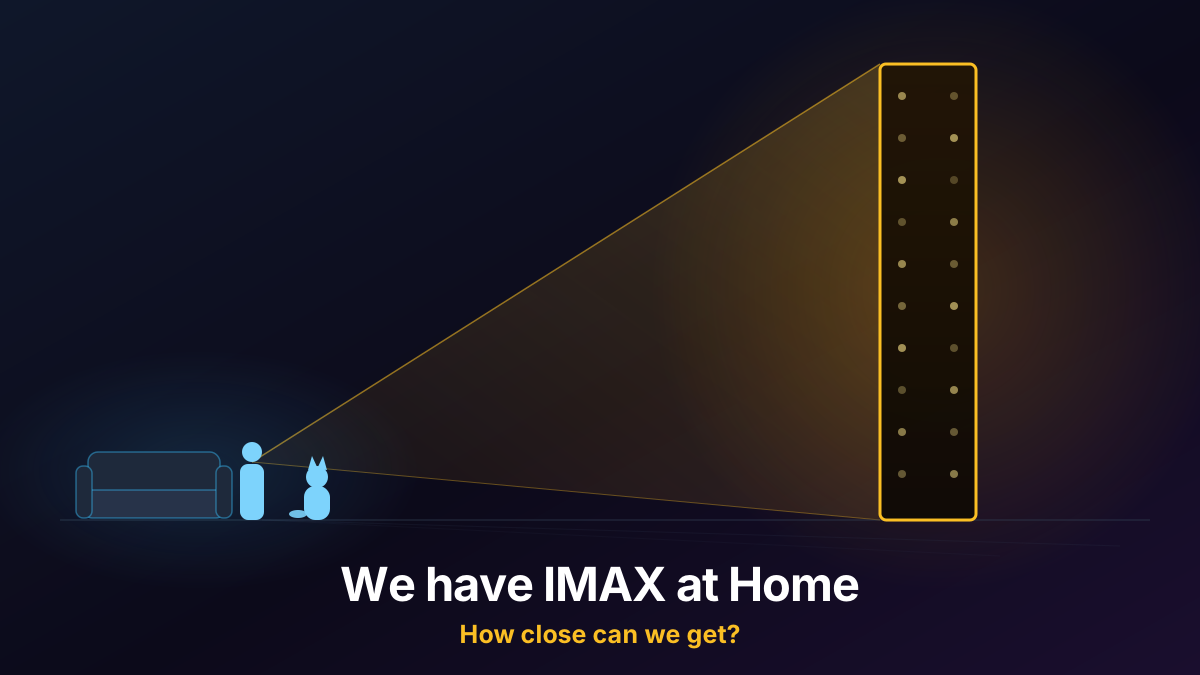
"We have IMAX at home" used to be the saddest sentence in home theater, the mom-meme substitute for the real thing. This year it reads different. The design standard behind IMAX's giant screens calls for a minimum 53-degree viewing angle at the farthest seat, and a 98-inch TV six feet from your couch clears it at 61.3 degrees. That is the number that matters, not 1.43:1. The catch: you cannot buy the ratio. IMAX 70mm film runs 1.43:1, and no consumer TV or projector has ever been built in that shape; 16:9 has been the standard since 1984. The useful question is how to hit the one part of IMAX that's a number instead of a format.
This stopped being academic six days ago. Christopher Nolan's The Odyssey opened July 17, the first commercial film ever shot entirely with IMAX film cameras, and only 41 theaters on Earth can project it in true 70mm, 25 of them in the US. Roughly 95% of the year-early advance seats sold out within an hour, and resale tickets now run $300 to $500 against a $25-28 face value, scalper money for a movie ticket. IMAX screens alone produced $52 million of the film's $263 million opening weekend. There is no home release date, no format announcement, nothing. Which makes right now the moment to get the room ready.
What 70mm IMAX Actually Gives You
Viewing angle is screen width against seating distance, run through an arctangent. The Giant Screen Cinema Association, whose standard is built on IMAX's original theater designs, sets 53 degrees as the floor for the farthest seat. THX's home guidance works out to 40 degrees: diagonal divided by 0.835. SMPTE's old minimum sits at 30. Three standards, three targets, and the IMAX floor is the only one that feels like the movies.
The math: a 65-inch TV at a typical 8-foot couch gives 32.9 degrees, technically past SMPTE's tube-era minimum, well short of THX's 40, and nowhere near IMAX territory. Move that same TV to 6 feet and you get 43 degrees, past the THX home target for free. A 98-inch TV at 6 feet hits 61.3 degrees, clearing the IMAX floor outright; back it up to 8 feet and it drops to 48. A 116-inch TV and a 120-inch projected image, both at 8 feet, land at 55.5 and 57.2. Both clear the floor without touching the couch. Run your own room through the viewing distance calculator before buying anything; one foot of distance moves the angle by several degrees.
Chasing 1.43:1 itself is like chasing 4:3 on your phone. The shape was never coming home. Weighing the theatrical formats against each other instead? Our Infinity Vision vs IMAX vs Dolby Cinema comparison covers that side.
The Three Ways to Get Close
A Projector at 110-120 Inches (Best)
The most comfortable path past 53 degrees: a 120-inch image at 8 feet measures 57.2 degrees from a normal couch. JVC DLA-NZ800 and JVC DLA-NZ900 are the flagship options in our catalog, with Sony VPL-XW6100ES the third name; none carry a price on our pages right now. JVC's newest flagship, the DLA-RS4200, is rated by JVC at 3,300 lumens and 150,000:1 native contrast, with the laser shutting off entirely during pure black. One honesty note: lumens and nits are different units, and nobody publishes a clean conversion between a 3,300-lumen projector and a 5,000-nit TV. Anyone dividing one by the other to declare a brightness winner is making it up. Skip it if: the room can't go dark on demand, or there's no clear 8-foot throw to a blank wall. A projector fighting daylight loses to a $700 TV.
A 98-116-Inch TV (Good)
The TCL 98X11L is the value pick and the reason this exercise stopped being theoretical this year. At $10,000 on our own product page, it's the cheapest screen that beats the IMAX floor from a 6-foot couch. Buy it if: the couch sits at 6 feet or can move there, and the room keeps enough daylight to rule a projector out.

TCL 98" X11L Series 4K UHD HDR Mini-LED TV
98-inch · Mini-LED · 4K UHD · Google TV
$9,999.99
See current price on CinemaConfig →Bigger exists. Hisense 98UX and Hisense 110UX are real panels in our catalog with no price shown on our pages. Hisense's 116-inch RGB flagship, the 116UXS, is the biggest single panel in the conversation; our own 2026 Hisense lineup piece put it north of $15,000, and it has no catalog page yet. The LG OLED97G6WUA, at $25,000 on our page, brings a genuinely better black level than anything else here. The gotcha: spend that $25,000 and you still can't play IMAX Enhanced content, because LG isn't a certified brand. Neither is Samsung. TCL, Hisense, and Sony are. Nobody at IMAX, DTS, LG, or Samsung has explained why. On the one feature named after the format you're chasing, the $25,000 OLED loses to the $10,000 TCL.
Your Current TV, Moved to 6 Feet (Cheapest)
A 65-inch TV at 8 feet gives 32.9 degrees. The same TV at 6 feet gives 43, past THX's home standard, still short of the IMAX floor, and a bigger jump than most people get from an entire upgrade cycle. It costs floor space and maybe a longer HDMI cable. Buy nothing if: your couch sits past 7 feet and you haven't tried pulling it closer first.
Rob's Take
Here's the problem nobody has had to solve before: every prior Nolan IMAX film was framed wider than 16:9, so the home-release trick was easy, open the IMAX scenes up until they fill the frame. The Odyssey is shot entirely in 1.43:1, which is taller than 16:9, not wider. Opening up doesn't work when the frame is taller than the display; the choice becomes cropping the top and bottom or pillarboxing a nearly square image. Nobody at Universal has said which, and my guess is nobody has decided. That decision will matter more to how this film looks in your room than any TV in this article.
The Disc Problem
Every Nolan 4K UHD release from The Dark Knight through Oppenheimer, six discs straight, uses a variable aspect ratio: footage shot on IMAX cameras opens to fill 1.78:1, everything else letterboxes to scope. The catch: only on disc. Digital versions of Dunkirk on iTunes, Movies Anywhere, Google Play, and Amazon lock to one constant ratio, cropping away the extra picture the disc shows in IMAX scenes. If the full frame is the reason you're watching, streaming loses on all six films.
The audio tells the same story. All six discs carry DTS-HD Master Audio 5.1 and nothing else, no Atmos, no DTS:X, in an era when Atmos ships on most studio releases by default. That looks like an oversight until you read Nolan on home viewing: discs "eliminate the variabilities" of streaming, and his goal is getting "as close as possible to the theatrical presentation." A Dunkirk sound designer has said Nolan stays on 5.1 because that's what most cinemas actually run, though that quote reaches us secondhand through a paywalled piece, not from Nolan himself. Practical upshot: a Nolan-first room is a 5.1 build, which is cheaper and simpler than a height array. The speaker layout planner lays one out around whatever screen you landed on above, and our Atmos vs DTS:X vs IMAX Enhanced comparison covers what height channels buy you elsewhere.
Common Mistakes
Buying a Bigger TV Before Moving the Couch
Before spending five figures on a screen, check whether distance was the actual problem. A free couch move takes a 65-inch room from 33 to 43 degrees; no purchase in this article moves the needle that far per dollar. Solve distance, then size.
Assuming Any TV Plays IMAX Enhanced
Certified TV brands are Sony, TCL, and Hisense, plus Honor, Hitachi, JVC, Toshiba, and Xiaomi; certified AVR brands include Denon and Marantz. The Denon AVR-X3800H and Marantz CINEMA 50 both confirm DTS:X on their own product pages. Certification runs per component: pair either receiver with an LG or Samsung panel and your audio is certified while your picture isn't.
Streaming the Movie and Wondering Why It Looks Cropped
Disney+ launched IMAX Enhanced's 1.90:1 expanded ratio on 13 Marvel titles back in 2021; whether that library has grown since is unclear from anything published. Discs and IMAX Enhanced sources show more picture. Streaming defaults usually don't.
Demo Scenes to Run Tonight
The Dark Knight's bank-heist prologue, about six minutes, and its Hong Kong sequence both open to the full 1.78:1 frame on the 4K disc, the cleanest possible demo of an IMAX camera cutting against 35mm. Dunkirk's beach opening and dogfights find every weakness a 5.1 setup has. Interstellar's docking sequence is what converts skeptics, and it's a scale shot a 65-inch TV genuinely cannot deliver the way a 98-inch one can. Oppenheimer's Trinity test, roughly ten minutes shot practically without CGI, is the best pure large-format detail demo on this list, though how many of its minutes count as "IMAX footage" depends on who's counting.
And one that shouldn't work: Inception contains zero frames of IMAX-camera footage. Nolan shot it on 35mm anamorphic with some 65mm, constant 2.39:1, no expanding frame anywhere. The zero-gravity hallway fight, built on a practical rotating set, and the Paris fold, live-action plates finished with VFX, are still two of the most-requested demo scenes in home theater. A great demo scene is choreography, not the badge on the poster. Our Star Wars demo-scenes list makes the same argument from a galaxy with zero IMAX pedigree. Meanwhile the multiplex habit of putting "IMAX" on an ordinary digital screen has its own name among enthusiasts (LieMAX), and none of tonight's list needs one.
Is Chasing IMAX at Home Worth It?
Dedicated room: yes, without much hesitation. A 120-inch projected image at 8 feet clears the IMAX floor, and the Nolan catalog rewards it with a 5.1 mix that doesn't demand a ceiling full of speakers.
Shared living room: the honest math says chase the couch before the screen. Close the distance by whatever the layout allows, then let the budget decide between the $10,000 TCL and the rest of the best TVs field above it. The dollar-per-degree argument runs out long before $25,000.
Prices verified July 23, 2026 from CinemaConfig product pages. The Odyssey has no home release date; when one lands, this page gets updated. Check current TV prices on CinemaConfig.
A 98-inch screen with a soundbar under it is a room half finished. The CinemaConfig builder matches a screen this size to an AVR, speakers, and seating distance for your actual room. IMAX built a camera. It never built a couch. That part, we have at home.
Rob Teller
Founder, CinemaConfig
15 years in consumer hardware and software, mostly on the product side. NZXT (cases and cooling), Asetek (liquid cooling, global sales), a short run advising on Alienware's roadmap at Dell, then four ... More about Rob · Affiliate disclosure
![LG G5 vs TCL X11L: 97-Inch OLED or Mini LED? [2026]](/images/blog/lg-g5-vs-tcl-x11l-97-inch-oled-mini-led-2026.svg?dpl=dpl_JDgjhGBvx2X3Sx5yVkYoeVoH9wAy)

