OLED or RGB Mini LED for $1,500: Three 65-Inch TVs, $300 Apart
Quick Verdict
- Best overall: LG C6 65" (OLED65C6PUA), about $1,600 now: per-pixel black, four HDMI 2.1 ports at 165Hz, and 1,438 measured nits where a dark room needs them.
- Best for bright rooms and sports: Sony Bravia 7 II 65" (K65XR70M2), about $1,799: 829 nits full-screen and the widest BT.2020 coverage of the three, held back by two HDMI 2.1 ports and off-axis blooming.
- The tiebreaker: Hisense UR8 65" (65UR8SG), about $1,499: the brightest panel here and the cheapest, if you can live with color that measures better than it looks.
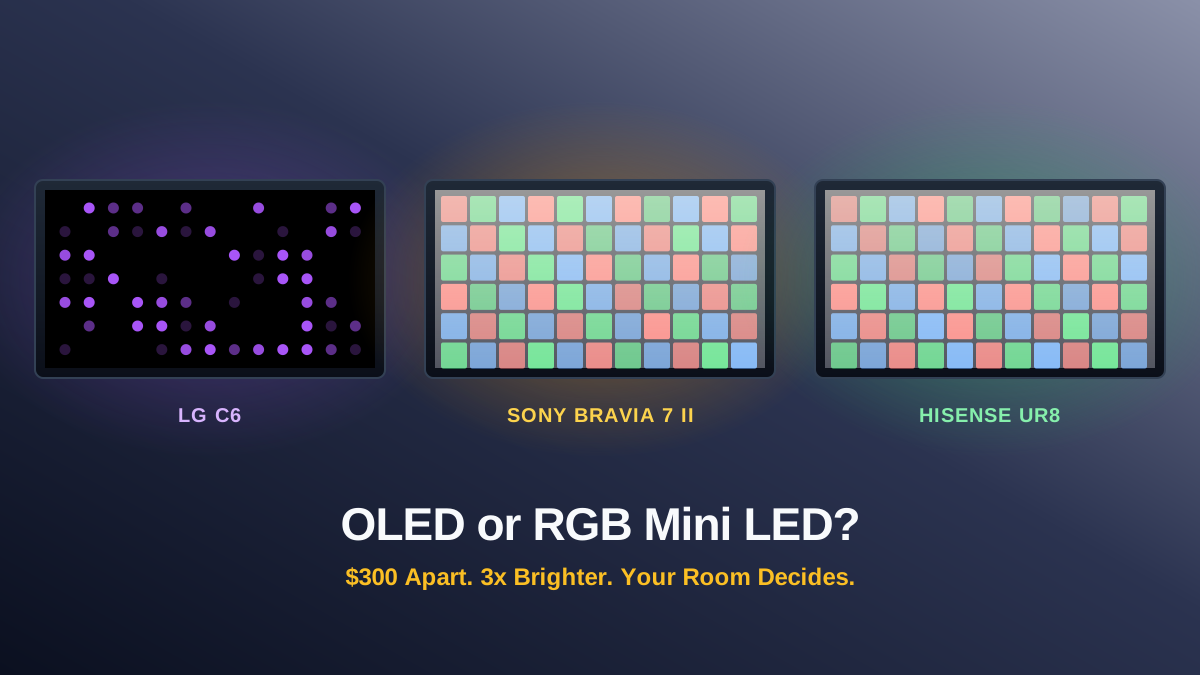
Three 65-inch TVs, three panel technologies, one $300 spread. The LG C6 launched at $2,699, the Sony Bravia 7 II at $2,599, and the Hisense UR8 at $1,999. A few months of discounting later, they sit at roughly $1,600, $1,799 and $1,499. For the first time, the RGB backlight sets everyone was promised at CES are priced against the mid-range OLED instead of above it.
The single number that decides this for most rooms is not peak brightness. It's full-screen brightness. TechRadar measured the C6 at 245 nits with the whole screen lit in HDR, against 829 for the Bravia 7 II and 771 for the UR8. That is a 3.4x gap, and it shows up every time a hockey rink, a snowfield or a white UI fills the frame.
Rob's Take
Based on the lab numbers from TechRadar and SamMobile, RGB has not killed OLED. It has done something more useful: it killed the reason to buy a regular Mini LED at $1,500. My market call for 2027 is that Sony's True RGB drops one tier lower, into the Bravia 5 slot, because a $1,799 Bravia 7 II already makes Sony's own white-LED sets look like last year's TV. The C6 should worry less about RGB than about LG's own C6H, which gets the brighter Primary RGB Tandem panel at 77 inches and up.
Three Ways to Make Light
LG C6: self-emissive OLED. LG Display calls the 42 to 65-inch C6 panel "Tandem WOLED," while the 77 and 83-inch models are a separate C6H line using the Primary RGB Tandem 2.0 panel from the G6. Each of the 8.3 million pixels makes its own light and switches fully off for black. No backlight, so no blooming, ever. The physics that buys that contrast also caps how hard the whole panel can be driven at once, which is where the 245-nit full-screen figure comes from. Our Tandem WOLED reference covers the stack in detail.
Sony Bravia 7 II: an LCD with a True RGB backlight, meaning separate red, green and blue LEDs behind the panel instead of blue LEDs plus quantum dots. Sony has not published a dimming-zone count for the Bravia 7 II.
Hisense UR8: the same idea at a lower price, branded RGB MiniLED, with a matte anti-glare screen similar to Samsung's Glare Free finish. Hisense rates it for a 180Hz native refresh rate. The RGB Mini LED explainer walks through why driving color in the backlight changes what an LCD can do.
Brightness: The UR8 Wins Peaks, the RGB Pair Wins the Whole Screen
On a 10% HDR window in each TV's accurate mode, TechRadar measured the UR8 at 2,087 nits, the C6 at 1,438 nits and the Bravia 7 II at 1,114 nits. The Sony number is the surprise. TechRadar called it one of the dimmer RGB TVs it has tested out of the box, and its Standard mode only lifts it to 1,295. Tom's Guide published 2,078 nits for the same TV on a 10% window, without a mode match to TechRadar's test, so treat Sony's peak as mode-dependent until RTINGS posts comparable numbers.
Full-screen is where the order flips. At 829 and 771 nits, the two RGB sets hold more than three times the C6's 245 when the entire image is bright. In a dark theater room, your eyes adapt and the C6's highlights still look explosive against true black. In a room with a south-facing window and Sunday football, the LCDs simply stay brighter for longer.
The math: 829 divided by 245 is 3.4, and 771 divided by 245 is 3.1. A 3x change in luminance is easy to see; the eye's response is closer to logarithmic, so it reads as "clearly brighter," not "three times brighter." Clearly brighter is enough to change which TV belongs opposite a window.
Color: Sony Measures Wide and Looks Wider
The Bravia 7 II covered 87.7% of BT.2020 and 99.2% of UHDA-P3 in TechRadar's testing. The C6 managed 75.8% of BT.2020 and 99.7% of DCI-P3. Almost every film and series you stream is mastered inside P3, so on today's content the two are close. On the BT.2020 headroom that future grades can use, Sony's RGB backlight has 12 points on LG's color-filtered OLED. Our BT.2020 reference explains why nobody hits 100% yet.
The UR8 is the odd case. Its color-volume readings ran off TechRadar's scale, past 145% of UHDA-P3, and its review still lists "real-world colors don't match measurements" as the main weakness. Natural, sometimes punchy, rarely the wow that the spec sheet implies. The meter and the eye are measuring different things here, and the eye is the one sitting on your couch.
The HDMI Problem Nobody Mentions on the Box
The C6 has four HDMI 2.1 ports supporting 4K at 165Hz, VRR with FreeSync and G-Sync, HGiG and Dolby Vision gaming. The UR8 also has four HDMI 2.1 ports, up to 4K 180Hz for PCs and 4K 120Hz for consoles. The Bravia 7 II has four HDMI inputs, but only two of them are HDMI 2.1, and Sony's own sheet says 120Hz works only on HDMI 3 and 4.
Plug in a PS5 Pro and an Xbox Series X and both 2.1 ports are spoken for. Add a soundbar or receiver on eARC and you are juggling inputs, or routing a console through the receiver instead. That is a solvable problem with a current AVR, and a $1,799 TV should not hand you a wiring puzzle. Sony also skips HDR10+, a long-standing Sony habit, while the UR8 supports Dolby Vision, HDR10+ and Dolby Vision 2, the last with no content available yet.
Gaming: A Narrow Win for the Four-Port TVs
TechRadar measured 10.4ms of input lag on the Bravia 7 II, one of the better results it has recorded from a Sony. The C6 and UR8 both feel instant in game mode, and TechRadar notes the UR8 needs settings adjusted to reach its lowest lag. Once you are under about 15ms, nobody on the couch can tell these three apart by feel.
The real gaming split is ports and refresh. If one console is all you own, it's a tie. If you run a gaming PC at 165Hz or more, the C6 and UR8 are the only two here that can take it, and the C6's per-pixel response is still the sharpest motion of the three. Pick the C6 if games share a dark room with films; pick the UR8 if the PC lives in a bright den.
Peak HDR (10% window): Hisense UR8 wins. 2,087 nits vs 1,438 (C6) vs 1,114 (Bravia 7 II, Professional mode).
Full-screen HDR: Sony Bravia 7 II wins. 829 nits vs 771 (UR8) vs 245 (C6).
Black level and blooming: LG C6 wins outright. Self-emissive pixels, zero halo; TechRadar flags off-center blooming on the Sony.
Color gamut (BT.2020): Sony Bravia 7 II wins. 87.7% vs 75.8% for the C6.
HDMI 2.1 ports: C6 and UR8 tie at four. The Bravia 7 II has two.
Max refresh: UR8 180Hz, C6 165Hz, Bravia 7 II 120Hz.
Glare: UR8 wins with its matte anti-glare screen. TechRadar calls both the C6 and the Bravia 7 II reflective.
Street price, 65": UR8 $1,499, C6 about $1,600, Bravia 7 II $1,799.
A Tangent About Samsung's Missing Seat
The Samsung R85H Micro RGB should be in this matchup. At $2,099.99 for 65 inches it is priced right next to the Sony. SamMobile's review found it "doesn't seem to push much beyond the 1,000-nit mark," rated its viewing angles among the worst in its price bracket, and concluded that at its current price the R85H is hard to recommend. If your budget stretches to Samsung's Micro RGB, the step-up R95H is the one TechRadar measured at 1,977 nits. Our Micro RGB reference explains what the branding does and doesn't mean.
Which Room Gets Which
The dedicated theater (dark walls, controlled light)

LG C6 65" (OLED65C6PUA)
Tandem WOLED, 4K 165Hz, 4x HDMI 2.1, 1,438 nits (10% HDR, measured)
About $1,600 (launched at $2,699)
See specs and current pricesThe LG C6, and it isn't close. When the lights go down, OLED's per-pixel black is worth more than every extra nit the RGB sets can make, and the C6's banding in dim gray areas (which TechRadar noted) is the only real blemish. Villeneuve's desert night scenes are exactly the material a backlit LCD still struggles to hold together.
Buy the LG C6 if: you watch at night with the lights off, sit within 30 degrees of center, run a PC or two consoles, and want the TV that will still look right in five years.
The bright living room (windows, daytime sports)
The Sony Bravia 7 II. Its 829-nit full-screen output and wider color hold up against daylight, and its processing is classic Sony. Seat everyone near the middle, because TechRadar saw blooming and faded contrast off-center. Buy the Bravia 7 II if: daytime viewing is half your hours, you own one console, and you don't need HDR10+.
The budget-first buyer
The Hisense UR8 at $1,499 is the brightest TV in this comparison for the least money, and the only one of the three with an anti-glare matte screen. Buy the UR8 if: your room fights glare, you want four full HDMI 2.1 ports, and you would rather spend the $300 you save on a subwoofer.
Not sure 65 inches is even the right size? Run your couch distance through the viewing distance calculator before choosing a panel; going up to 75 inches often matters more than which of these three you pick. For the OLED-only version of this decision, see our LG C6 vs Samsung S90H comparison, and the full field lives on the TV comparison hub.
Specs at a Glance
- Panel: C6 = Tandem WOLED | Bravia 7 II = LCD, True RGB LED backlight | UR8 = LCD, RGB MiniLED backlight
- Peak HDR, 10% (TechRadar, accurate mode): C6 = 1,438 nits | Bravia 7 II = 1,114 nits | UR8 = 2,087 nits
- Full-screen HDR: C6 = 245 nits | Bravia 7 II = 829 nits | UR8 = 771 nits
- BT.2020 coverage: C6 = 75.8% | Bravia 7 II = 87.7% | UR8 = measured past the UHDA-P3 scale (see above)
- Max refresh: C6 = 165Hz | Bravia 7 II = 120Hz | UR8 = 180Hz
- HDMI 2.1: C6 = 4 | Bravia 7 II = 2 of 4 | UR8 = 4
- HDR formats: C6 = Dolby Vision, HDR10, HLG | Bravia 7 II = Dolby Vision, HDR10, HLG | UR8 = Dolby Vision, Dolby Vision 2, HDR10+, HDR10, HLG
- Launch / street (65"): C6 = $2,699 / about $1,600 | Bravia 7 II = $2,599 / $1,799 | UR8 = $1,999 / $1,499
Prices verified October 29, 2026 from CinemaConfig price tracking and TechRadar's US street-price notes; holiday sales move these weekly. Check current TV prices on CinemaConfig.
Whichever panel wins your room, the TV is only the front of the system. The CinemaConfig builder matches it to an AVR with enough HDMI 2.1 inputs, speakers and seating distance for the room you actually have. Brightness is a room decision. Contrast is a lights-off decision.
Rob Teller
Founder, CinemaConfig
15 years in consumer hardware and software, mostly on the product side. NZXT (cases and cooling), Asetek (liquid cooling, global sales), a short run advising on Alienware's roadmap at Dell, then four ... More about Rob · Affiliate disclosure


