Sony's TV Business Is Now 51% Chinese. Panasonic's Is 100%., what we recommend
The Short Version
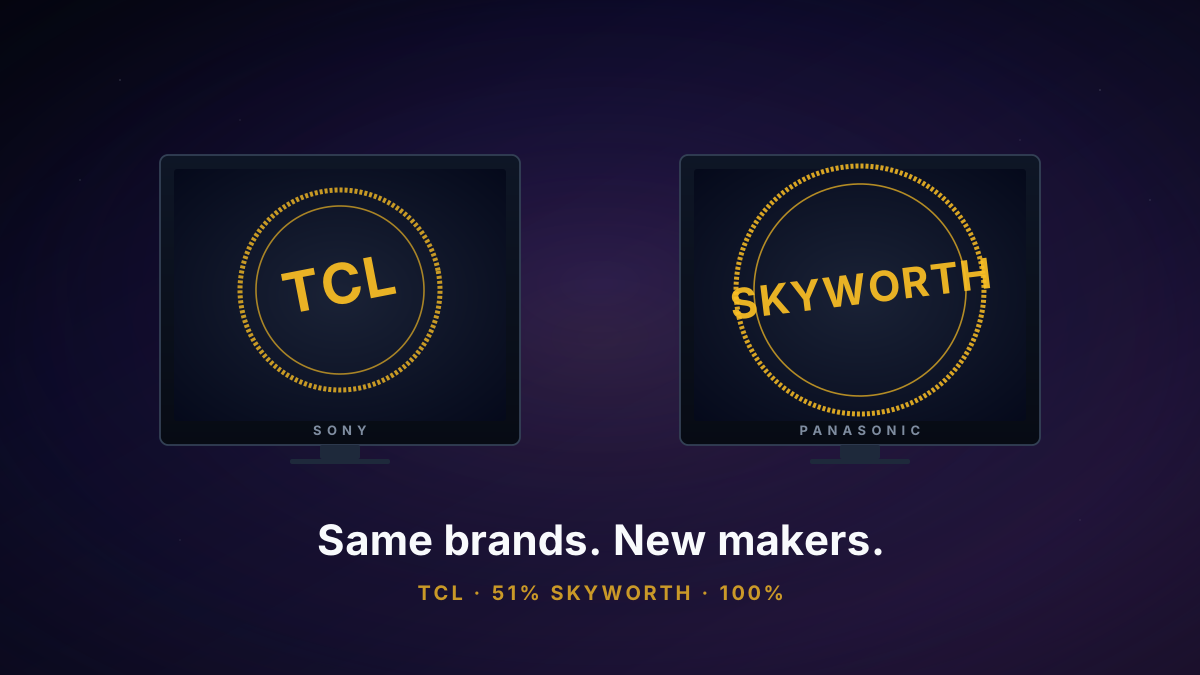
Sony's TV business is now 51% Chinese, owned by TCL via a $650 million joint venture closing April 2027. Panasonic's is already 100% Chinese-operated, with Skyworth taking over manufacturing, sales, marketing, and logistics on April 1. Sony's processing chip stays. Panasonic's Hollywood Lab tuning stays. Everything else (panel, factory, supply chain, sales, warranty fulfillment) is now Chinese. The badges are the same. The companies behind them aren't. Buying advice below.
Two deals just collapsed the operational backbone of Japan's two remaining premium TV brands inside two weeks. Sony and TCL signed their January MoU into binding terms at the end of March, finalizing a $650 million joint venture with TCL holding 51% and Sony 49%. Operations begin April 2027. Sony's own announcement calls it "establishing a strategic partnership in the home entertainment field," which is the polite version of "TCL bought the operational guts of the Bravia business." Two weeks earlier, Skyworth's deal with Panasonic went live on April 1, with Skyworth USA Corporation taking over manufacturing, sales, marketing and logistics for Panasonic-branded TVs in the U.S. and Europe. Same playbook, smaller deal, already shipping.
Bangkok Post called it "ending the era of Japan-made TVs." That's the right framing.
Chinese ownership stake: TCL holds 51% of the new Sony-Bravia JV ($650m). Skyworth runs 100% of Panasonic's TV operations.
Effective date: Panasonic-Skyworth went live April 1, 2026. Sony-TCL JV begins operations April 2027.
What the legacy brand keeps: Picture processing chip, color tuning, QA, warranty, brand name.
What moves to the partner: Panel sourcing, manufacturing, distribution, sales, marketing, logistics.
Panel impact: Sony shifts heavily to TCL's CSOT. Panasonic keeps LG OLED for flagships.
Rob's take
I want to call this a tragedy and the data won't let me. Sony stopped making its own panels 15 years ago, when the S-LCD joint venture with Samsung wound down. Panasonic exited domestic Japan-side panel production over a decade ago. The engineering left first. What just collapsed is the operational shell of being a Japanese TV company. The processing chip stays Sony's. The Hollywood Lab tuning stays Panasonic's. But if your mental model of "buying a Sony" was "Japanese-built premium TV with cinema heritage," that mental model just moved to TCL's side of the ledger. The badge on the bezel is doing more work in 2027 than it ever has.
So Should You Buy One Right Now?
If you have a 2026 Sony Bravia 9 II or a Panasonic Z95B in your shopping cart, nothing about that specific TV changes. The 2026 Sony lineup is the last Bravia generation that will be designed, sourced, sold, and supported entirely under Sony's umbrella before the JV takes over in April 2027. If you're a brand-provenance buyer, this is your last clean shot at it. The "buy the last 100% Sony Bravia" line floating around Reddit isn't wrong; it's just narrowly applicable.
For everyone else, the practical answer is calmer. The 2027 post-JV Bravia should still have Sony's processing chip, Sony's tuning, and Sony's name on the warranty card. The panel becomes a CSOT product, which is a step away from the curated mix of LG WOLED and Samsung QD-OLED that Sony has been picking from. Whether that hurts picture quality depends on whether Sony's processing team retains real authority over panel selection inside the JV, and whether TCL's procurement team lets them pay for the panels they want. That's unknowable today.
The honest signal is to buy what's on shelves now if you have a strong opinion about Japanese-engineered TVs, and buy what's best for your room and budget if you don't. Three to five years of ownership won't be operationally affected either way. For the actual flagship comparison at this generation's prices, see our LG G6 vs Samsung S95H vs Sony Bravia 9 II breakdown.
What Stays Japanese, What Goes
The split is roughly the same in both deals.
Stays with the legacy brand: picture processing chips and firmware (Sony's XR cognitive processor; Panasonic's HCX engine). Color tuning and HDR mastering relationships (Sony's involvement in mastering monitors at Sony Pictures; Panasonic's tuning at the Hollywood Lab). Industrial design and product specification. Quality assurance and warranty fulfillment. The OS layer (Google TV on Sony; Fire TV on Panasonic flagships, with Google TV on some continental European models).
Moves east: the panel itself. Manufacturing capacity. The supply chain into Best Buy and Costco. Marketing, advertising, retail operations. Logistics and after-sale staffing. Effectively everything between the engineering team and your living room.
For Panasonic the panel-side change is partial. Both companies already use LG Display OLED panels for their flagships, so the OEM relationship doesn't shift much; the retail-side machinery does. For Sony the panel sourcing changes meaningfully. CSOT becomes the dominant supplier, and the historic Sony preference for a curated mix of best-in-class WOLED and QD-OLED gets renegotiated under TCL's procurement priorities.
Why This Is Happening (Margin Compression, All the Way Down)
TV is a brutal business. Samsung and LG control the high end through panel ownership: LG Display makes WOLED, Samsung Display makes QD-OLED, and both use that internal supply to undercut competitors on flagship pricing. TCL and Hisense control the volume end through CSOT and BOE panel scale. A brand that owns no panel fab and runs no high-volume manufacturing is paying retail for inputs and competing on processing and brand alone. That's the position Sony and Panasonic have been in for years.
Bravia margins were sustainable as long as Sony could charge a premium for processing. As TCL and Hisense closed the processing gap with their own AI engines, and as RGB Mini-LED gave LCD a credible path to flagship-class color volume, the premium got harder to justify. Operating a global TV distribution and assembly network just to ship Sony-tuned LG and Samsung panels stopped making financial sense.
The cleaner economic move is what we're now seeing. Sell the operational layer to a partner who runs it cheaper at scale. Keep the IP and the badge. Take the licensing economics. TrendForce projects the combined Sony-TCL entity could challenge Samsung Electronics' TV market leadership by 2027. That's the strategic logic on TCL's side: scale plus Sony's brand equity and cinema-grade tuning IP is a more competitive package than scale alone.
Panasonic moved first. Sony followed. The second-tier Japanese brands are out of similar moves to make: the Toshiba TV unit was absorbed by Hisense in 2018, Sharp's TV business was sold to Foxconn in 2016. In 2010 the premium TV conversation was Sony, Panasonic, Pioneer (Kuro plasma, before it died), Sharp, Samsung, LG. Six players, four Japanese. By 2027 two of those four are licensees of TCL and Skyworth. The premium-TV oligopoly is now Samsung and LG, plus a handful of legacy brand-licensing arrangements with Chinese manufacturers. That's a smaller field than it has been at any point in the era of flat-panel TV.
The Practical Effect
For someone buying a TV in 2026, this changes nothing about the decision. The 2026 lineup is on shelves and behaves the way every 2026 review says it does. For someone planning a 2028 build, the panel-supply landscape will look meaningfully different, and the premium-brand price gap may compress in ways that benefit buyers. CinemaConfig's builder can map your room, viewing distance, and budget to specific 2026 flagships now. The question of what a 2028 Sony or Panasonic actually is gets answered when the first wave of CSOT-panel Bravias hits reviewer benches.
The Japanese TV industry didn't end this month. It stopped being a manufacturing industry. The badges stay Japanese. Everything behind them is Chinese.
Rob Teller
Founder, CinemaConfig
15 years in consumer hardware and software, mostly on the product side. NZXT (cases and cooling), Asetek (liquid cooling, global sales), a short run advising on Alienware's roadmap at Dell, then four ... More about Rob · Affiliate disclosure


