U6N Through 116UXS RGB evo, Every Model Explained (Hisense 2026 TV Lineup)
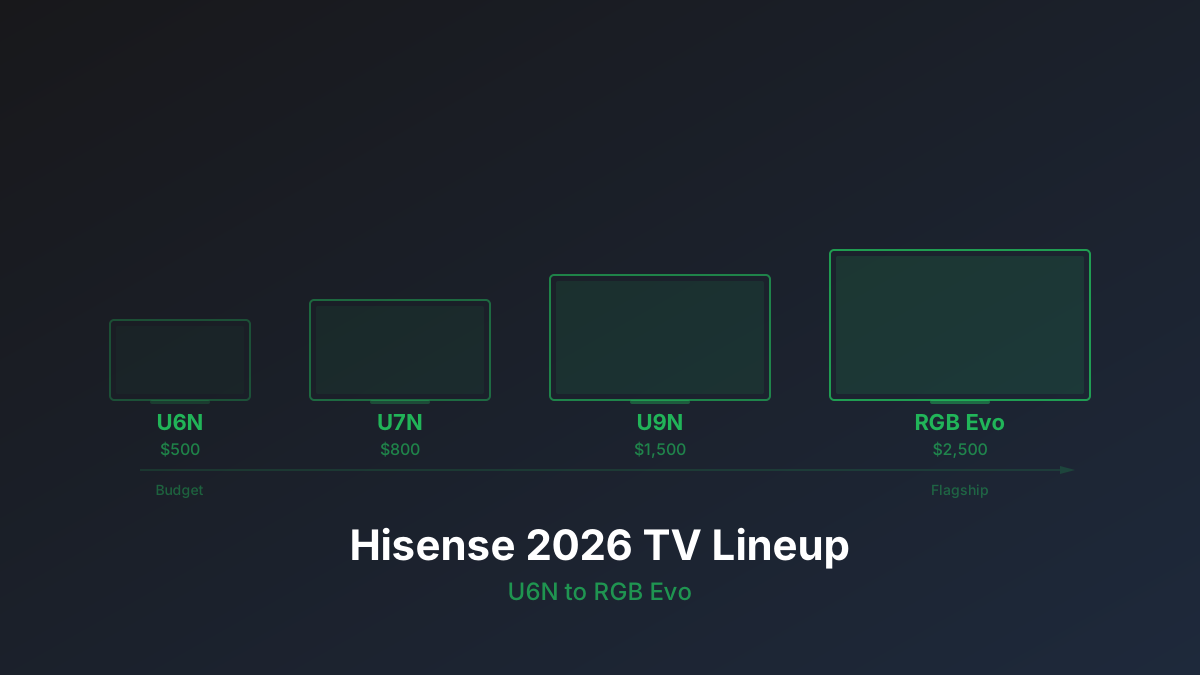
The Hisense U7N at $700 for a 65-inch is the TV we recommend most often for budget home theaters in 2026. It delivers 4K/144Hz, solid local dimming, and HDR performance that would have cost $1,500 two years ago. But Hisense's lineup now spans from the $400 U6N to a $15,000+ 116-inch RGB evo monster, and picking the right model for your room and budget matters more than chasing the biggest number on the spec sheet.
Here is every 2026 Hisense model, what actually changed from the 2025 lineup, and which ones are worth buying.
Quick Picks
- Hisense U7N 65" ($700): Best value TV for home theater. 4K/144Hz, VRR, good local dimming. The one most people should buy.
- Hisense U8N 65" ($1,000): Step up for bright rooms. 2,000+ nits peak, more dimming zones, quantum dot color. Competes with TVs at twice its price.
- Hisense U6N 65" ($400): Entry-level mini-LED for casual viewers. 60Hz native, limited dimming. Fine for a bedroom or guest room.
U6N: The Entry Point
The U6N is Hisense's cheapest mini-LED, and it exists to get you off an old LCD without breaking $500. At $400 for a 65-inch, it is the most TV per dollar you can buy in 2026. Full-array local dimming, 4K resolution, Dolby Vision and HDR10+ support. It checks all the boxes on paper.
The catch: it is a 60Hz native panel. Hisense markets it as "120Hz" through frame interpolation, but the actual refresh is 60Hz. For movies at 24fps this does not matter. For gaming, it means no 120Hz mode and no VRR support. If you game at all, skip to the U7N.
The local dimming zone count is also lower than the U7N and U8N, which means blooming around bright objects on dark backgrounds is more noticeable. In a bright living room you will not care. In a dark home theater room watching sci-fi with bright stars against black space, you will notice halos.
Buy the U6N if: you need a big TV for a bright room, you do not game, and you want to spend as little as possible. It is a perfectly fine television for watching sports, Netflix, and regular cable. It is not a home theater display.
U7N: The Sweet Spot
The U7N is where Hisense starts getting genuinely good. At $700 for a 65-inch (prices at launch, expect drops by fall), it delivers specs that Samsung and Sony charge $1,200-1,500 for. Native 4K/144Hz panel with VRR and ALLM for gaming. Improved mini-LED backlight with more dimming zones than the U6N. Noticeably better peak brightness, pushing past 1,500 nits in HDR highlights.
The 2026 U7N adds a few things over the 2025 model. The zone count is up roughly 30%, which reduces blooming. The gaming features now include a dedicated game bar overlay. The processor handles motion interpolation more cleanly, which matters for sports viewing. The Google TV interface is the same, which is fine because it was already the best smart TV platform for app availability.
For home theater use, the U7N handles Dolby Vision content well and has enough brightness to make HDR pop in a room with some ambient light. In a fully dark room, the black levels are good but not OLED-good. You will see some blooming on high-contrast content. That is the trade-off at this price: you get 90% of the HDR experience at 40% of the OLED cost.
Rob's take
The U7N is what I tell people to buy when they ask for a "good TV for movies and games" and their budget is under $1,000. It is not the best TV at any single thing, but it is competitive at everything that matters. The extra $300 over the U6N buys you native 144Hz, better dimming, and gaming features. That is the single best $300 upgrade in the entire TV market right now.
Buy the U7N if: you want the best value for a home theater or gaming setup under $1,000. Pair it with a budget receiver and bookshelf speakers and you have a genuinely good home theater for under $1,500 total.
U8N: The Premium Play
The U8N at $1,000 for a 65-inch is where Hisense starts competing directly with Samsung's QN85B and Sony's X90L tier. Peak brightness pushes past 2,000 nits in HDR highlights, which is enough to make specular highlights genuinely eye-catching. The quantum dot color layer produces wider color gamut coverage than the U7N, noticeable in saturated reds and greens.
The dimming zone count takes another significant jump. In practice, this means you can watch a bright explosion in a dark scene without seeing a halo of light around it. Blooming is not eliminated (only OLED does that) but it is controlled well enough that you stop thinking about it during normal viewing.
The U8N also gets Hisense's better motion processing, which handles 24fps film content with less judder than the U7N. If you are a movie purist who notices the way panning shots stutter on cheaper TVs, this matters. If you have never thought about it, you probably will not notice the difference.
Buy the U8N if: you have a bright room where the extra peak brightness matters, or you want the best movie-watching experience Hisense offers without jumping to the flagship tier. It is the Goldilocks model for people who want genuinely good picture quality without paying OLED prices.
U9N: Flagship Mini-LED
The U9N is Hisense's statement piece in the mini-LED category. Peak brightness exceeds 5,000 nits in small windows, dimming zones number in the thousands (Hisense has not published exact counts for all sizes), and the quantum dot layer is the same premium grade used across the U8N and above. At $1,500-2,000 for a 65-inch depending on promotions, it is expensive for a Hisense but cheap compared to equivalent Samsung or Sony flagships.
This is the model that competes with the TCL X11L for the mini-LED brightness crown. In practice, you will rarely see content that pushes either TV to its full 5,000+ nit capability, since most HDR content is mastered at 1,000-4,000 nits. But the headroom means the TV tone-maps HDR content with more precision, keeping highlights clean and detailed rather than clipped.
The downside at this price is that you are getting close to OLED territory. A 65-inch LG C4 OLED can be found for $1,300-1,500 on sale, and while it cannot match the U9N's peak brightness, it offers perfect blacks and zero blooming. If your room is dark, the OLED is likely a better choice. If your room has significant ambient light, the U9N's brightness advantage is real and worth the trade-off. Check our Mini-LED vs OLED comparison for the full breakdown.
116UXS RGB evo: The Showpiece
Hisense's 116-inch RGB evo is less a TV and more a statement. It uses an RGBC (red, green, blue, cyan) subpixel layout that achieves over 110% BT.2020 color gamut coverage, which is wider than any consumer OLED or standard mini-LED can produce. The extra cyan subpixel extends the TV's ability to reproduce colors that exist in nature but fall outside the range of traditional RGB displays.
At 116 inches, this is a projector replacement for dedicated home theater rooms. The Viewing Distance Calculator puts the ideal seating distance for a 116-inch 4K display at roughly 8-10 feet, so you need a room where that works. The price tag of $15,000+ puts it firmly in the "if you have to ask, you can't afford it" category.
The more interesting question is what RGB evo technology means for future Hisense models. If the RGBC subpixel layout works its way down to the U8N or U9N tiers in 2027-2028, that would be a genuine color quality leap for mainstream buyers. For now, the 116UXS is a halo product that proves Hisense can build flagship-grade displays. Read more about the technology in our RGB Mini-LED explainer.
What Changed from 2025
The 2026 Hisense lineup is an evolution, not a revolution. The core improvements across the range:
- Larger screen options: the U7N and U8N now come in 85-inch and 100-inch sizes at prices that undercut everyone else. A 100-inch U7N at $1,500-1,800 is remarkable value for a media room.
- Gaming upgrades: 144Hz support now starts at the U7N (previously U8K-tier), and Game Mode latency is improved across the board.
- Mini-LED zone counts: up 20-40% across most models, which directly improves contrast and reduces blooming.
- AI processing: Hisense's Hi-View Engine gets iterative updates for upscaling and motion. Marginal but real improvements over 2025.
- Google TV standardized: All US models now run Google TV (some 2025 models still used the older VIDAA platform). This is a welcome change for app availability.
Rob's take
Hisense's 2025-to-2026 jump is not as dramatic as the 2024-to-2025 jump was. If you bought a U8K or U7K last year, there is no reason to upgrade. If you are buying new, the 2026 models are clearly better. The biggest deal is Google TV on everything, because VIDAA was the one thing that consistently dragged Hisense reviews down.
The Trade-Offs vs. Premium Brands
Hisense gives you 80-90% of a Samsung or Sony's picture quality at 40-50% of the price. That is the honest pitch. The remaining 10-20% gap shows up in three areas.
Software and updates: Samsung and LG support their TVs with OS and app updates for 5+ years. Hisense's track record is shorter, typically 2-3 years of meaningful updates. Google TV mitigates this somewhat since Google controls app availability, but firmware updates for picture quality improvements are less frequent.
Motion processing: Sony's motion handling remains the industry benchmark. Hisense's motion interpolation has improved but still introduces more artifacts on complex motion (sports with crowd panning, fast camera movement in action films). If motion quality is your top priority, Sony is still worth the premium.
Build quality and finish: Hisense TVs feel like they cost what they cost. The bezels are slightly thicker, the stands are less elegant, and the remote feels cheaper than Samsung or Sony equivalents. None of this affects picture quality, but it affects the ownership experience.
For a dedicated home theater where the TV is wall-mounted in a dark room and you care primarily about picture quality per dollar, Hisense is the rational choice. For a living room centerpiece where aesthetics, long-term software support, and brand confidence matter, Samsung and Sony earn their premium. Build your setup around the U7N and put the savings into speakers. Your ears will thank you more than a slightly better panel ever could.
Rob Teller
Founder, CinemaConfig
15 years in consumer hardware and software, mostly on the product side. NZXT (cases and cooling), Asetek (liquid cooling, global sales), a short run advising on Alienware's roadmap at Dell, then four ... More about Rob · Affiliate disclosure


