Why Your Room Modes Matter More Than Your Speaker Brand, what we recommend
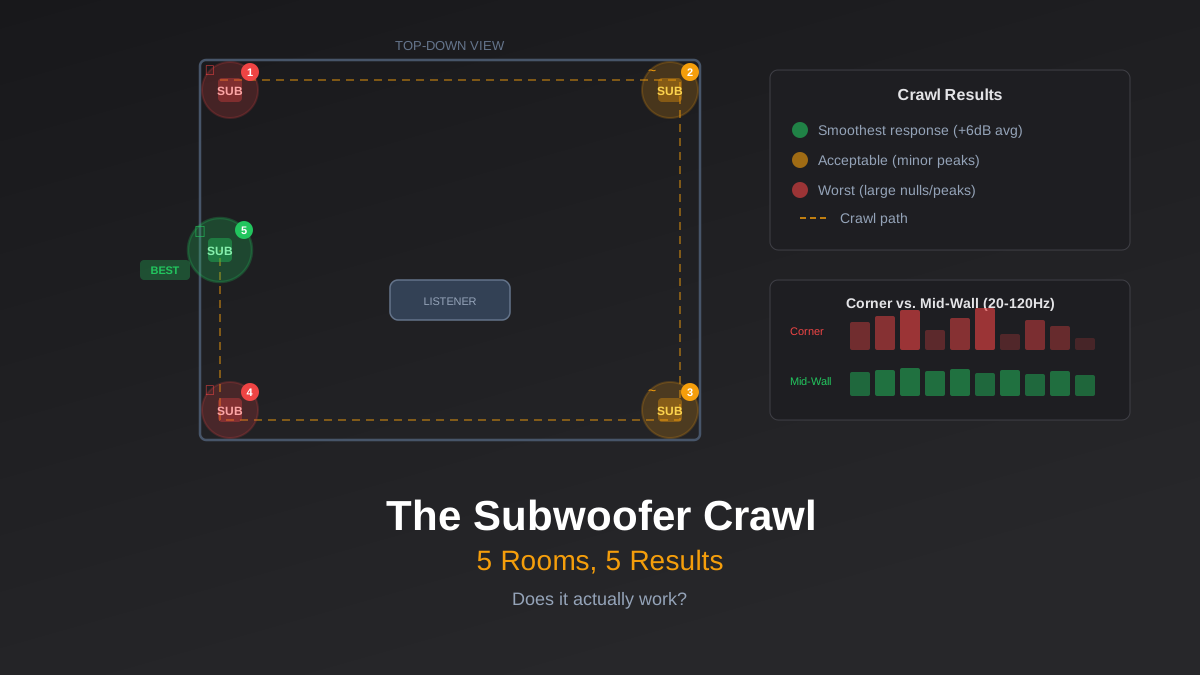
I have spent more money on speakers than I am comfortable admitting. KEF R3 Metas, Paradigm Prestige towers, Emotiva T2+ floorstanders, and half a dozen bookshelf speakers at various price points. I have A/B tested them in the same room, same content, same receiver. And here is the thing I wish someone had told me before all those purchases: the differences between speakers in the same quality tier were consistently smaller than the differences caused by moving my listening position three feet in the same room with the same speakers.
That is not an exaggeration. It is a measurement. And once you understand why, it changes how you allocate your home theater budget.
What Room Modes Actually Are
Sound is pressure waves. When a subwoofer or speaker produces a low-frequency note, that pressure wave travels outward, hits a wall, and bounces back. In a rectangular room, the wave bounces between parallel surfaces — front wall to back wall, left wall to right wall, floor to ceiling. At certain frequencies, the distance between those surfaces is an exact multiple of half the wavelength, and the outgoing and reflected waves reinforce each other, creating a standing wave.
These standing waves are room modes. Every rectangular room has them. They are determined entirely by the room's dimensions — length, width, and height — and they cannot be eliminated by buying different speakers, changing your receiver, or wishing very hard.
A room that is 20 feet long has its first axial mode at approximately 56 Hz. That means at 56 Hz, sound pressure is maximum at the front and back walls and minimum at the center of the room. A room that is 14 feet wide has its first axial mode at about 40 Hz. A room with an 8-foot ceiling has its first axial mode at approximately 70 Hz. These three fundamental modes, plus all their harmonics and the tangential modes created by wave paths bouncing between multiple surfaces, create a complex pattern of peaks and nulls throughout the room.
Run the Room Modes Calculator with a 14 x 20 x 8 room and you will see axial modes at 40 Hz, 47 Hz, 56 Hz, 70 Hz, 80 Hz, and many more. The calculator highlights frequency clusters where multiple modes stack up — those are the problem zones where bass peaks or cancellations are most severe.
The Measurement That Changed How I Buy Speakers
Two years ago I set up a measurement microphone at my primary listening position and ran frequency sweeps with three different pairs of speakers, all within the same price tier. The speakers measured differently in an anechoic chamber — their published frequency response curves showed meaningful differences in tonal balance, off-axis behavior, and low-frequency extension.
In my room, at my listening position, those differences were buried under the room's influence. The room imposed a 14 dB peak at 63 Hz and a 10 dB null at 45 Hz regardless of which speakers were playing. The speaker swap changed the response above 200 Hz in subtle but measurable ways. Below 200 Hz, the room was in charge. Every speaker showed the same peaks and the same nulls because the room modes do not care what brand of driver is producing the sound.
Above 200 Hz, speaker choice matters. Tweeter dispersion, crossover design, and cabinet resonances all contribute to the sound you hear. But below 200 Hz — the region where home theater fundamentally lives, where the weight of explosions, the rumble of scores, and the foundation of every soundtrack exists — the room dominates.
This does not mean all speakers sound the same. It means that in an untreated room, the differences between speakers are smaller in practice than the differences caused by room acoustics. And room acoustics are fixable for a fraction of what most people spend on speaker upgrades.
Rob's take
If you are debating between $1,500 speakers and $2,500 speakers in an untreated room, buy the $1,500 speakers and spend $500 on bass traps and first-reflection panels. You will hear a bigger improvement than the speaker upgrade would have given you. I know this sounds like heresy in audiophile circles, but the measurements do not lie.
SBIR: The Other Room Problem Nobody Talks About
Speaker Boundary Interference Response — SBIR — is a related but distinct acoustic problem. When a speaker is placed near a wall, the direct sound from the driver and the reflected sound from the wall behind it arrive at your ears at slightly different times. At certain frequencies, those two arrivals cancel each other out, creating a dip in the frequency response.
The frequency of the cancellation depends on the distance between the speaker and the wall. A speaker placed 3 feet from the front wall will have an SBIR cancellation at approximately 94 Hz. Move it to 2 feet from the wall and the cancellation shifts to 141 Hz. The SBIR Calculator computes the exact cancellation frequency for any speaker-to-wall distance.
SBIR is particularly treacherous because it creates a narrow, deep notch in the bass response that room correction software often struggles to fix. EQ can boost the signal at the affected frequency, but the cancellation is position-dependent — boosting to fix one seat can make another seat worse. The real solution is speaker placement: positioning the speaker so that the SBIR cancellation falls at a frequency where it does the least perceptual damage, or placing the speaker close enough to the wall that the cancellation shifts above the problematic bass range entirely.
In my room, I measured a 12 dB SBIR dip at 94 Hz with my front speakers 3 feet from the front wall. Moving them to 18 inches from the wall shifted the dip to 188 Hz, where it was far less perceptually significant. That single repositioning — free, took ten minutes — improved the midbass clarity more than the $400 speaker cables I almost bought.
Reverberation Time: Why Some Rooms Sound "Bad"
Reverberation time — measured as RT60, the time it takes for sound to decay by 60 dB — determines how "live" or "dead" your room sounds. A room with a long RT60 sounds echoey and muddy. A room with a very short RT60 sounds dead and lifeless. The sweet spot for a home theater is an RT60 between 0.3 and 0.5 seconds across the critical frequency range.
RT60 is primarily determined by the room's volume and the total absorption in the room. Hard surfaces (bare drywall, glass, tile floors) reflect sound and increase RT60. Soft surfaces (carpet, curtains, upholstered furniture, acoustic panels) absorb sound and decrease RT60. A room with hardwood floors, bare walls, and minimal furniture will have a significantly longer RT60 than the same room with carpet, heavy curtains, and a large sectional sofa.
The RT60 Calculator estimates your room's reverberation time based on its dimensions and surface materials. If your RT60 is significantly above 0.5 seconds, acoustic treatment will make a dramatic improvement to dialogue clarity, stereo imaging, and overall sound quality — regardless of how good your speakers are.
I measured my room at 0.72 seconds RT60 before treatment. After adding four 2-inch absorption panels at the first reflection points and two 4-inch bass traps in the front corners, RT60 dropped to 0.41 seconds. The improvement in dialogue intelligibility was immediate and dramatic. Movies I had been watching with subtitles because I could not understand quiet dialogue were suddenly clear without them. No speaker upgrade has ever given me that kind of improvement.
Treatment Solutions: What Actually Works
Bass Traps (Priority One)
Bass traps are thick, dense absorption panels placed in room corners where low-frequency energy accumulates. They are the single most impactful acoustic treatment you can add to a home theater. Minimum effective thickness is 4 inches of rigid fiberglass or mineral wool (Owens Corning 703 or Roxul/Rockwool Safe'n'Sound are the standard materials). Six inches is better.
Place them in the vertical corners of the front wall first (floor to ceiling if possible), then the rear corners. Four corner bass traps will smooth out the worst room mode peaks and tighten the bass response across all listening positions. Commercial options like GIK Acoustics 244 Bass Traps or ATS Acoustics corner traps work well. DIY bass traps with rigid fiberglass and fabric wrapping cost roughly half as much and perform identically.
First Reflection Panels (Priority Two)
First reflections are the sound waves that bounce off the side walls, floor, and ceiling on their way from the speakers to your ears. These early reflections arrive within milliseconds of the direct sound and interfere with it, smearing the stereo image and reducing clarity.
The First Reflections Calculator shows you exactly where to place panels on your side walls based on your speaker and listening positions. Use the mirror trick: have someone hold a mirror flat against the side wall and slide it along until you can see the speaker's tweeter from your listening position. That is your first reflection point. A 2-inch absorption panel at that spot eliminates the reflection.
Two panels on the side walls at the first reflection points typically improve stereo imaging and dialogue clarity more than any single equipment upgrade in the same price range. At $50-100 per panel (DIY) or $100-200 per panel (commercial), this is the highest-return investment in home theater audio.
Diffusion on the Rear Wall (Priority Three)
The rear wall of a home theater benefits from diffusion rather than absorption. You want some acoustic energy behind you for a sense of spaciousness and envelopment — completely dead rear walls make surround sound feel lifeless. But you do not want a strong, focused reflection that arrives as a distinct echo.
Diffusers scatter the reflected energy in many directions, preserving the room's liveliness while eliminating the focused reflection. Skyline-type diffusers (the ones that look like a cityscape of different-height blocks) are effective from about 600 Hz and up. For lower frequencies, you need larger, deeper diffuser designs or a combination of diffusion and absorption.
Bookshelves filled with irregularly sized books are surprisingly effective diffusers. If you have a bookshelf on your rear wall, you already have functional acoustic treatment. This is not a joke — the irregular surfaces scatter sound in exactly the way a purpose-built diffuser does.
Room Correction Software: The Digital Supplement
Modern AVRs include room correction systems — Audyssey, YPAO, Dirac Live — that measure your room's acoustic problems and apply EQ to compensate. These systems are genuinely useful, but they have limitations that physical treatment does not.
Room correction can reduce the severity of peaks (by cutting the affected frequencies). It cannot fill nulls without pushing the amplifier harder, which eats headroom and can cause clipping. It cannot fix reverberation time — a reverberant room will still sound reverberant, just with a flatter frequency response. And its corrections are optimized for one listening position (or a small zone around it), so other seats in the room may sound worse after correction.
Physical treatment works everywhere in the room, does not consume amplifier headroom, and addresses the root cause rather than the symptom. The ideal approach is physical treatment first, room correction second. Treat the room to get it as close to good as possible, then let room correction handle the remaining imperfections.
The Budget Allocation That Actually Works
Here is how I would allocate a $3,000 home theater audio budget, knowing what I know now:
- $1,200 — Speakers (front L/R, center, surrounds): Buy the best front three you can afford in this range. Emotiva, KEF Q series, JBL Stage, Polk Reserve — all excellent at this price point.
- $600 — Subwoofer: SVS PB-1000 Pro or RSL Speedwoofer 12S. The sub is doing the heavy lifting below 80 Hz where room modes dominate.
- $700 — AVR: Denon X3800H or equivalent with good room correction (Audyssey XT32 or Dirac Live).
- $500 — Acoustic treatment: Four corner bass traps and two first-reflection panels. DIY with rigid fiberglass keeps this under $300; commercial panels from GIK or ATS run $400-600 for a basic package.
That $500 in treatment will improve the sound of your system more than moving from $1,200 speakers to $2,000 speakers in an untreated room. I am not guessing. I have done it both ways, and I have the measurements to prove it.
Start with the Room Modes Calculator to see what your room is doing to your bass. Then use the RT60 Calculator to estimate your reverberation time. Those two numbers will tell you more about how your system will sound than any speaker spec sheet. Your room is the largest component in your audio chain. Treat it like one.
Rob Teller
Founder, CinemaConfig
15 years in consumer hardware and software, mostly on the product side. NZXT (cases and cooling), Asetek (liquid cooling, global sales), a short run advising on Alienware's roadmap at Dell, then four ... More about Rob · Affiliate disclosure
![Klipsch Reference vs Premiere: Differences and Picks [2026]](/images/blog/klipsch-speakers-guide.svg?dpl=dpl_A7yvEusbtVmAimLWJZTA31x7Ag82)

