The Before/After That Made Me a Believer (Dual Subwoofers)
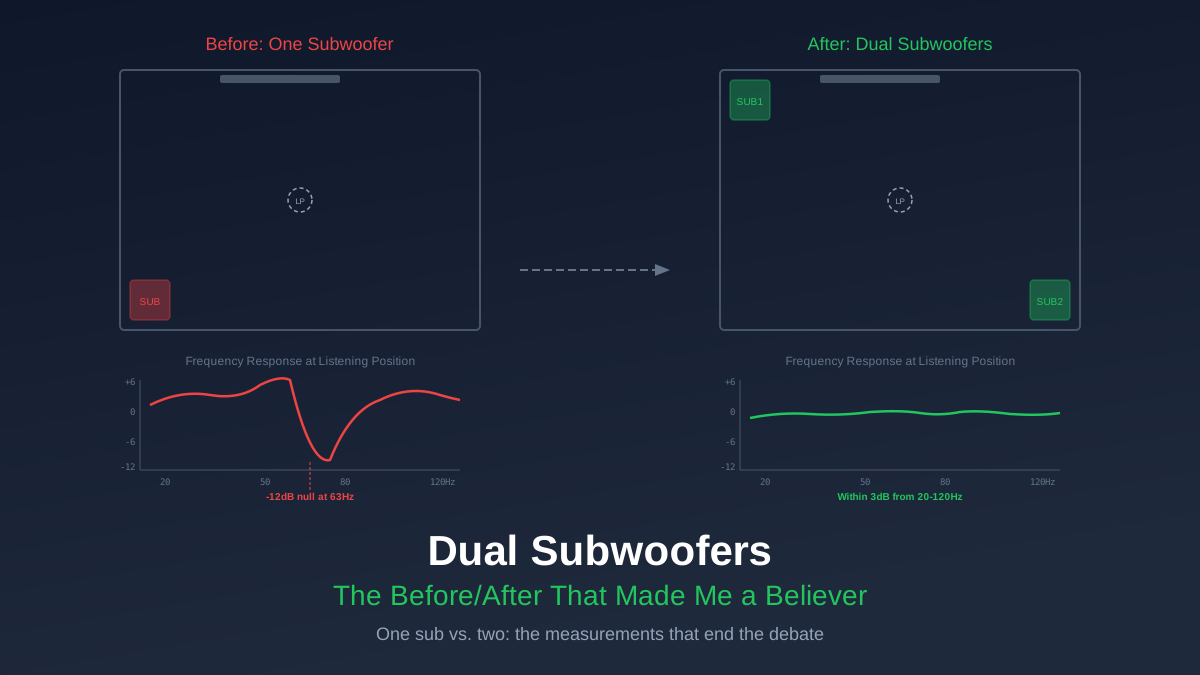
I was a dual sub skeptic. Then I saw the measurement graphs.
For two years I ran a single SVS PB-2000 Pro in my 2,000 cubic foot dedicated theater room and thought the bass was "pretty good." It hit hard on explosions, rumbled during deep synth passages, and generally did what a subwoofer should do. But when I finally took a measurement mic to my primary listening position, "pretty good" turned out to be a lie. A polite, expensive lie.
The Physics: Why One Subwoofer Is Fighting a Losing Battle
Every enclosed room has standing waves, also called room modes. These are predictable resonant frequencies determined by the room's length, width, and height. At certain frequencies, sound waves reflecting off opposing walls reinforce each other (creating peaks) or cancel each other out (creating nulls). The result is a frequency response that looks more like a mountain range than a flat line.
A single subwoofer excites room modes from one location. That means peaks and nulls are locked to specific spots in the room. Move the sub, and the pattern shifts, but it never goes away. You are always trading one problem for another. The fundamental issue is that one source point can only produce one modal pattern.
Two subwoofers placed strategically excite the room from two different positions. Each sub creates its own pattern of peaks and nulls, but because they are in different locations, the patterns are different. When you combine them, peaks from one sub partially fill nulls from the other. The result is not perfect, but it is dramatically smoother. This is not marketing fluff. It is basic acoustics, and the math has been validated in peer-reviewed research by Todd Welti and Allan Devantier at Harman International.
For a deeper dive into how room dimensions affect bass, check out our Home Theater Acoustic Treatment Guide.
Rob's take
Dual subwoofers are the single most impactful upgrade for achieving even bass response across multiple seats. One subwoofer has one position relative to room modes, which means it sounds different depending on where you sit. Two subs placed at mid-points on opposite walls cancel each other's worst room modes, flattening bass response across the entire listening area. The effect is not subtle.
My Before/After: The Numbers Tell the Story
Here is what I measured with a calibrated UMIK-1 and Room EQ Wizard (REW) at my primary listening position.
Single Sub (Front Left Corner)
- 63Hz: -12dB null. A full 12 decibels below target. Male dialogue fundamentals, cello, kick drums - all of it disappeared into a hole.
- 42Hz: +8dB peak. Boomy, one-note bass that masked detail and made everything below 50Hz sound like the same note.
- Overall variance (20-120Hz): 20dB window. Wildly uneven.
Dual Subs (Front Left Corner + Rear Right Corner)
- 63Hz null: Reduced from -12dB to -2dB. The null did not vanish entirely, but it went from a canyon to a shallow dip.
- 42Hz peak: Reduced from +8dB to +3dB. Still slightly elevated, but no longer a resonant boom.
- Overall variance (20-120Hz): Within 6dB window before EQ, within 3dB after running Audyssey XT32.
The difference was not subtle. Before, the subwoofer crawl had me chasing "least bad" placement. After, I had a foundation that room correction could actually work with. EQ can pull down peaks, but it cannot fill nulls without pushing enormous power into frequencies the room actively cancels. Two subs gave the EQ something to work with instead of fighting physics.
Placement Strategies That Actually Work
Not all dual sub placements are equal. Here are the three most effective configurations, ranked by how well they reduce seat-to-seat variation across multiple listening positions.
1. Opposite Walls (Midpoint)
Place one sub at the midpoint of the front wall and the other at the midpoint of the rear wall. This targets the strongest axial mode (front-to-back length mode) and is the single most effective two-sub configuration for most rectangular rooms. It reduces the dominant length mode by roughly 50% across all seats. This is the configuration that worked best in my room.
2. Front Diagonal (Opposite Corners)
One sub in the front-left corner, one in the rear-right corner (or front-right and rear-left). Corner loading gives you maximum output and excites all three axial modes. The diagonal placement ensures the two subs see different path lengths to every seat. This is a strong choice if you need maximum output and cannot place a sub mid-wall.
3. Both Subs on the Front Wall (Quarter Points)
Place both subs on the front wall at the 1/4 and 3/4 width positions. This specifically targets the width mode and keeps both subs near the screen, which can help with visual integration. It is less effective at taming front-to-back modes but works well in rooms where the width mode is the primary offender.
Whichever configuration you choose, spend 30 minutes with a measurement mic before you commit. Move one sub at a time, measure, compare. The "right" answer depends on your specific room dimensions and construction.
The Budget Argument: Two Smaller Subs Beat One Big Sub
This is where the dual sub argument gets really compelling. Consider two options at roughly the same price point:
- Option A: One SVS PB-2000 Pro - $900. 550 watts RMS, 12-inch driver, -3dB at 17Hz.
- Option B: Two SVS PB-1000 Pro - $550 each ($1,100 total). 325 watts RMS each, 12-inch drivers, -3dB at 19Hz.
Option B costs $200 more but gives you two independent source points in the room. You lose 2Hz of extension and some headroom per unit, but the combined output of two PB-1000 Pros actually exceeds a single PB-2000 Pro by about 3dB (doubling sources adds 6dB, minus some overlap). More importantly, you get dramatically smoother bass across more seats.
If your budget is truly fixed at $900, two Monolith M-10 V2 subs ($400 each, $800 total) or two RSL Speedwoofer 10S MKIIs ($450 each) will outperform a single sub at that price in terms of in-room response. The smoothness gain from dual placement is worth more than the last few Hz of extension in almost every practical scenario.
For help choosing the right subwoofer model for your room, see our subwoofer buying guide.
Tools for Getting It Right
You do not need expensive equipment to dial in dual subs. Here is the essential toolkit:
Room EQ Wizard (REW) - Free
REW is the gold standard for acoustic measurement. Use it to take frequency response measurements at your listening position before and after adding the second sub. The waterfall and spectrogram views show you exactly where nulls and peaks live. It runs on Windows, Mac, and Linux.
Measurement Microphone
A miniDSP UMIK-1 ($99) or UMIK-2 ($220) with its calibration file gives you accurate measurements from 20Hz up. This is a one-time purchase that pays for itself immediately by taking the guesswork out of placement and EQ.
miniDSP 2x4 HD or SHD ($200-$1,300)
If you want independent EQ, delay, and level control for each sub, a miniDSP unit between your AVR's sub output and the subwoofers gives you surgical precision. You can time-align subs to the millisecond, match levels to 0.1dB, and apply parametric EQ to each independently. This is the enthusiast path, but it unlocks performance that AVR room correction alone cannot match.
AVR Room Correction
If a standalone DSP is not in the budget, your AVR's built-in room correction (Audyssey, Dirac, YPAO, MCACC) can still do solid work. Run the calibration after placing both subs. Most modern AVRs with dual sub outputs can apply independent EQ to each sub output. Audyssey XT32 and Dirac Live are the strongest options here. Even basic Audyssey MultEQ can smooth out the remaining peaks once dual placement has done the heavy lifting.
Common Concerns (And Why They Do Not Hold Up)
"Two subs will be too loud." Volume is a knob. Two subs at -6dB each produce the same SPL as one sub at 0dB, but with much smoother response. You are not adding volume. You are adding consistency.
"My room is too small." Small rooms actually benefit more from dual subs because the modal problems are worse (modes are more widely spaced and nulls are deeper). A 1,200 cubic foot room with two compact subs like the SVS SB-1000 Pro will sound better than the same room with one larger sub.
"I do not have space." The second sub does not need to be a 70-pound ported tower. Sealed subs like the SVS SB-1000 Pro (13.5 x 13 x 13 inches) or RSL Speedwoofer 10S MKII tuck against a wall or behind furniture. If you can fit a small end table, you can fit a sealed sub.
"My AVR only has one sub output." A simple RCA Y-splitter ($5) sends the same signal to both subs. Level matching is done on the subs themselves. This is a solved problem.
The Bottom Line
Dual subwoofers are not about more bass. They are about better bass. The physics of room modes guarantee that a single sub will always have significant frequency response problems at some seats in your room. A second sub, placed correctly, attacks the root cause instead of masking it with EQ or brute-force power.
If you are spending $800 or more on a single subwoofer, stop and consider whether two $500 subs would serve you better. In most rooms, they will. The measurement mic does not lie, and mine turned me from a skeptic into a believer in a single afternoon.
Rob Teller
Founder, CinemaConfig
15 years in consumer hardware and software, mostly on the product side. NZXT (cases and cooling), Asetek (liquid cooling, global sales), a short run advising on Alienware's roadmap at Dell, then four ... More about Rob · Affiliate disclosure


