The Subwoofer Crawl: The Free Trick That Fixes Boomy Bass
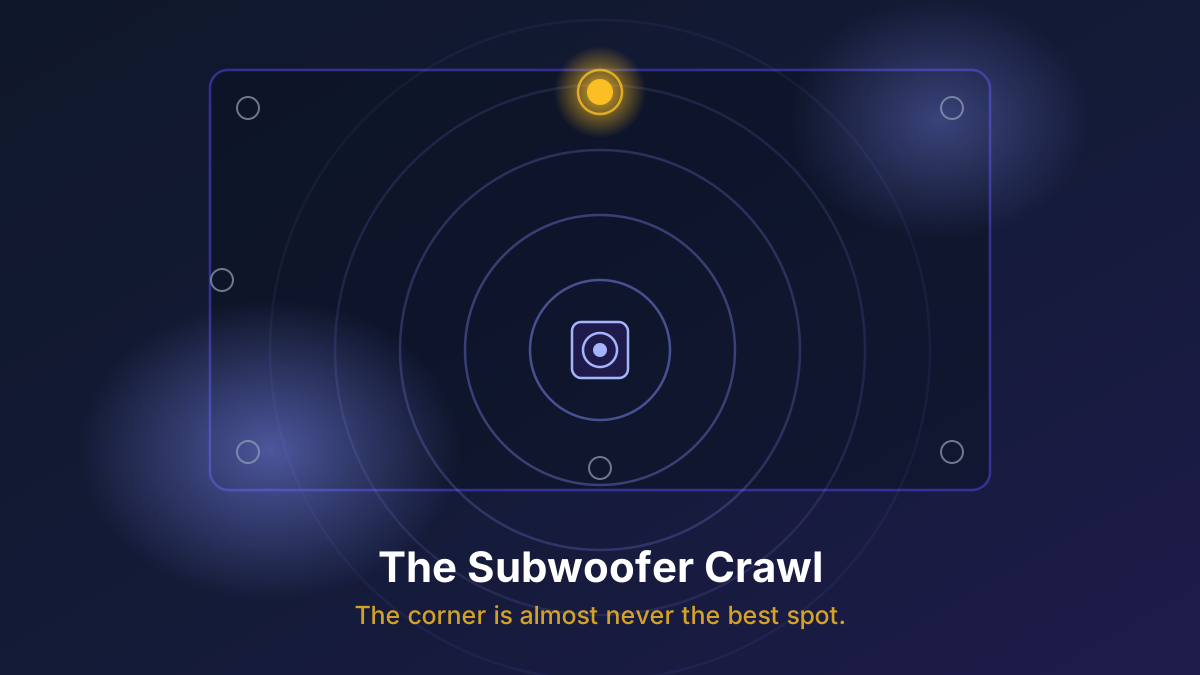
Your boomy bass probably isn't the subwoofer. It's where the sub is sitting. The subwoofer crawl is the easy, free fix: a 30-minute trick that finds the spot in your room where bass actually sounds even, instead of booming in the corner you happened to park it in. If you want a subwoofer crawl guide that skips the theory, the five steps come first and the why comes after.
How to do the subwoofer crawl: 5 easy steps
The subwoofer crawl is easy: put the sub where your head normally sits, play bass, then crawl until it sounds smoothest. Step by step:
Put the sub on your seat
Right where your head sits, as high as you can lift it.
Play steady bass
A sweep or pink noise from REW, not a song.
Crawl to each spot
Corners, wall mids, quarter points. Ear near the floor.
Pick even, not loud
The corner sounds loudest. That's the trap.
Move the sub there
Sit back down. The difference is obvious in seconds.
What you're listening for: a bad spot makes a bassline lurch, loud then normal then gone. A good spot sounds boring in the best way, every note the same weight. On movies, that's clean impact in your chest instead of a one-note drone on every explosion.
Why the spot beats the sub
Bass doesn't behave like the rest of your sound. A 40Hz wave is about 28 feet long, wider than most rooms. Those waves bounce off your walls and stack on themselves.
Where they reinforce, you get a peak: one note that booms. Where they cancel, a null: one note that vanishes. These are room modes, and they're why a SVS PB-2000 Pro can sound like mud in one spot and tight, room-filling bass three feet away.
The corner is everyone's default, because the sub fits and the cable reaches. It's also usually the worst spot. Three boundaries meet there, so it excites every mode at once: maximum output, maximum unevenness. That's the "too boomy" sub people blame, when the culprit is the room.
Which should change how you spend. The crawl matters as much for an entry SVS SB-1000 Pro as for a flagship SVS PB16-Ultra. More driver and more amp buy you output, not control over where the room piles it up. A well-placed SVS PB-1000 Pro will walk all over a SVS PB-3000 stuck in the wrong corner. Still shopping? Our best subwoofers roundup ranks the lineup. But fix placement first.
Why the crawl works
It comes down to acoustic reciprocity: the sound at point B from a source at point A is identical to the sound at A if you swap them. So instead of hauling a 50-pound sub to a dozen positions, you park it at your seat and move the cheapest mic you own to each candidate spot. Your head.
Audioholics has the clearest writeup if you want the physics. You crawl instead of walk because bass at floor level, where the driver sits, differs from bass at standing height. Survey it standing, and you optimize for a sub floating five feet in the air.
Rob's take
People drop $500 on a DSP processor to kill a bass peak the crawl would have avoided for free. And EQ can pull a peak down, but it can't fill a null: you cannot boost a frequency the room is actively cancelling. Do the crawl before you spend a dime on correction.
After the crawl: measure, then correct
The crawl finds the best physical spot. It doesn't make the room perfect, since some peaks are baked into its dimensions. Place first, then correct.
To see what you've got, a miniDSP UMIK-1 ($99) and free REW turn your ear's verdict into a graph. Then let your AVR's room correction (Audyssey, YPAO, Dirac) clean up what's left. It works far better on a well-placed sub than on a badly placed one.
One honest limit: your ears aren't a measurement mic. When two spots sound close, I trust the graph for magnitude and my ears for which leftover peak grates more. A peak at 45Hz, dead in the kick-drum range, bothers me far more than the same peak at 90Hz.
Does it actually work?
It holds up. I ran the crawl in five rooms with an SVS PB-2000 Pro and REW, and the corner won in only one, the room that already had bass traps. In the other four, the crawl found a spot averaging 6dB smoother. One room's best position was behind the couch.
If the best spot won't work for your seating, that's the case for a second sub. A pair of SVS SB-2000 Pros in decent spots smooths more of the room than one sub in the perfect one. The dual subwoofer question covers when it's worth it.
Even SVS's own placement guide walks buyers through the crawl. Rare for a company to admit placement matters as much as the product.
CinemaConfig's builder handles what the crawl can't: it checks your AVR has a sub preout, that your cable reaches the spot you picked, and that your crossover fits your speakers. The room mode calculator predicts the problem frequencies from your room dimensions before you start.
Half an hour on your knees, no new gear, and the bass you already paid for finally shows up.
Rob Teller
Founder, CinemaConfig
15 years in consumer hardware and software, mostly on the product side. NZXT (cases and cooling), Asetek (liquid cooling, global sales), a short run advising on Alienware's roadmap at Dell, then four ... More about Rob · Affiliate disclosure


