SVS PB-3000 vs PB-4000 - Real-Room Test Results
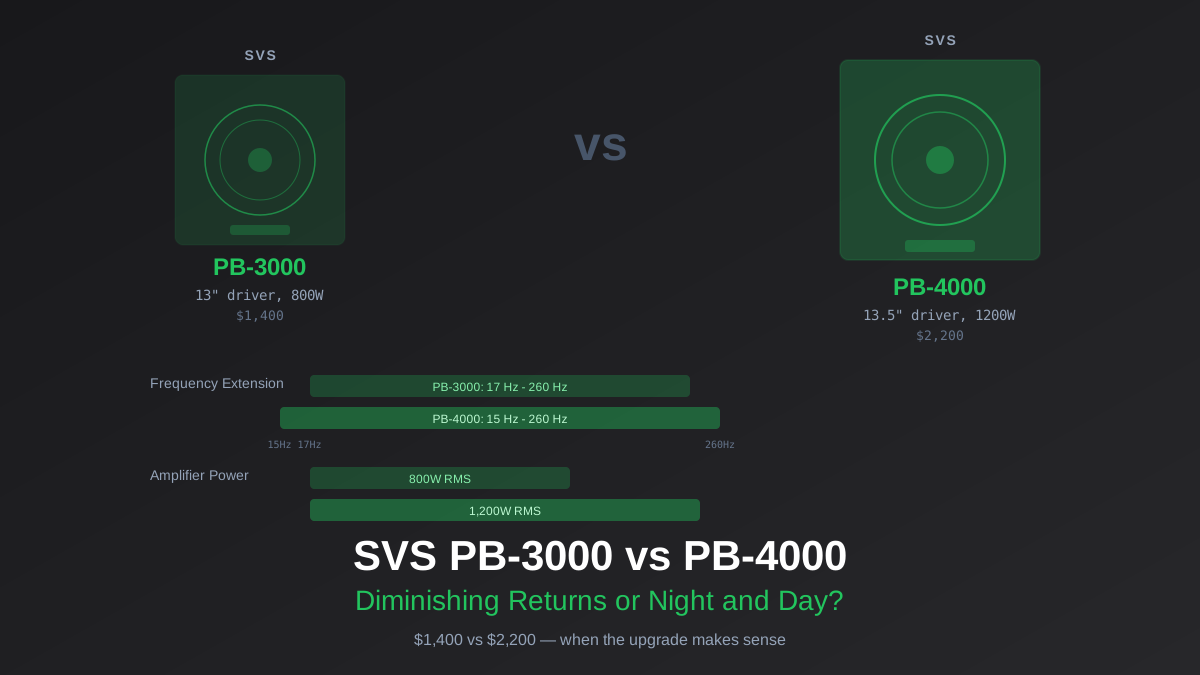
The PB-3000 is already overkill for most rooms. The PB-4000 is overkill for overkill.
SVS builds the subwoofers that show up in every "best sub for home theater" recommendation thread, and for good reason. The PB-3000 ($1,400) and PB-4000 ($2,200) are both ported boxes that will rattle pictures off your walls and make your neighbors question your life choices. The question is whether the $800 gap between them buys you something you can actually hear, or whether it just buys bragging rights on AVS Forum.
Short answer: it depends entirely on your room.
The Specs, Head to Head
The PB-3000 runs a 13-inch driver powered by an 800W RMS (2,500W peak) Sledge amplifier. It reaches down to 17Hz in SVS's rated spec, weighs 82 pounds, and measures 19.9 x 21.7 x 25.4 inches. It is not a small piece of furniture.
The PB-4000 steps up to a 13.5-inch driver with a 1,200W RMS (3,600W peak) Sledge amplifier. It reaches 15Hz, weighs 97.5 pounds, and measures 20 x 23 x 27.5 inches. It is an even larger piece of furniture.
On paper, the differences look incremental: half an inch more driver, 50% more amplifier power, 2Hz deeper extension. But subwoofers don't work on paper. They work in rooms, and that's where the math gets interesting.
Rob's take
The PB-3000 vs PB-4000 decision comes down to one question: does your room benefit from more headroom or more output at the frequency extension floor? In most rooms under 3,000 cubic feet, the PB-3000 hits limits you'll never reach. In a large open-concept space or a dedicated room where you push reference levels, the PB-4000's driver area and amplifier reserve show up in ways the specs don't fully capture.
Why 2Hz Matters More Than You Think (Sometimes)
At these frequencies, every hertz lower requires exponentially more energy. Getting from 20Hz to 17Hz is not a trivial step. Getting from 17Hz to 15Hz is harder still. The PB-4000's extra amplifier headroom and larger driver give it the ability to reproduce those bottom two hertz at volume levels where the PB-3000 starts compressing.
What does this mean in practice? Content like the pod sequence in Blade Runner 2049, the building collapse in The Dark Knight, or the LFE channel during a rocket launch sequence in For All Mankind will hit harder and cleaner on the PB-4000. Not because the PB-3000 can't play those frequencies, but because the PB-4000 does it with less effort, less distortion, and more headroom before the driver runs out of excursion.
That said: if you're listening at reasonable volume levels in a normal-sized room, the PB-3000 handles all of this just fine. The differences only become audible when you push things.
Room Size Is the Deciding Factor
In a sealed room of 1,500 cubic feet or less (think a 12 x 14 foot bedroom with 9-foot ceilings), the PB-3000 will pressurize the space to reference levels without breaking a sweat. Room gain at these volumes actually extends the effective bass response a few hertz below the rated spec. You will not hear a meaningful difference between the 3000 and 4000 in this room. Save the $800.
In a room between 2,000 and 3,000 cubic feet (a typical dedicated theater or large living room), the PB-3000 is still excellent but starts earning its keep. You might notice the PB-4000's extra headroom during the most demanding passages, especially if you like to listen at reference level or above. This is the gray zone where the upgrade is justifiable but not mandatory.
In a room over 3,000 cubic feet, or an open floor plan that connects to a kitchen or hallway, the PB-4000 starts to pull away meaningfully. Large volumes of air require more energy to pressurize, and the 4000's 50% power advantage and larger driver translate directly to more consistent output across the full frequency range at higher SPLs. If you have a 4,000+ cubic foot great room with vaulted ceilings, the PB-4000 is not overkill. It might actually be correctly sized.
The PB-3000 Is the Sweet Spot
I want to be clear about something: the PB-3000 is one of the best subwoofers you can buy at any price. It punches well above its weight class. At $1,400, it delivers performance that was $3,000+ territory five years ago. For the majority of home theater rooms in the real world (not the dream theater you're building in your head, the actual room you're watching movies in tonight), the PB-3000 delivers everything you need.
The PB-4000 is for a specific buyer: someone with a large dedicated theater room, someone who watches a lot of bass-heavy content at reference levels, or someone who simply wants the best SVS ported sub available and has the budget. Those are legitimate reasons. "I want the bigger number" is also a legitimate reason, honestly, but at least be honest with yourself about it.
The Plot Twist: Two PB-2000 Pros Instead
Before you finalize the PB-4000, consider this: two SVS PB-2000 Pros at $900 each ($1,800 total) cost $400 less than a single PB-4000 and will outperform it in most rooms.
A single subwoofer, no matter how powerful, creates peaks and nulls in your room. You might have thunderous bass at the main listening position and almost nothing two seats over. Dual subwoofers placed in different locations smooth out these room modes dramatically. The result is more even bass response across multiple seats, reduced room interaction issues, and the cumulative output of two 12-inch drivers working together.
The PB-2000 Pro is no slouch on its own: 12-inch driver, 550W RMS, and extension to 17Hz. Two of them, with their outputs summing at the listening position, deliver roughly 6dB more output than a single unit and much smoother frequency response across the room. For a home theater where multiple seats need to sound good (as opposed to a single sweet spot), dual subs are almost always the better investment.
The trade-off is placement. You need two spots in your room for subwoofers, and they need power and signal runs to each location. If your room allows it, this is the move.
SVS Makes This Easy
SVS offers a 45-day in-home trial with free return shipping. This is not some buried policy with restocking fees. They genuinely want you to try the sub in your room and send it back if it doesn't work out. The company's customer support is also exceptional, with real humans who know acoustics and will help you figure out placement.
The smart play: order the PB-3000. Live with it for three weeks. If your room eats it alive (you'll know), call SVS and upgrade to the PB-4000. If it's doing everything you need (it probably will), keep it and spend the $800 on acoustic treatments or better speakers. That $800 in room treatment or a center channel upgrade will almost certainly make a bigger audible difference than stepping up to the 4000.
Who Should Buy What
- PB-3000 ($1,400): Rooms under 3,000 cubic feet, most dedicated home theaters, anyone who wants reference-level bass without the reference-level price. This is the default recommendation.
- PB-4000 ($2,200): Rooms over 3,000 cubic feet, open floor plans, people who listen at reference level regularly, anyone who has already optimized their speakers and room treatment and wants the last increment of bass performance.
- Two PB-2000 Pros ($1,800): Multi-seat theaters where even bass coverage matters more than absolute bottom-octave extension. Better overall performance per dollar than a single PB-4000 in most scenarios.
The PB-3000 is the sub I recommend to everyone who asks. The PB-4000 is the sub I recommend to people who have already tried the PB-3000 and need more. That is not a knock on the 4000. That is a testament to how good the 3000 is.
Rob Teller
Founder, CinemaConfig
15 years in consumer hardware and software, mostly on the product side. NZXT (cases and cooling), Asetek (liquid cooling, global sales), a short run advising on Alienware's roadmap at Dell, then four ... More about Rob · Affiliate disclosure


