LG C6 vs Samsung S90H - Best Mid-Range OLED
Quick Verdict
- Best value: Samsung S90H 65" ($1,600) -- WOLED with Glare Free coating, higher brightness, $1,100 less than the C6
- Best for bright rooms: Samsung S90H -- Glare Free anti-reflective coating plus higher brightness makes it the better daytime TV
- Best for LG ecosystem: LG C6 65" ($2,700) -- webOS, wider viewing angles, and the LG smart home integration some buyers prefer
The LG C6 at $2,700 for a 65-inch and the Samsung S90H at $1,600 for the same size are two of the most popular OLEDs in 2026. Flagships get the headlines. These get the credit card swipes.
Both are 144Hz panels with full gaming feature sets. Both will look stunning out of the box. At a $1,100 price gap, the real question is what the LG buys you over Samsung's aggressively priced WOLED.
Rob's Take
This is the price tier where the real action is. The G6 and S95H get all the attention because they are flashy flagships, but the C6 and S90H are what people with actual budgets buy. The big surprise this year: T3's review confirmed that Samsung quietly dropped QD-OLED from the S90H entirely, switching to standard WOLED panels across the board. That changes the comparison. The S90H's edge is no longer color saturation from quantum dots. It's the $1,100 price advantage, Samsung's Glare Free coating, and higher brightness from their processing. At $1,600 for a 65-inch OLED with Glare Free and 165Hz gaming, the value argument is hard to beat even without QD-OLED.
The Panel Story: Why the C6 Is a Bigger Deal Than It Looks
LG's C-series has used the same basic WOLED panel architecture since 2020. White OLED with a color filter. The C6 is measurably brighter than the C5 in both HDR and SDR, though the gains are evolutionary: roughly 1,350 nits on a 10% HDR window versus the C5's 1,165 nits measured by RTINGS. Better, not transformative.
The C6H (77" and 83" only) is the one that breaks the mold. TFTCentral confirmed with LG that the C6H uses the same Primary RGB Tandem 2.0 panel as the G6 flagship, just binned to a lower brightness tier (Brightness Booster Pro versus the G6's Brightness Booster Ultra). LG estimates the C6H delivers 3.2x the luminance of the B6 versus the G6's 3.9x, putting the C6H around 3,700 nits panel-spec peak. If you are shopping for 77 inches or larger, the C6H changes the competitive equation entirely, but it starts at $3,700 and is a different comparison.
Samsung's S90H is the surprise of the year, and not for the reason anyone expected. Samsung quietly moved the entire S90H line from QD-OLED to standard WOLED panels sourced from LG Display. No quantum dot layer. No blue OLED emitter with color conversion. Just WOLED, the same base technology as the C6, with Samsung's own processing and their Glare Free anti-reflective coating on top. T3 still gave it 5/5 stars, calling the picture quality "excellent" in Filmmaker Mode. The panel swap means the S90H and C6 are now much more similar underneath than their predecessors were.
Brightness: LG Closes the Gap, Then Some
The C5 peaked around 1,165 nits on a 10% HDR window. The C6 65" lands at roughly 1,350 nits on the same test — a ~16% improvement from LG's Brightness Booster processing, not the dramatic leap some early reports suggested. The S90H should land near 2,100 nits, consistent with what the S90D delivered last year plus incremental gains Samsung typically extracts per generation.
In a dark theater room, both numbers are more than enough. Your eyes adapt. The perceptual difference between 1,350 and 2,100 nits in a pitch-black room is smaller than the spec sheet implies.
In a living room with windows? The S90H's ~750-nit brightness advantage becomes visible. HDR highlights punch through ambient light noticeably better on the Samsung. If your TV sits across from a window, the S90H's brightness edge is real and relevant.
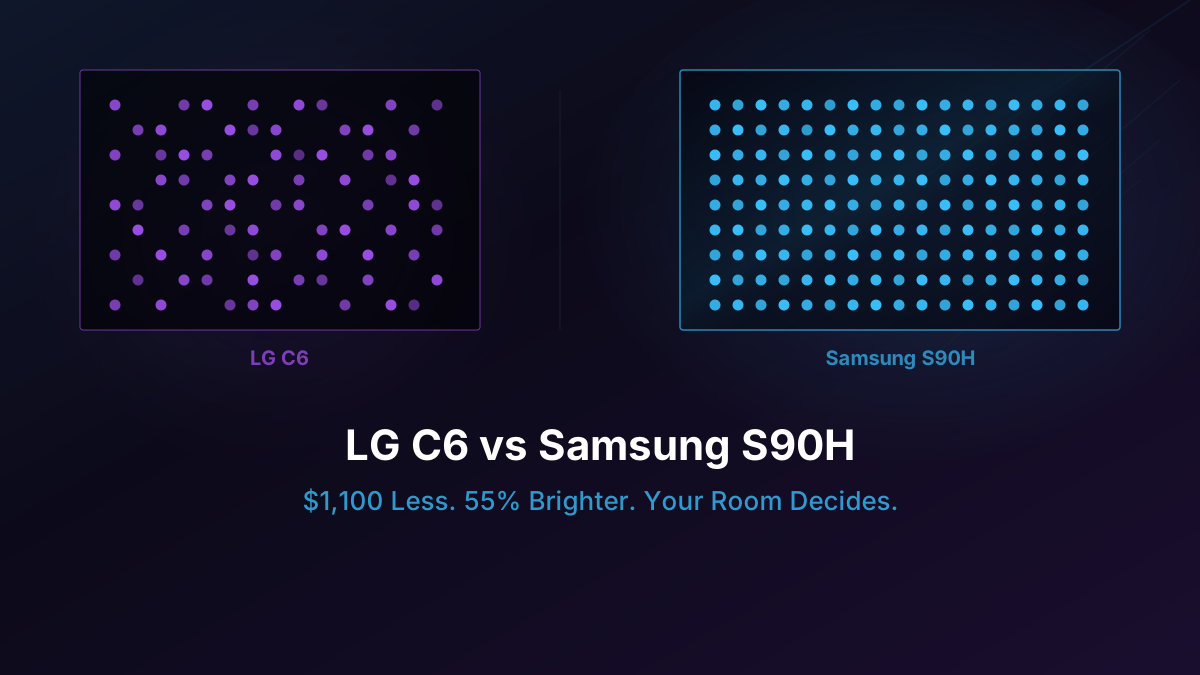
Brightness: Samsung S90H wins. ~2,100 nits vs ~1,350 nits on the 65-inch C6. The S90H is roughly 55% brighter in peak HDR.
Color saturation: Near-identical. Both use WOLED panels now. Any color difference comes from processing, not panel chemistry.
Anti-glare: Samsung S90H wins. TechRadar called the Glare Free coating "a game changer for that price range."
Price: Samsung S90H wins. $1,600 vs $2,700 for the 65-inch. That $1,100 gap is enormous.
Viewing angles: Effectively a draw. Both are WOLED now, so off-axis performance should be comparable.
Color: The Gap That Disappeared
Last year, the S90D's QD-OLED panel produced measurably wider color volume than the C5's WOLED. That advantage is gone. With both the C6 and S90H running WOLED panels, color gamut coverage is effectively the same at the hardware level. Both cover DCI-P3 at near-full coverage, which is what streaming services and Blu-rays actually use.
The remaining color differences come down to processing. Samsung's color mapping tends to push slightly more saturated reds and greens out of the box, which looks "punchier" in a showroom. LG's default calibration skews slightly more accurate. Neither is wrong, and both are adjustable. If you were choosing the S90D over the C5 specifically for QD-OLED's color advantage, that reason no longer applies to the S90H.
A Tangent About Size Pricing
Something that gets lost in the panel technology debate: size-for-dollar is often a bigger factor than panel type. The S90H 55" at roughly $1,200 is a genuinely compelling option if 55 inches fits your viewing distance. The C6 55" comes in at $2,000 with a non-Tandem WOLED panel; LG only puts Tandem WOLED on the C-series at 77" and up (the C6H sizes), and the pricing curve is steep at the small end regardless. Meanwhile, Samsung offers the S90H in 55", 65", and 77", and the 77" is expected around $2,600, which undercuts the C6H 77" by a meaningful margin.
I haven't seen finalized pricing on every size variant, and early-year MSRPs often drop 10-15% by the time Black Friday rolls around. The price gap between these two could widen or narrow depending on how aggressive Samsung gets with promotions.
Gaming: A Draw, Mostly
Both panels run 4K at 144Hz. Samsung's own announcement emphasized the S90H's "Ultimate Gaming Pack" with 165Hz, G-Sync Compatible, and FreeSync Premium Pro, all of which match the C6's gaming spec sheet feature-for-feature. Both have four HDMI 2.1 ports. Input lag should be in the 9-10ms range for both, based on prior generation measurements. For the PS5 Pro, Xbox Series X, or a gaming PC, either TV will perform identically in any scenario that matters.
LG's webOS 26 has a dedicated Game Optimizer menu. Samsung's Tizen has Game Mode with similar features. Neither platform's game-specific software is a reason to choose one over the other. Pick based on which smart TV ecosystem you prefer (or plan to ignore entirely with an external streamer, which, honestly, is the right call).
Who Should Buy Which
What Hi-Fi awarded the C6 a full five stars, calling it "a revelation" and "the new benchmark for step-down OLED TVs." The C6 is the better TV for a living room with ambient light, where peak brightness matters and you want the most future-proof panel technology at this price point. Tandem WOLED is now LG's flagship architecture, available in the G6, W6, and the 77" and 83" C6H sizes. The 65" C6 specifically uses a non-Tandem WOLED panel, so it is not future-proofed against the Tandem transition the way a C6H would be.
The Samsung S90H is the better TV for anyone who doesn't want to spend $2,700 on a 65-inch OLED. At $1,600 with Glare Free and 165Hz gaming, it's a staggering amount of TV for the money. The switch from QD-OLED to WOLED means you lose the color saturation edge the S90D had, but you gain a $1,100 savings and an anti-glare coating that Samsung's flagship didn't have at this price last year.
If you are agonizing between these two at a store, the $1,100 price gap is the honest answer for most people. The C6 is the better panel. The S90H is the better deal. Both are excellent OLEDs at prices that would have been impossible two years ago.
Building a system around a new TV? The CinemaConfig builder matches your display to compatible AVRs, speakers, and sources based on your room size and what you actually watch.
Prices cited are MSRP as of April 2026. Street prices typically drop 10-15% by mid-summer. Samsung historically discounts more aggressively than LG during Prime Day and Black Friday.
With both LG and Samsung pushing their mid-range OLED panels this hard, the real loser in 2026 might be Mini LED. When you can get a genuine OLED for $1,600, the value proposition for a $1,200 Mini LED gets a lot harder to defend.
Rob Teller
Founder, CinemaConfig
15 years in consumer hardware and software, mostly on the product side. NZXT (cases and cooling), Asetek (liquid cooling, global sales), a short run advising on Alienware's roadmap at Dell, then four ... More about Rob · Affiliate disclosure


