Streaming Audio in 2026: AC-4, Atmos, TrueHD, and What Your Setup Actually Receives
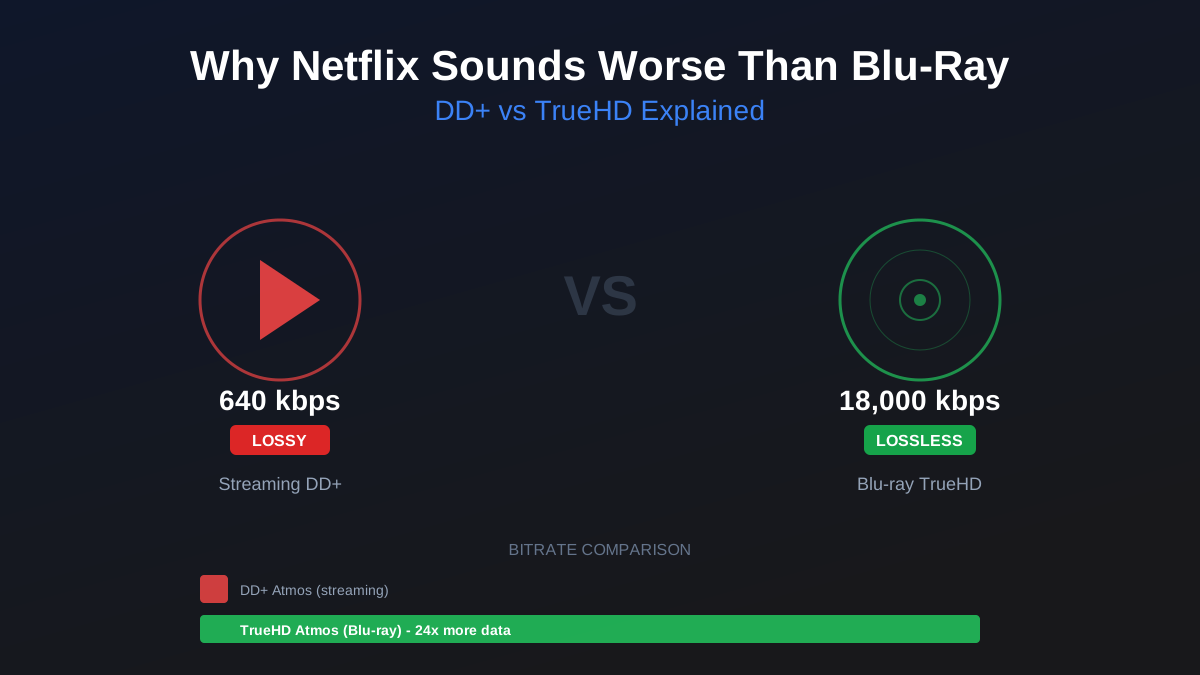
Your Netflix "Dolby Atmos" stream is running at 768 kbps. The same movie on 4K Blu-ray plays TrueHD Atmos at 4,000-8,000 kbps. That is a 5x to 10x difference in audio data, and on a good Atmos system with ceiling speakers, you can hear it. The spatial precision in overhead channels is the first thing that degrades at lower bitrates, followed by bass definition and quiet-scene detail.
The big 2026 story is AC-4, Dolby's next-generation audio codec, which Peacock adopted for live sports and select films alongside Dolby Vision 2. AC-4 delivers roughly 30% better quality per bit than DD+, which means streaming audio is finally getting meaningfully better without requiring more bandwidth. Here is what every service sends, what your equipment actually decodes, and whether any of it matters for your setup.
The Audio Format Hierarchy
Not all "Dolby Atmos" is equal. The Atmos label describes the spatial audio format (object-based positioning of sounds in 3D space), but the underlying codec determines how much of that spatial data actually reaches your speakers.
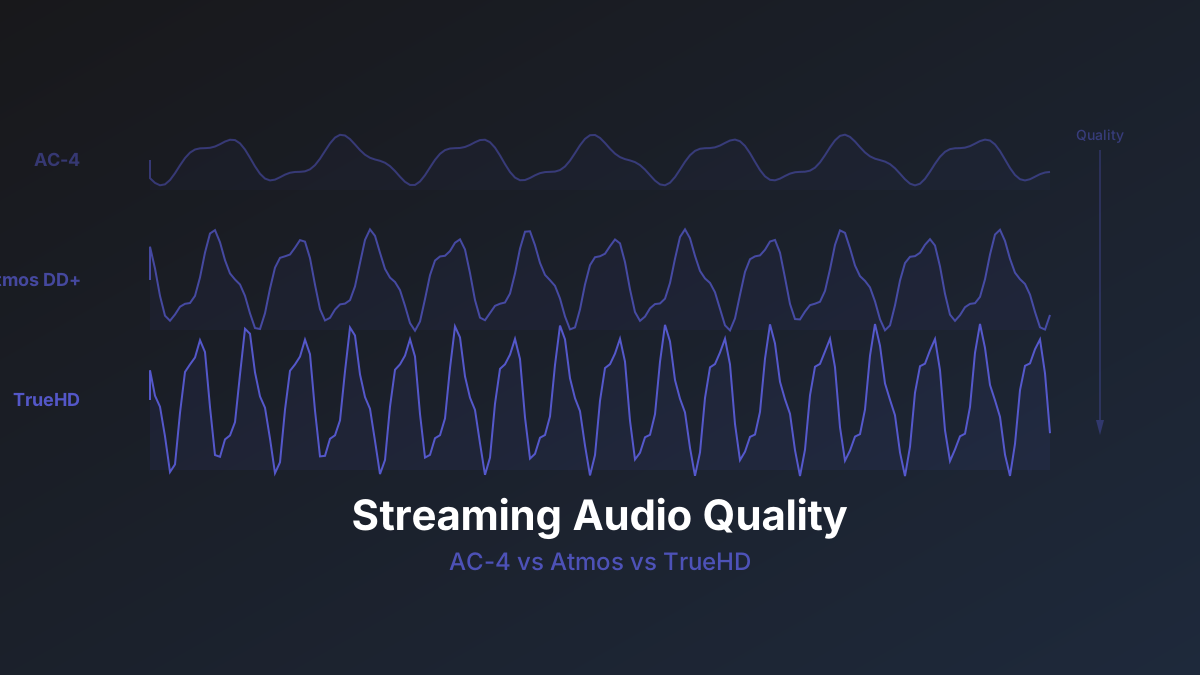
- DTS:X Master Audio / Dolby TrueHD Atmos (lossless): Full bitrate, bit-for-bit identical to the studio master. Available only on 4K Blu-ray and some HD Blu-rays. Bitrates of 4,000-8,000+ kbps for TrueHD, comparable for DTS:X MA. This is the reference standard.
- AC-4 with Atmos (new): Dolby's next-gen lossy codec. More efficient compression than DD+, delivering audibly better spatial audio at 384-640 kbps. Currently exclusive to Peacock. The most significant streaming audio improvement in years.
- Dolby Digital Plus (DD+) with Atmos: The current streaming standard. Lossy compression at up to 768 kbps (Netflix max) but more typically 384-640 kbps on other services. Perfectly listenable but compromised compared to lossless.
- DD+ 5.1 / 7.1 without Atmos: Channel-based surround without height information. Still 640-768 kbps but no overhead speaker data. What you get if your device does not support Atmos passthrough.
- AAC Stereo: The fallback. If your streaming device, HDMI connection, or AVR cannot handle any of the above, you get two-channel stereo. This happens more often than people realize.
AC-4: Why It Matters
AC-4 (also called AC-4 IMS or Dolby AC-4) is a ground-up codec redesign, not an incremental update to DD+. The compression algorithm is fundamentally more efficient at preserving spatial audio metadata, which means the overhead channel positioning data that makes Atmos sound three-dimensional survives the compression process better.
In practical terms: AC-4 at 640 kbps delivers spatial precision that approaches DD+ at 768 kbps, and AC-4 at 384 kbps is competitive with DD+ at 640 kbps. The improvement is most noticeable in overhead effects (rain falling, planes passing above) and in the sense of envelopment during ambient scenes. Bass reproduction also improves because the codec allocates bits more intelligently across the frequency spectrum.
The catch is compatibility. AC-4 requires decoder support that most pre-2024 AVRs do not have. If your receiver cannot decode AC-4 natively, the streaming device (or TV app) falls back to sending DD+ over eARC, which defeats the entire purpose. We will cover compatibility in detail below.
Service-by-Service Breakdown (April 2026)
Netflix
DD+ Atmos at up to 768 kbps on Premium plans. Netflix has the highest DD+ bitrate of any streaming service, and their audio encoding team is excellent. No AC-4 support yet, though Netflix has been testing it internally and an industry source says a rollout is expected late 2026. Netflix also adaptively adjusts audio bitrate based on your connection speed, so a slow connection may drop you to DD+ 5.1 or even AAC stereo without any notification.
Apple TV+
DD+ Atmos at up to 768 kbps. Apple consistently delivers the highest audio quality among DD+ services, with more content at the maximum bitrate than Netflix. Apple's original films (Killers of the Flower Moon, Napoleon) have some of the best Atmos mixes on any streaming platform. All Apple TV+ content is included at no extra tier cost.
Disney+
DD+ Atmos at up to 768 kbps on Premium plans. Quality is good but inconsistent across the catalog. Marvel and Star Wars titles tend to have excellent Atmos mixes. Older catalog content varies widely. The IMAX Enhanced titles stream with DTS:X audio at higher bitrates on supported devices.
Peacock
AC-4 Atmos on select content, paired with Dolby Vision 2 on supported devices. This is the first and currently only US streaming service with AC-4. The initial rollout focused on live sports (NBC Sunday Night Football was the flagship) and has expanded to select Peacock original films. The audio quality improvement over DD+ is audible on a proper Atmos system, particularly in sports where the crowd ambience and overhead flyover effects gain noticeable clarity.
Amazon Prime Video
DD+ Atmos at up to 640 kbps. Slightly lower max bitrate than Netflix or Apple. The Atmos catalog is growing but still smaller than the competition. Amazon's UHD content with Atmos requires a separate purchase or Prime subscription depending on the title.
4K Blu-ray
TrueHD Atmos or DTS:X Master Audio. Lossless. 4,000-8,000+ kbps. This remains the gold standard by a significant margin, and if you care enough about audio to have a full Atmos speaker system, owning a 4K Blu-ray player for reference content is worth the investment.
Rob's take
I keep a 4K Blu-ray player in my theater for one reason: reference audio. Streaming Atmos is fine for casual watching, but when I sit down for a proper movie night with something like Dune Part Two or Oppenheimer, the difference between DD+ at 768 kbps and TrueHD at 6,000+ kbps is not subtle. The overhead channels gain definition, the bass tightens up, and quiet scenes have a texture that lossy compression smooths away. If you have spent $2,000+ on speakers, spending $200 on a disc player to hear them properly is the most efficient upgrade you can make.
AVR and Device Compatibility
This is where streaming audio gets frustrating. The format your streaming service sends and the format your speakers actually receive can be two different things, depending on the chain of devices between them.
AC-4 decoding: requires AVR firmware from 2024 or later. Denon and Marantz receivers from the X-series 2024 lineup onward support AC-4 via firmware update. Yamaha and Onkyo support varies by model. If your AVR cannot decode AC-4, the streaming app (or TV) will transcode it to DD+ before sending it over eARC or HDMI ARC, and you lose the quality advantage. Check your receiver manufacturer's website for AC-4 firmware availability.
eARC vs. ARC: HDMI eARC (Enhanced Audio Return Channel) supports full-bitrate DD+ Atmos and AC-4 passthrough. Regular HDMI ARC (found on older TVs and receivers) is limited to standard Dolby Digital 5.1 at 640 kbps. If your setup uses ARC instead of eARC, you are not getting Atmos from any streaming service regardless of your subscription tier. Check that both your TV and AVR have eARC on the connected HDMI port.
Streaming device matters: the Apple TV 4K supports DD+ Atmos passthrough to any eARC receiver. The Nvidia Shield Pro does the same. Built-in TV apps vary: LG and Samsung smart TV apps generally handle Atmos well, but some Hisense and TCL models have had issues with Atmos passthrough on certain apps. If you are running audio through a TV's eARC to an AVR, test with a known Atmos title and verify your receiver displays "Dolby Atmos" on its front panel.
Can You Actually Hear the Difference?
Honest answer: it depends entirely on your system.
Soundbar: you will not hear the difference between DD+ Atmos and AC-4 Atmos, and you probably will not hear the difference between DD+ Atmos and TrueHD Atmos. Soundbar "Atmos" is a processing simulation anyway, since the bar is bouncing sound off your ceiling rather than using dedicated overhead speakers. The codec quality is not the bottleneck. Enjoy your soundbar without worrying about it.
5.1.2 Atmos system: you may hear a difference between DD+ and lossless TrueHD on familiar content in a quiet room. The improvement is subtle: slightly more precise overhead effects, marginally better bass definition. AC-4 vs DD+ at comparable bitrates is harder to distinguish. Most people in a blind test would struggle.
7.1.4 Atmos system with quality speakers: the difference between DD+ and TrueHD is clearly audible on well-mixed Atmos content. The four overhead channels benefit the most from higher bitrates because spatial precision in the height layer is the first thing lossy compression sacrifices. AC-4 is a meaningful step up from DD+ and closes about half the gap to lossless.
Rob's take
The streaming audio quality debate is real but proportional. If you have a $300 soundbar, do not think about codecs. If you have a $5,000 Atmos system, a $200 4K Blu-ray player is the best investment you can make. Everything in between is a judgment call based on how much you care and how much reference content you actually watch. For more on the underlying formats, see our Dolby vs DTS and DD+ vs TrueHD guides.
The practical advice is simple: stream casually without guilt (DD+ Atmos is genuinely good), buy discs for the content you love, and make sure your HDMI chain supports eARC so you are actually receiving what you are paying for. The format war is less important than having your system correctly configured to receive whatever format is available.
About CinemaConfig
CinemaConfig helps you build a home theater that works. Our free system builder validates component compatibility, and our calculator tools handle the math behind viewing distance, amplifier power, room acoustics, and more.
Our content is based on manufacturer specifications and industry standards. For full details, see our affiliate disclosure.