The $1,400 Soundbar That Almost Made Me Forget Real Atmos (Samsung HW-Q990D)
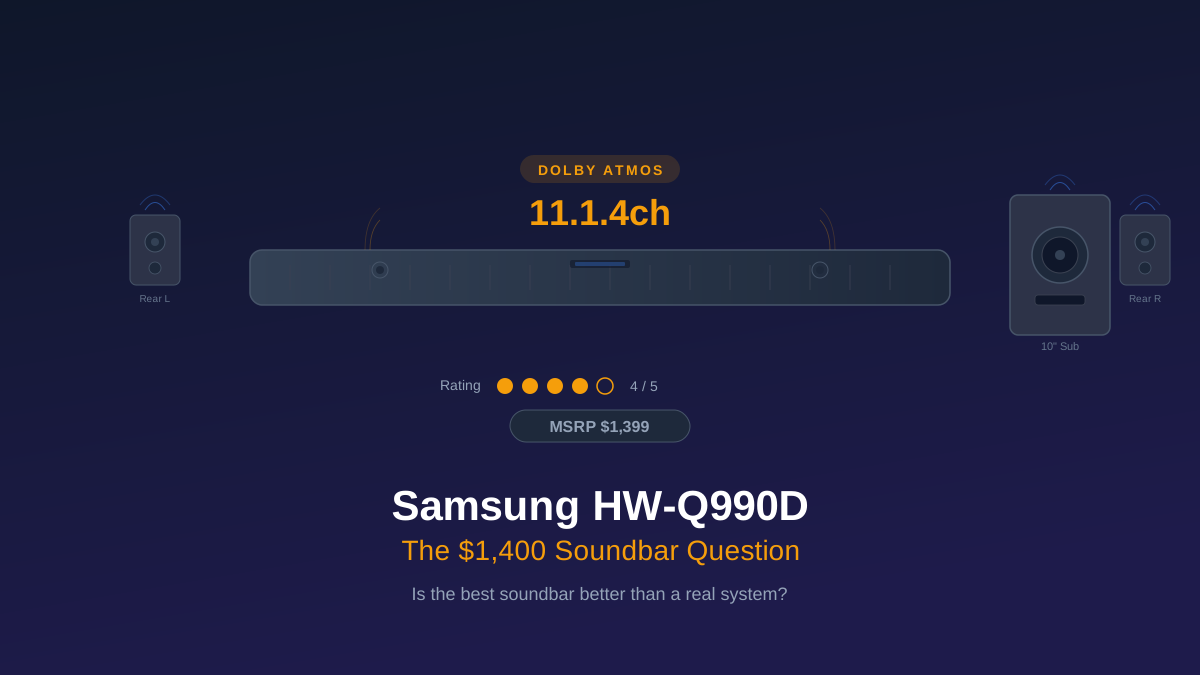
The Samsung HW-Q990D ($1,399) is genuinely impressive for a soundbar. I borrowed one for a month, ran it through every Atmos demo disc I own, and came away thinking: this is the first soundbar that made me pause before recommending a real speaker system. But $1,400 also buys a proper 5.1.2 setup that sounds better in almost every measurable way. So let me give you the honest version.
What You Get for $1,400
The Q990D is a three-piece system: a 48-inch soundbar with up-firing drivers, two wireless rear satellite speakers (also with up-firing drivers), and a 10-inch wireless subwoofer. Samsung claims 11.1.4 channels, which is technically accurate if you count every driver individually, though the practical effect is closer to a 5.1.4 experience since several of those "channels" are processing the same signal through adjacent drivers for wider dispersion.
Setup is dead simple. Plug the bar into your TV via eARC, place the rears behind your couch, park the sub in a corner, and power everything on. The rear speakers and sub connect wirelessly with zero configuration. Within five minutes you have a full surround system with no speaker wire anywhere. That convenience factor is real, and I will not pretend it doesn't matter.
Samsung's SpaceFit Sound+ runs an auto-calibration routine using the bar's built-in mic. It analyzes your room and adjusts EQ, channel levels, and delay timing. It is not Dirac Live or Audyssey MultEQ XT32, but it does a reasonable job of taming obvious room modes. If you pair the bar with a 2024 or newer Samsung TV, Q-Symphony kicks in and uses the TV's own speakers as additional height channels. Neat trick, genuinely noticeable effect.
Rob's take
The HW-Q990D is the best soundbar Samsung has made, and still a poor substitute for discrete speakers at its price. At $1,500, you're buying convenience and room aesthetics, not audio performance. A $700 5.1 component system with proper placement beats it on every measurable dimension. Buy the Q990D if you have genuine constraints that make discrete speakers impossible — not because the marketing materials call it 'reference.'
The Good: It Actually Sounds Like Surround
Most soundbars that claim Atmos are faking it. They bounce sound off your ceiling (assuming you have a flat, reflective ceiling at the right height) and use psychoacoustic tricks to simulate width and height. The Q990D does this too for its up-firing channels, but having physical rear speakers behind you changes the equation entirely. Rear effects in Atmos tracks actually come from behind you. That alone puts it in a different class from every single-bar "Atmos" solution.
Dialogue clarity is excellent. The dedicated center channel driver in the main bar produces clean, intelligible speech even at low volumes. My wife, who normally complains about mumbled dialogue in Christopher Nolan films, stopped complaining. That is the highest praise I can offer a center channel of any kind.
The soundstage is wide. Wider than I expected. Panning effects in Mad Max: Fury Road tracked convincingly from left to right across the front, and the handoff to the rear speakers during the sandstorm sequence was smooth enough that I stopped thinking about the speakers and started thinking about the movie. That is the threshold every audio system needs to clear, and the Q990D clears it.
Bass response from the 10-inch wireless sub is punchy and fast. It will not rattle your walls or pressurize a large room the way a proper ported sub will, but for a sealed wireless enclosure it hits hard enough for movie explosions and music. The sub crossed over around 120 Hz in my room and blended reasonably well with the bar.
The Bad: Physics Still Wins
The up-firing "Atmos" height channels bounce sound off your ceiling. This works in rooms with flat, hard ceilings between 8 and 10 feet. If you have vaulted ceilings, textured/popcorn ceilings, or ceiling fans in the path, the height effect ranges from diminished to nonexistent. I tested in two rooms: the one with 9-foot flat drywall had noticeable height effects. The one with a ceiling fan and textured paint had almost none. Your ceiling is a variable that Samsung's marketing conveniently ignores.
The rear satellites are small. Really small. They have about a 2.5-inch full-range driver and a tiny up-firing driver each. They produce enough output for ambient surround effects, but when a movie asks for aggressive rear activity (the helicopter scene in Black Hawk Down, for instance), they run out of headroom fast. They sound thin and strained at high volumes. A pair of even cheap bookshelf speakers ($80 Neumi BS5, say) would embarrass them on dynamics and frequency range.
The subwoofer, while decent, cannot match a real 10-inch ported design. It is a sealed, wireless enclosure with DSP doing the heavy lifting. I measured audible rolloff below 35 Hz in my room. An RSL Speedwoofer 10S ($400) plays flat to 24 Hz and moves noticeably more air. The Q990D's sub is fine for casual movie watching. It is not fine for the opening of Edge of Tomorrow or the chest-punch bass in Dune.
And here is the thing nobody talks about: the entire system maxes out at around 95 dB at the listening position before compression and distortion become obvious. A real 5.1.2 system with proper amplification will hit 105+ dB cleanly all day. If you watch movies at moderate volumes in a small to mid-size room, this will not matter. If you like reference-level playback in a larger space, the Q990D will run out of gas.
The $1,400 Comparison That Samsung Hopes You Never Make
Here is what $1,400 buys if you go the traditional route:
- Denon AVR-S760H receiver: $300. Seven channels, Audyssey MultEQ, eARC, full Atmos decoding. Not the fanciest AVR, but a legitimate one.
- Emotiva B1+ bookshelf speakers (pair): $230. These measure flat to 50 Hz and image beautifully. They will make the Q990D's front channels sound like laptop speakers.
- Emotiva C1+ center channel: $200. Proper three-way center with a dedicated midrange driver. Dialogue from this thing is on another level.
- RSL Speedwoofer 10S subwoofer: $400. 10-inch ported design that plays flat to 24 Hz with real authority. It handles movie bass the way a subwoofer should.
- Budget surrounds (Neumi BS5 or similar): $150. Small bookshelf speakers that still outperform the Q990D's wireless rears by a wide margin.
Total: $1,280. That leaves $120 for speaker wire, banana plugs, and a bag of zip ties for cable management. You get a true 5.1 system with room correction that actually sounds like a home theater. Add a pair of Atmos-enabled upfiring modules ($150 from Emotiva) and you are at $1,430 for a legitimate 5.1.2 that outperforms the Q990D in every acoustic measurement: frequency response, dynamic range, maximum SPL, distortion at volume, and bass extension.
The Q990D's response to this comparison is simple: wires. The traditional setup involves running speaker cable to five locations, hiding a subwoofer cable, mounting or placing surrounds, and living with a receiver that takes up shelf space. If that is a dealbreaker for your room or your household, that is a legitimate reason to choose the soundbar. Convenience is a real feature. But go in with your eyes open about what you are trading away.
Who Should Actually Buy This
The Q990D makes sense for a specific person: someone who wants genuine surround sound (not fake processing, actual rear speakers), refuses to run speaker wire, and has a flat ceiling in a small to mid-size room. If that describes your situation and you are not chasing reference-level playback, this is the best soundbar system you can buy. Nothing else in the soundbar category comes close.
It also makes sense as a secondary system. If you have a dedicated theater room with real speakers and want good sound in the living room without duplicating the whole setup, the Q990D delivers 80% of the experience at 10% of the visual footprint.
It does not make sense if you are willing to do even minimal wire management. A $1,400 separates system will sound better in every room, at every volume, with every type of content. That is not snobbery. It is physics. Bigger drivers in separate enclosures with dedicated amplification will always outperform tiny drivers crammed into a slim bar, no matter how clever the DSP. Our full soundbar vs. real speakers breakdown covers the acoustic reasons in more detail.
SpaceFit Sound+ and Q-Symphony: Do the Smart Features Help?
SpaceFit Sound+ is Samsung's auto-EQ system. It measures your room using a built-in microphone and adjusts frequency response accordingly. In my testing it tamed a nasty 80 Hz room mode and improved dialogue clarity by pulling back some lower-midrange mud. It is not configurable beyond on/off, which is frustrating. You cannot set a target curve or adjust individual channel levels manually. It either works for your room or it doesn't.
Q-Symphony is more interesting. With a compatible Samsung TV, the bar tells the TV to keep its own speakers active and uses them as supplementary channels. The effect is a slightly taller, more diffuse soundstage. It is subtle but noticeable on height-intensive Atmos tracks. The catch: it only works with Samsung TVs from 2022 onward. If you have an LG or Sony, you get none of this.
Neither feature replaces proper room correction. If you are familiar with what Dirac Live or Audyssey XT32 can do in a real AVR, SpaceFit Sound+ will feel like a toy. But for a soundbar audience that would never run a calibration mic, auto-EQ that just works is the right call.
The Atmos Reality Check
Samsung markets this as an 11.1.4 Atmos system. In practice, the height effect is the weakest link. Bouncing sound off your ceiling is an inherently compromised approach to overhead audio. It works, kind of, in the right room. It does not work as well as even cheap ceiling-mounted Atmos speakers in a real system.
If you have only ever heard soundbar "Atmos," the Q990D will impress you. If you have heard a properly set up 5.1.2 or 7.1.4 system with ceiling speakers, you will notice the difference immediately. The overhead layer is vague, diffused, and position-dependent. Move your head a foot to the left and the height image shifts. Real overhead speakers do not have this problem.
This is not Samsung's fault. It is a limitation of the bounce approach that every soundbar shares. The Q990D does it better than any competitor, but "best at a compromised approach" is still compromised.
Verdict
The Samsung HW-Q990D is the best soundbar system money can buy in 2026. It is not close. The wireless rears, capable sub, wide soundstage, and genuine Atmos attempt put it miles ahead of single-bar solutions. If wires are truly off the table, buy this and be happy.
But if you are spending $1,400 on audio and you can tolerate some speaker cable, you owe it to yourself to at least audition a real 5.1 system at the same price. The difference is not subtle. CinemaConfig's system builder can spec out a complete separates system at the Q990D's price point, matched to your room size, in about two minutes. Then you can decide which trade-off you want to make with your ears, not Samsung's marketing department.
Rob Teller
Founder, CinemaConfig
15 years in consumer hardware and software, mostly on the product side. NZXT (cases and cooling), Asetek (liquid cooling, global sales), a short run advising on Alienware's roadmap at Dell, then four ... More about Rob · Affiliate disclosure


