Here's the Math ($800 Soundbar Loses to $400 Speakers)
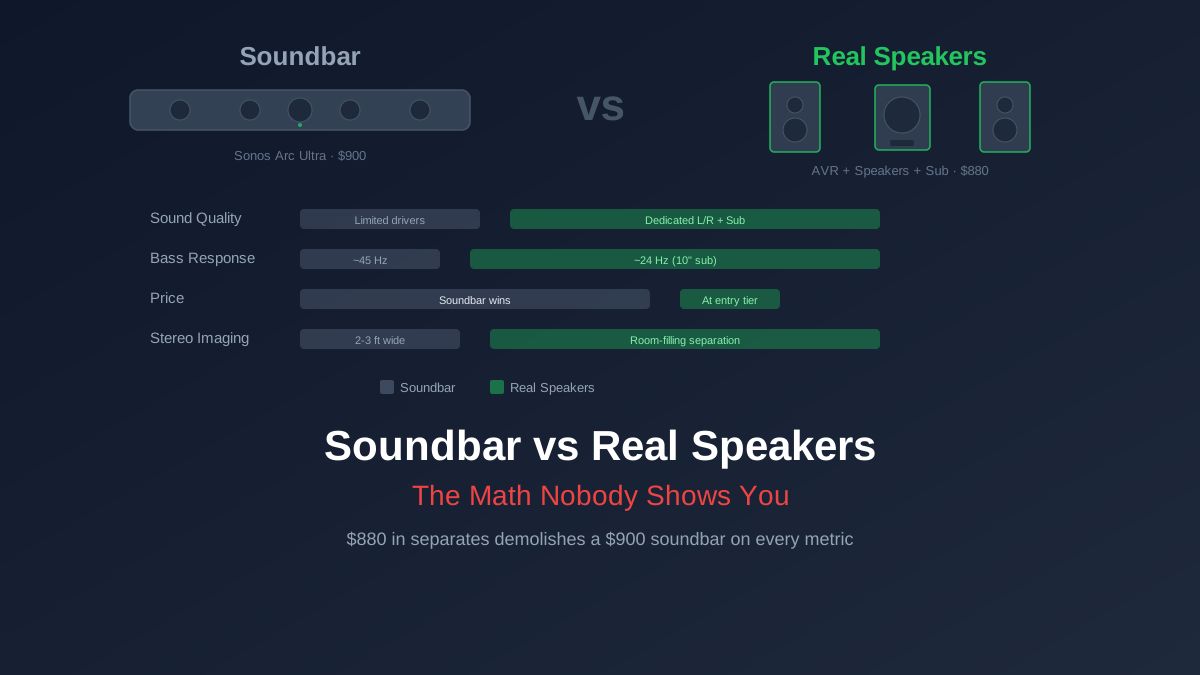
Stop buying soundbars. Seriously. Every single day on r/hometheater, someone posts "I just bought a $800 soundbar, did I do good?" and the answer is always no. You didn't do good. You paid twice as much as you needed to for half the performance. Let's finally put numbers to this so you can see exactly how badly soundbar marketing is ripping you off.
The Core Problem With Soundbars
Physics doesn't care about your marketing budget. A soundbar is a thin rectangular box sitting under your TV, trying to produce full-range sound from tiny drivers crammed inches apart. It cannot do what two properly separated speakers with a dedicated subwoofer can do. It's not a matter of opinion. It's a matter of driver surface area, cabinet volume, and spatial separation.
A Sonos Arc Ultra ($900) has a total driver radiating area of roughly 50 square inches. A single Emotiva B1+ bookshelf speaker ($115 each) has about 28 square inches from its woofer alone. A pair of them gives you 56 square inches of midrange/bass driver area, plus two separate tweeters with actual stereo separation. Add a subwoofer and you're not even in the same universe.
But let's stop talking theory. Let's talk dollars and specs.
Rob's take
Soundbars win on convenience but concede a physical constraint that no amount of engineering fully overcomes: a sound source that's 4 feet wide versus two 6-inch drivers separated by 8 feet produces fundamentally different stereo imaging. The soundbar fakes width through processing; the speakers produce it through physics. That difference is audible to anyone who has heard both in the same room.
The $400 Tier: Soundbar Gets Destroyed
At $400, your soundbar options are things like the Sonos Beam Gen 2 ($350) or the Polk MagniFi Max AX ($400). These are single-box solutions with small drivers, limited bass, and fake "surround" processing that bounces sound off your walls (assuming your room is perfectly shaped, which it isn't).
For $400 in real speakers, here's what you get:
- Receiver: Onkyo TX-SR494 (refurbished) or similar. $150.
- Speakers: Neumi BS5 pair. $110.
- Subwoofer: Dayton Audio SUB-1200. $140.
Total: $400. That Dayton sub alone hits 25 Hz with authority. The Sonos Beam bottoms out around 65 Hz. That's not a small difference. That's the entire bottom octave of movie soundtracks just missing from the soundbar. Every explosion, every rumble of thunder, every Hans Zimmer organ note below 65 Hz: gone. You paid $350 to not hear it.
The Neumi BS5 pair, sitting three to six feet apart on your TV stand or on small stands, gives you real stereo imaging. Instruments have placement. Dialogue has presence. The Sonos Beam is a single point source trying to fake width through DSP tricks.
The $800 Tier: Where It Gets Embarrassing
This is the price range where most people get suckered. The Samsung HW-Q800D ($700), the Sonos Arc ($699), the Bose Smart Soundbar 700 ($800). These are "premium" soundbars that cost real money and still can't compete with entry-level separates.
Here's your $800 real speaker setup:
- Receiver: Denon AVR-S670H. $250. Full HDMI 2.1, room correction, actual surround decoding.
- Speakers: Emotiva B1+ pair. $230. These measure flat to 50 Hz with low distortion. Audiophile-grade performance at a budget price.
- Subwoofer: Dayton Audio SUB-1500. $250. 15-inch driver. Hits 20 Hz in-room.
Total: $730, and you have $70 left over for speaker wire and banana plugs. The Denon alone gives you things no soundbar at any price offers: Audyssey room correction that actually measures your room with a microphone, four HDMI inputs, a phono input if you have a turntable, and the ability to add more speakers later. That $800 Bose soundbar? Two HDMI ports, no room correction, and the "upgrade path" is buying more $300 Bose satellite speakers that are still worse than $50 bookshelf speakers.
On measured frequency response, the Emotiva B1+ pair with the Dayton SUB-1500 covers 20 Hz to 20 kHz with no gaps. The Bose Smart Soundbar 700 rolls off below 45 Hz. You're missing a full octave and a half of bass. For more money.
The $1,200 Tier: Total Domination
At $1,200, soundbar manufacturers want you to buy a Samsung HW-Q990D ($1,400, sometimes on sale for $1,200) with its wireless rear speakers and sub. This is their flagship. Their best. The one that reviewers call "the soundbar that sounds like a real system." It doesn't.
Here's what $1,200 in separates gets you:
- Receiver: Denon AVR-S670H. $250.
- Front speakers: Emotiva B1+ pair. $230.
- Center channel: Emotiva C1+. $250.
- Subwoofer: RSL Speedwoofer 10S. $400.
Total: $1,130. You now have a proper 3.1 system with a center channel for locked-in dialogue, two bookshelf speakers for wide stereo imaging, and an RSL sub that audiophile forums consistently rank as the best value in its class. The Speedwoofer 10S hits a true 22 Hz at reference levels with low distortion. It's not even close to what the wireless Samsung sub module can do.
You still have $70 left. Buy a pair of cheap surround speakers later and you'll have a 5.1 system that the Samsung Q990D cannot touch, for the same money. Or use our system builder tool to plan the full upgrade path.
What About Atmos?
Soundbar Atmos is fake. Every "Dolby Atmos soundbar" is using upfiring drivers to bounce sound off your ceiling. This only works if your ceiling is flat, hard, between 7.5 and 9 feet high, and the soundbar is positioned perfectly. In practice, the "height" effect ranges from subtle to nonexistent. Most people can't tell when it's on or off in blind tests.
Real Atmos requires speakers above you, either ceiling-mounted or Atmos-enabled modules on top of your front speakers. Even a budget 5.1.2 setup with two upfiring modules on your front speakers will produce more convincing overhead effects than a $1,400 soundbar, because the sound is actually coming from closer to the ceiling instead of bouncing off it from three feet off the ground.
The One Valid Soundbar Argument
Simplicity. That's it. That's the only honest argument for a soundbar.
A soundbar is one box, one power cable, one HDMI cable. A speaker setup has a receiver, speaker wire runs, potentially a subwoofer cable, and some basic calibration. If you genuinely cannot deal with that (rental restrictions, a partner who will not tolerate visible speakers, a room where there's physically nowhere to put anything), then fine. Get a soundbar. But know what you're giving up.
You're not paying for equivalent performance in a smaller package. You're paying a convenience tax of 50 to 100 percent. The soundbar companies know this. They just hope you don't.
The Real Budget Breakdown
Here's the comparison table. Every spec listed is based on manufacturer published data or independent measurements from sources like Audioholics, ASR, and Audioscience Review.
$400 tier
- Soundbar (Sonos Beam Gen 2, $350): Bass extension ~65 Hz. No real stereo separation. No upgrade path. 1 HDMI input.
- Separates ($400): Bass extension ~25 Hz. Real stereo imaging. Add surround speakers anytime. Multiple HDMI inputs.
$800 tier
- Soundbar (Bose 700, $800): Bass extension ~45 Hz. Simulated surround. 2 HDMI inputs. No room correction.
- Separates ($730): Bass extension ~20 Hz. Real stereo. Audyssey room correction. 4 HDMI inputs. Expandable to 5.2 channels.
$1,200 tier
- Soundbar (Samsung Q990D, $1,200-$1,400): Bass extension ~35 Hz. Wireless rears with limited output. Simulated Atmos.
- Separates ($1,130): Bass extension ~22 Hz. Dedicated center channel. Real 3.1 expandable to 5.1.2. True Atmos capable.
What to Do Next
If you're on a tight budget, read our guide to building a home theater on a budget in 2026. It walks through every price tier from $200 to $2,000 with specific product recommendations.
If you already know your budget and room size, the CinemaConfig system builder will generate a component list matched to your space and listening habits. It accounts for room size, seating distance, and your priorities (music vs. movies vs. gaming).
And if you already bought the soundbar? Return it. Most retailers have 30-day return windows. Your future self, sitting in front of a real speaker system that actually reproduces what the sound engineers intended, will thank you.
Rob Teller
Founder, CinemaConfig
15 years in consumer hardware and software, mostly on the product side. NZXT (cases and cooling), Asetek (liquid cooling, global sales), a short run advising on Alienware's roadmap at Dell, then four ... More about Rob · Affiliate disclosure

![Klipsch Reference vs Premiere: Differences and Picks [2026]](/images/blog/klipsch-speakers-guide.svg?dpl=dpl_A7yvEusbtVmAimLWJZTA31x7Ag82)
