Is the Sony A95L Still Worth Buying Over an LG G6 or Samsung S95H?
Quick Verdict
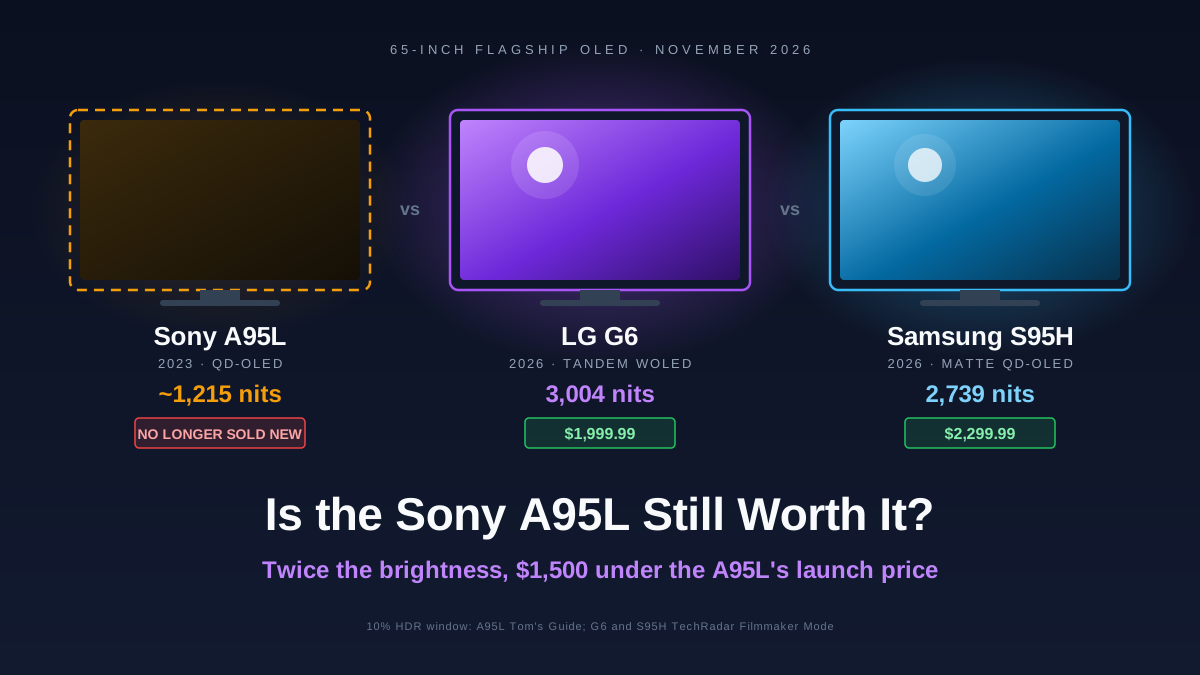
- Best overall: LG G6, $1,999.99 for 65": the LG OLED65G6WUA is now $1,400 under its launch price, measured about 2.5 times as bright as the A95L in HDR, keeps Dolby Vision, and runs 165Hz on all four HDMI 2.1 ports.
- Best for bright rooms and color: Samsung S95H, $2,299.99 for 65": the Samsung QN65S95H adds a matte QD-OLED screen and the widest HDR color of the three. No Dolby Vision.
- The A95L question: Sony's US store lists the 65 inch Sony XR65A95L as no longer available. Buy one only as a leftover or open-box unit priced clearly below the G6. If you want Sony's processing new, its successor is the Sony K65XR80M2 (Bravia 8 II) at $2,499.99.
The Sony A95L was the TV that home theater people measured everything else against. RTINGS still calls it unmatched for a home theater, citing its accuracy and processing. It is also a 2023 TV. Sony's own US product page for the 65 inch model now reads "Item no longer available," and Best Buy says the same for new units.
Meanwhile the 2026 flagships fell hard in price. The LG G6 65 inch is $1,999.99 on LG.com after launching at $3,399.99, and the Samsung S95H 65 inch is $2,299.99, down from $3,399.99. So the real question for anyone searching "A95L vs G6" this fall is whether a three-year-old reference TV still beats two newer panels that now cost less than it did at launch ($3,499.99). On brightness and gaming, no. On color and film processing, closer than you would think.
Rob's Take
The quiet story of 2026 is that Sony stopped competing at the top of OLED. Its new flagships, the Bravia 9 II and Bravia 7 II, are True RGB LCDs, and Sony's OLED line is still the 2025 Bravia 8 II. That makes a leftover A95L a collector's buy, not a default. I would pay A95L money for an A95L only if I watched almost nothing but films in a dark room and the price tag started with a one. Everyone else should take the brightness and the warranty and move on.
Where Each TV Stands in November 2026
Sony A95L (2023): QD-OLED with Sony's Cognitive Processor XR, sold in 55, 65, and 77 inches. The 65 inch is gone from Sony's US store. The 77 inch Sony XR77A95L may still appear at some retailers, partly because Sony's store offers the Bravia 8 II only in 55 and 65 inches; check open-box and refurbished listings before assuming it is gone.
Sony Bravia 8 II (2025): the A95L's replacement as Sony's QD-OLED, $2,499.99 for the 65 inch on Sony's store and Best Buy (Best Buy lists a $3,299.99 comparison value). It is the TV to compare if "Sony processing on a QD-OLED" is the part of the A95L you actually want.
LG G6 (2026): LG's Primary RGB Tandem 2.0 WOLED. RTINGS confirms the 55, 65, 77, and 83 inch sizes share that panel, while the 97 inch does not and is dimmer. LG's product page lists a 5-year panel warranty, and RTINGS notes every US size ships with a wall mount instead of a stand.
Samsung S95H (2026): matte QD-OLED in 55, 65, and 77 inches. The 83 inch is an RGB Tandem WOLED panel and performs differently, so the 83 inch S95H is a different TV wearing the same name.
Brightness: The 2026 Sets More Than Double the A95L
RTINGS' August retest measured the G6 at 3,092 nits on a 10% HDR window (Filmmaker mode with Game Optimizer), and Tom's Guide measured the S95H at 2,721 nits. Tom's Guide measured the A95L at about 1,215 nits on a 10% window. Those numbers come from different labs and test modes, so read the gap as approximate. It is still a gap of more than 1,500 nits, and no calibration difference closes that.
RTINGS' real-scene test points the same way for the two new sets: with each TV's dynamic tone mapping switched on (LG's Dynamic Tone Mapping, Samsung's Active HDR Tone Mapping), its "Hallway Lights" HDR scene (target about 1,950 nits) hit 2,124 nits on the G6 and 2,071 on the S95H. In a dark room the A95L's highlights still look superb. In a room with daylight, the newer panels hold their punch where the A95L starts to look flat.
Reflections: RTINGS rates the S95H's reflection handling as superb, with its blacks raised in a bright room, and calls the G6's direct-reflection handling excellent. TechRadar's side-by-side gave the G6 a slight edge in a bright room in Filmmaker Mode. The A95L's glossy screen is the weakest of the three against windows.
Color: The A95L Still Holds Its Own
The A95L still wins one measured category. On RTINGS' SDR color volume test, the A95L covers 86.16% of BT.2020, ahead of the S95H at 84.66% and the G6 at 78.32%. That is the QD-OLED advantage showing up in a lab, and it is why reds and greens on the Sony and Samsung look richer than on the LG.
In HDR, TechRadar measured the S95H at 89.2% of BT.2020 and the G6 at about 83%, so among the new sets Samsung is the color pick by a clear margin. Tom's Guide measured the A95L at 99.95% of UHDA-P3.
Dolby Vision: Two of Three
The A95L and the G6 both support Dolby Vision. The S95H does not, and supports HDR10+ instead. The A95L lacks HDR10+, per Tom's Guide. When a Dolby Vision stream from Netflix, Disney+, or Apple TV+ hits the Samsung, it plays the HDR10 base layer without the scene-by-scene metadata. Our LG G6 vs Samsung S95H matchup covers that trade-off in depth, and it is still the deciding factor for most G6 vs S95H shoppers.
Gaming: G6 and S95H Tie, the A95L Trails
The A95L has four HDMI inputs, but only two are HDMI 2.1 with 4K/120, VRR, and ALLM, and one of those two is the eARC port. Tom's Guide measured its input lag at 16.1ms, acceptable but well behind the newer sets. The G6 (8.9ms at 4K/60 per TechRadar) and the S95H (9.5ms) both run 4K at 165Hz on all four HDMI 2.1 ports. Call the two 2026 sets tied. With a PS5 Pro, an Xbox, and a PC, the A95L runs out of full-bandwidth ports.
Processing: Why Anyone Still Asks About the A95L
Sony's case was never the spec sheet. RTINGS credits the A95L with top-tier image processing and superb accuracy, which shows up as cleaner gradients in compressed streams and smoother 24fps motion. That processing lives on in the Bravia 8 II, which is the honest Sony comparison in 2026. LG and Samsung have narrowed the gap, and Filmmaker Mode on any of the three removes most of the "processing look" purists complain about. Our LG G6 vs Sony Bravia 9 II comparison covers how Sony's 2026 LCD flagship handles the same question.
HDR brightness: LG G6 wins (3,092 nits 10% window, RTINGS; S95H 2,721 and A95L about 1,215, Tom's Guide)
SDR color volume: Sony A95L wins (86.16% BT.2020 vs 84.66% S95H and 78.32% G6, RTINGS)
HDR color: Samsung S95H wins among the new sets (89.2% BT.2020 vs about 83% G6, TechRadar)
Dolby Vision: G6 and A95L (S95H is HDR10+ only)
Gaming: G6 and S95H tie (165Hz, four HDMI 2.1, about 9ms); A95L trails (120Hz, two HDMI 2.1, 16.1ms)
Bright room: S95H and G6 close (matte vs low-reflection glossy); A95L last
Warranty: G6 wins (5-year panel coverage)
Price, 65" new: G6 $1,999.99, S95H $2,299.99, Bravia 8 II $2,499.99, A95L no longer sold new by Sony US
Which Room Gets Which TV

LG G6 65" (OLED65G6WUA)
Primary RGB Tandem WOLED, 4K 165Hz, 4x HDMI 2.1, Dolby Vision, 3,092 nits (10% HDR, RTINGS)
$1,999.99 on LG.com (launched at $3,399.99)
See specs and current pricesThe dark dedicated theater
The LG G6. In a light-controlled room every one of these is stunning, so the tiebreakers are Dolby Vision, brightness headroom for HDR highlights, and price, and the G6 wins all three against a new-in-box alternative. Buy the G6 if: you stream Dolby Vision, own more than one console, and want the panel warranty.
The bright living room
The Samsung S95H, narrowly. Its matte screen and HDR color give it the edge against windows, and $300 over the G6 is a fair price for that. Buy the S95H if: your room fights daylight, you mostly watch sports or HDR10+ content, and you can live without Dolby Vision.
The film purist who wanted an A95L
The Bravia 8 II at $2,499.99 is the new Sony QD-OLED, or hunt a leftover A95L. A leftover is only a good deal when it undercuts the G6, because the G6 is brighter, games better, and carries a longer warranty. Buy an A95L if: it is priced well under $2,000, you watch in the dark, and you value Sony's motion and color handling over brightness.
The 77 inch shopper
At 77 inches, look at the LG C6H too. It is a 77 and 83 inch-only C6 variant that uses the Primary RGB Tandem panel, so it gets most of the G6's panel tech for less. The LG OLED77C6HUP is the US model. A "C6H vs A95L" comparison only exists at 77 inches, because the C6H does not come in 65.
Not sure which size fits your seating? The viewing distance calculator settles 65 vs 77 faster than any spec sheet, and the full field lives on our best TVs for home theater page.
Specs at a Glance
- Panel: A95L = QD-OLED (2023, glossy) | G6 = Primary RGB Tandem 2.0 WOLED (97" differs) | S95H = matte QD-OLED (83" is WOLED)
- HDR 10% peak: A95L = about 1,215 nits (Tom's Guide) | G6 = 3,092 nits (RTINGS) | S95H = 2,721 nits (Tom's Guide)
- SDR BT.2020 color volume (RTINGS): A95L = 86.16% | G6 = 78.32% | S95H = 84.66%
- HDR formats: A95L = Dolby Vision, HDR10, HLG | G6 = Dolby Vision, HDR10, HLG | S95H = HDR10+, HDR10, HLG
- Refresh and HDMI 2.1: A95L = 120Hz, 2 of 4 ports | G6 = 165Hz, 4 of 4 | S95H = 165Hz, 4 of 4
- Input lag (4K/60): A95L = 16.1ms (Tom's Guide) | G6 = 8.9ms | S95H = 9.5ms (TechRadar)
- 65" price: A95L = launched $3,499.99, no longer sold new by Sony US | G6 = $1,999.99 (launched $3,399.99) | S95H = $2,299.99 (launched $3,399.99)
Prices verified November 11, 2026 from LG.com, Samsung.com, Sony's US store, and Best Buy. Holiday pricing moves weekly, and the G6 and S95H prices above are sale prices. Check current TV prices on CinemaConfig.
Picked your panel? The CinemaConfig builder matches it to an AVR with enough HDMI 2.1 inputs, speakers, and seating distance for your room. For the wider 2026 OLED field, see our OLED TV buying guide and the G6 vs S95H vs Bravia 9 II three-way. Reference TVs age. Brightness and warranties don't wait for them.
Rob Teller
Founder, CinemaConfig
15 years in consumer hardware and software, mostly on the product side. NZXT (cases and cooling), Asetek (liquid cooling, global sales), a short run advising on Alienware's roadmap at Dell, then four ... More about Rob · Affiliate disclosure


