DTS:X vs Dolby Atmos in 2026 - The Format War Nobody Won
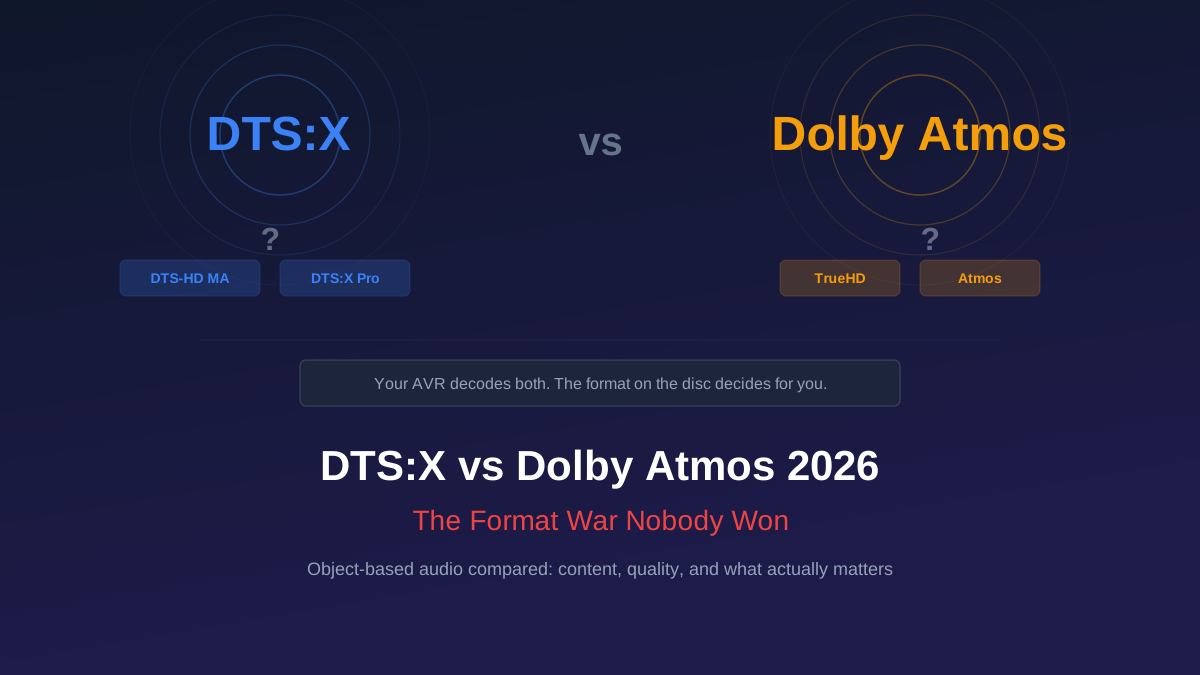
Nobody has ever passed a blind test distinguishing Dolby Atmos from DTS:X on the same content at the same bitrate. The "format war" is a licensing war, not a quality war.
If you have spent any time on home theater forums in the last few years, you have seen this debate. DTS:X vs Dolby Atmos. Which one sounds better? Which one should you build your system around? Which one is "winning"? The answers, in order: neither, it does not matter, and Dolby, but not for the reason you think.
We already covered the full DTS:X vs Dolby Atmos breakdown in a separate post. This one focuses specifically on the object-based formats: Dolby Atmos and DTS:X. The two technologies that were supposed to revolutionize home theater audio and then mostly just confused people about speaker placement.
Object-Based Audio: Same Concept, Different Paperwork
Both Dolby Atmos and DTS:X are object-based audio formats. That means instead of mixing sound into fixed channels (front left, surround right, etc.), the mixing engineer places sound "objects" in a 3D space. Your AVR then figures out how to render those objects through whatever speakers you have.
A helicopter flies overhead. In a traditional 5.1 mix, the mixer has to decide which channels get that helicopter sound and at what volume. In an object-based mix, the helicopter is tagged with a position and trajectory, and the AVR calculates in real time which of your speakers should fire to create that movement.
Dolby Atmos and DTS:X both do this. The underlying math is different, the metadata format is different, and the licensing terms are very different. The audible result is, for all practical purposes, identical.
Rob's take
Content availability is the only reason Atmos wins this comparison. If every Blu-ray had both a TrueHD Atmos and a DTS-HD Master Audio DTS:X track, there would be no reason to prefer one over the other — the perceptual quality is identical at lossless. Atmos wins because more content is mixed in Atmos, not because the technology is superior.
Why Atmos Won the Content War
Dolby won by showing up with a bigger checkbook. Atmos launched in cinemas in 2012 (Pixar's Brave) and reached home theater by 2014. DTS:X arrived in 2015, already playing catch-up. But the real gap was not timing. It was partnerships.
Dolby signed licensing deals with every major streaming platform. Netflix, Disney+, Apple TV+, Amazon Prime Video, HBO Max, Tidal, Apple Music. All of them support Dolby Atmos. Dolby also embedded Atmos into mobile devices, laptops, soundbars, and car audio systems. The Atmos logo is everywhere, even on devices with two tiny speakers that cannot possibly reproduce spatial audio in any meaningful way.
DTS:X has almost no streaming presence. You will not find DTS:X on Netflix. You will not find it on Disney+. The format exists almost exclusively on Blu-ray discs and in movie theaters. DTS did try to push into streaming with DTS Play-Fi and DTS:X integration, but adoption never reached critical mass.
The result: Atmos has thousands of titles across dozens of services. DTS:X has a solid Blu-ray library and not much else. If you only stream, Atmos is the only object-based format you will ever encounter.
Why DTS:X Is Technically More Flexible
Here is where DTS:X fans have a legitimate point. Dolby Atmos requires a specific speaker layout to be officially "Atmos." You need height channels, either overhead speakers or upfiring modules. Dolby's licensing mandates a minimum configuration for a system to carry the Atmos badge.
DTS:X does not care about your speaker layout. It takes whatever speakers you have and renders the object-based audio to fit. Five speakers? Seven? Thirteen? Heights, no heights? DTS:X adapts without requiring any specific configuration. There is no mandatory layout, no licensing fee for speaker placement, and no certification hoops for manufacturers.
In practice, this flexibility barely matters for most people. If you have set up a Dolby Atmos speaker layout with height channels, DTS:X will use those same speakers perfectly. And if you have a basic 5.1 system without heights, both formats fall back to rendering objects across your existing speakers. The Atmos layout requirements only affect manufacturers who want to put the logo on the box.
The Streaming Problem Nobody Talks About
This is the part that should bother you more than any format war debate.
When you stream "Dolby Atmos" from Netflix or Disney+, you are not getting Dolby Atmos the way a Blu-ray delivers it. Streaming Atmos is Dolby Digital Plus with Atmos spatial metadata layered on top. Dolby Digital Plus is lossy, compressed audio. It tops out at 768 kbps for streaming services, though most deliver less.
On a Blu-ray, Dolby Atmos rides on top of Dolby TrueHD, which is lossless. We are talking about bitrates of 4,000 to 8,000+ kbps, bit-for-bit identical to the studio master. The difference between streaming Atmos and disc-based Atmos is not subtle on a good system. Streaming Atmos sounds fine. Disc-based Atmos sounds like the mixing engineer intended.
Streaming DTS:X barely exists, so the comparison is almost academic. But it is worth noting: on Blu-ray, DTS:X rides on DTS-HD Master Audio, which is also lossless. DTS-HD MA and Dolby TrueHD are both lossless codecs that produce bit-perfect audio. In blind listening tests, nobody can tell them apart, because there is literally nothing to tell apart. Both are mathematically identical reconstructions of the original PCM master.
DTS-HD Master Audio: The Unsung Hero
DTS's real value in 2026 is not DTS:X. It is DTS-HD Master Audio.
Many Blu-ray releases include both a Dolby TrueHD/Atmos track and a DTS-HD MA track. Some titles only have one or the other. The point is that DTS-HD MA is a lossless codec that delivers identical audio quality to TrueHD. If your Blu-ray has a DTS-HD MA track but no Dolby equivalent, you are not missing anything. Lossless is lossless.
Some audiophile-grade releases and concert Blu-rays ship exclusively with DTS-HD MA tracks. The format has a slightly different approach to compression (DTS uses higher bitrates for equivalent quality, which matters for encoding but not for what reaches your speakers), and some mastering engineers prefer working with DTS tools. None of this is audible in the final product.
Where DTS-HD MA does have a small technical edge: it supports a higher maximum bitrate than TrueHD (24.5 Mbps vs 18 Mbps). In practice, no consumer content comes close to hitting either ceiling. But the headroom exists.
What Your AVR Actually Does With All This
Every AVR sold in the last five years decodes both Dolby Atmos and DTS:X. The Denon AVR-X1800H ($450), the Yamaha RX-V6A ($500), the Marantz Cinema 50 ($1,300). All of them handle both formats transparently. You put in a disc or start a stream, and the AVR reads the audio track and decodes it. You do not choose. You do not configure. It just works.
Your AVR's room correction system (Audyssey, YPAO, Dirac Live) then processes the decoded audio to match your speakers and room acoustics. This processing step has a far larger impact on what you actually hear than the difference between Atmos and DTS:X. A well-calibrated 5.1.2 system playing DTS:X will sound dramatically better than a poorly calibrated 7.1.4 system playing Atmos.
The room correction is doing most of the heavy lifting. The format on the disc is doing almost none of it.
Stop Worrying About the Format
Here is the practical advice, condensed to what actually matters for your purchase decisions in 2026:
- If you only stream: You will hear Dolby Atmos and nothing else. DTS:X is irrelevant to your setup. This is fine. Streaming Atmos sounds good, just not as good as disc-based lossless.
- If you buy Blu-rays: You will get a mix of Dolby and DTS tracks depending on the studio and release. Your AVR handles both. Buy whichever disc is cheaper or has the better transfer. Do not choose a release based on the audio codec.
- If you are building a speaker layout: Build for Atmos (with height channels) since it is the more common format. DTS:X will happily use those same speakers.
- If you are buying an AVR: Every current model supports both. This is not a differentiator. Focus on room correction quality, channel count, and power output instead.
The format war between Dolby and DTS made sense in the 1990s when you had to pick a decoder. Dolby Digital or DTS on your LaserDisc. Real stakes, real differences in quality. In 2026, the war is over and the answer is both. Your AVR does not care, your speakers do not care, and in a proper blind test, your ears do not care either.
Spend the energy you would have used debating audio codecs on room treatment and speaker placement instead. That is where the actual sound quality lives.
Rob Teller
Founder, CinemaConfig
15 years in consumer hardware and software, mostly on the product side. NZXT (cases and cooling), Asetek (liquid cooling, global sales), a short run advising on Alienware's roadmap at Dell, then four ... More about Rob · Affiliate disclosure


