Power Conditioners for Home Theater: What They Fix and What They Don't
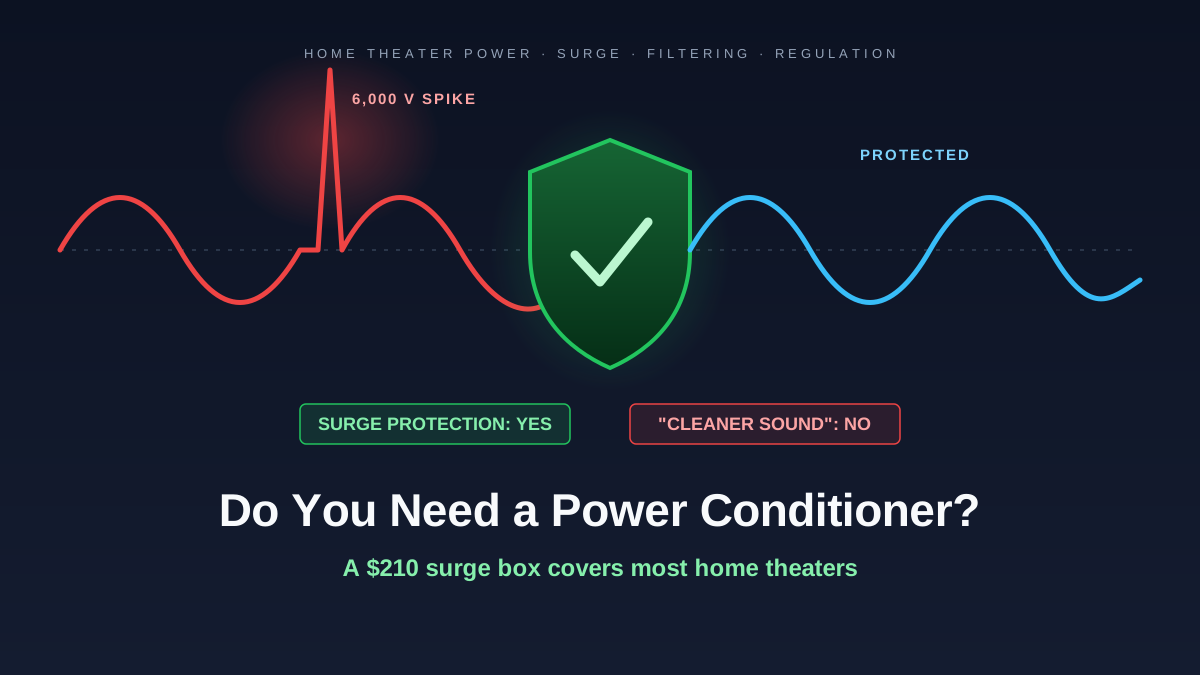
Most home theaters need good surge protection, not a power conditioner that promises cleaner sound. A $210 box like the Furman PST-8D covers the typical AVR, TV, and source stack. You need more only if your wall voltage sags, you own a projector that should shut down gracefully in a blackout, or you live where lightning takes out electronics. If none of those describe your house, you can stop reading after the next section.
The confusion comes from the name. "Power conditioner" is a marketing label stuck on at least five different kinds of box, and they solve different problems. Some of those problems are real. One of them mostly isn't.
Five Boxes Sold Under One Name
Surge protection: stops voltage spikes from lightning, utility switching, or big motors on your circuit. Furman notes spikes can reach 6,000 volts, briefly, which is plenty to kill an HDMI board. This is the job that matters for nearly everyone.
Noise filtering: knocks down radio-frequency and electromagnetic noise riding on the AC line. Real on a test bench. Whether it is audible through a modern AVR is a different question, covered below.
Voltage regulation: holds the output steady when the wall voltage sags or swells. The Furman M-8x AR accepts 97 to 141 volts and outputs 120 volts, plus or minus 5. Useful on a bad grid, dead weight on a good one.
Battery backup (UPS): keeps gear running through a short outage and lets it shut down cleanly. This is the projector owner's box.
Regeneration and isolation: the high end. A regenerator like PS Audio's PowerPlant line rebuilds the AC waveform from scratch and regulates it, at $2,999 to $9,999. Balanced-power units like the Furman IT-REF 15i ($3,449.95) use an isolation transformer to cut common-mode noise; they can help with some hum problems, but a true ground loop is usually fixed at the cable or with a ground-loop isolator. Both are real engineering. Neither is something a typical home theater needs.
Rob's Take
The power conditioning aisle is the last place in home theater where you can still spend $3,000 on a feeling. Every dollar there buys real engineering, and almost none of it changes what comes out of your speakers. The money that actually protects your system is boring: a $210 surge box at the rack and a whole-house protector at the panel. If a salesperson starts talking about "blacker backgrounds" from AC filtering on a receiver, ask which measurement shows it. I have not seen one that does.
What a Conditioner Actually Fixes
Surges (the job that matters)
The number to look for on any surge protector is its UL 1449 voltage protection rating (VPR): how much voltage gets through to your gear during a standard test surge. Ratings run from 330 volts upward, and lower is better. The joule rating printed on cheap strips is the number to ignore. The Defense Department's surge protection guidance calls joules "not an important performance attribute" and "frequently misunderstood."
The catch with cheap strips: most use metal oxide varistors (MOVs), which wear a little with every surge they absorb. UL 1449 includes fail-safe rules for MOVs at end of life, so a listed strip should not catch fire, but it can quietly stop protecting. Furman's SMP design puts a series filter stage in front of its MOV so the clamping part sees less of each surge. That is the main reason a $210 Furman beats a $30 strip for an AVR, and it is worth more than every filtering claim on the box.
Low or unstable voltage
US utilities aim to deliver 114 to 126 volts at your service, the ANSI C84.1 "Range A." If your lights dim when the AC compressor kicks on, your AVR drops into protection mode during summer evenings, or you live at the end of a long rural line, a regulator earns its price. If none of that happens, regulation does nothing for you.
Projector shutdowns
Projectors want power after you turn them off. JVC's manual for its DLA-NZ700 laser projectors says the fan runs about 10 seconds to cool the laser block and warns "Do not disconnect the power cable while cooling is in progress." Epson's laser projectors skip the cool-down, but Epson still says not to unplug while the status light is on or flashing. Lamp projectors are more sensitive still. A UPS keeps the projector alive through a blackout long enough to shut down properly.
What a Conditioner Can't Fix
Hum from your cable or antenna line. The most common home theater hum is a ground loop through the coax from your cable or antenna feed, not dirty power. Audioholics calls a cable TV ground isolator the "most common, and easiest" fix, and its review of a Furman Elite-15 found the conditioner only "attenuated slightly" a hum and could not fully cure a ground loop. An inexpensive isolator on the coax beats a $1,000 conditioner here.
Sound quality on a normal circuit. Audio Science Review measured a PS Audio P12 regenerator in 2022 and found "zero difference in noise and distortion" on a Topping PA5 amplifier, while one of its outlet zones cost an Outlaw amplifier 7.5% of its power. That is one unit and one reviewer, not a blind listening test. Nobody we can find has published a controlled listening test showing audible gains from a conditioner on a typical AVR. Audioholics' Elite-15 review found no picture improvement either.
An overloaded circuit. No conditioner adds capacity to your wall. That is a wiring question, covered next.
Sizing: Watts, Amps, and the Circuit
The math: a standard 15 amp, 120 volt circuit carries 1,800 watts. The usual practice for loads that run for hours is to stay under 80% of that, about 1,440 watts. A Denon AVR-X3800H is rated at 660 watts of power consumption, while idling at 60 to 100 watts with no sound playing. Add a 65 inch TV, a powered subwoofer or two, and a gaming console, and a loud movie night gets closer to that 1,440 watt line than most people assume.
The home theater power draw calculator adds up your actual components, splits them across circuits, and sizes a UPS in VA if you need one. Run it before buying anything with "power" on the box; a second circuit for the subwoofers often solves more than a conditioner would.
Who Needs What
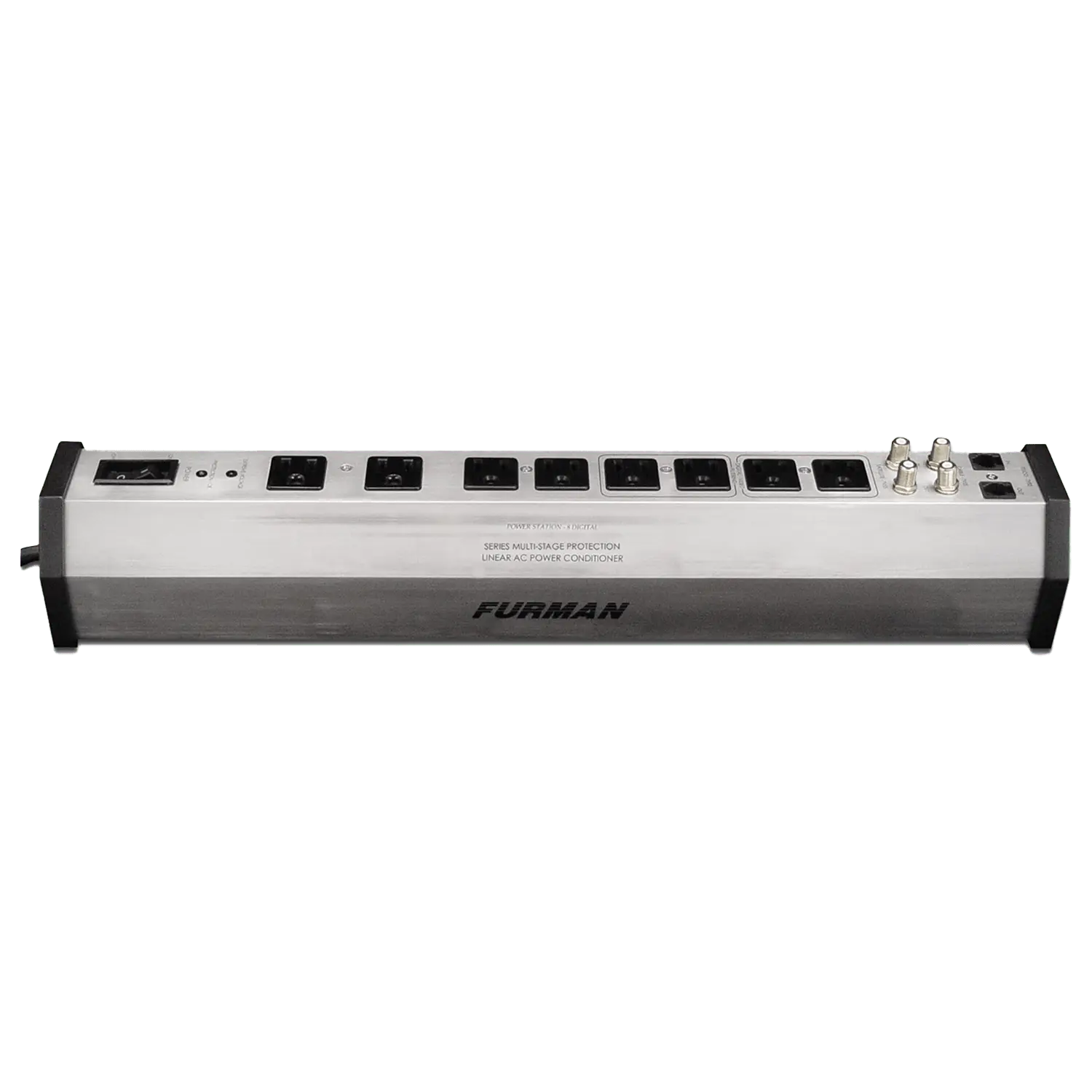
Furman PST-8D
8 outlets, 15 A, SMP+ surge protection, LiFT filtering, extreme voltage shutdown
$209.95 list at Furman
See specs and current pricesMost rooms: real surge protection, and stop
The Furman PST-8D at $209.95 gives eight protected outlets, Furman's SMP+ surge stage, and extreme-voltage shutdown that cuts power when the line goes dangerously high. That covers an AVR, a TV, a few sources, and a sub. Buy it if: you have an AVR-based system on a normal suburban or city grid.
Bad grid: add regulation
The Furman M-8x AR ($799.95) holds 120 volts across a 97 to 141 volt input range, with nine outlets. The rackmount Furman P-1800 AR ($1,499.95) does the same job with Furman's LiFT filtering and a front-panel meter; both are rated at 15 amps, so it is not a current upgrade. Furman listed both as out of stock when we checked. Buy one if: you see sags, flicker, or AVR protection trips on a rural or generator-fed line.
Projectors: a UPS with shutdown control
The Furman F1500-UPS is a 1,500 VA, 900 watt battery backup with dual learning IR blasters that can send your projector its off command when the power fails. It lists at $2,299.95 and sells closer to $2,000 at pro audio retailers. Furman rates it for about 12 minutes at full load and 32 at half load, and explicitly says not to run amplifiers, powered subwoofers, or high-wattage displays from it. Put the projector, streamer, and network gear on it, and leave the AVR and subs on the surge protector. Buy it if: you own a projector worth more than the UPS, or your power drops often enough to notice.
Lightning country: protect the whole house first
Since the 2020 National Electrical Code, new and replaced home electrical services must include a whole-house surge protective device at or next to the panel (Type 1 or Type 2). A point-of-use box like the PST-8D then catches what gets past it. Older homes can add one with an electrician, and it protects the refrigerator and furnace boards too.
When the answer is simply no
A TV, a soundbar, and a streaming stick on a newer house with a whole-home protector do not need a conditioner. A UL-listed strip with a low VPR is enough, and the money is better spent on a subwoofer.
Our best power conditioners for home theater page ranks the full field by use case, including where each Furman fits.
Prices verified November 11, 2026 from Furman, PS Audio, and B&H. Furman listed the M-8x AR and P-1800 AR as out of stock that day. Check current power conditioner prices on CinemaConfig.
Planning the rack? The CinemaConfig builder totals the power draw of the AVR, amps, and displays you pick, so you know whether you need a second circuit before you need a conditioner. Protection is cheap. Placebo is expensive.
Rob Teller
Founder, CinemaConfig
15 years in consumer hardware and software, mostly on the product side. NZXT (cases and cooling), Asetek (liquid cooling, global sales), a short run advising on Alienware's roadmap at Dell, then four ... More about Rob · Affiliate disclosure


