Bose Lifestyle vs a Real 5.1 System - The $3,000 Question
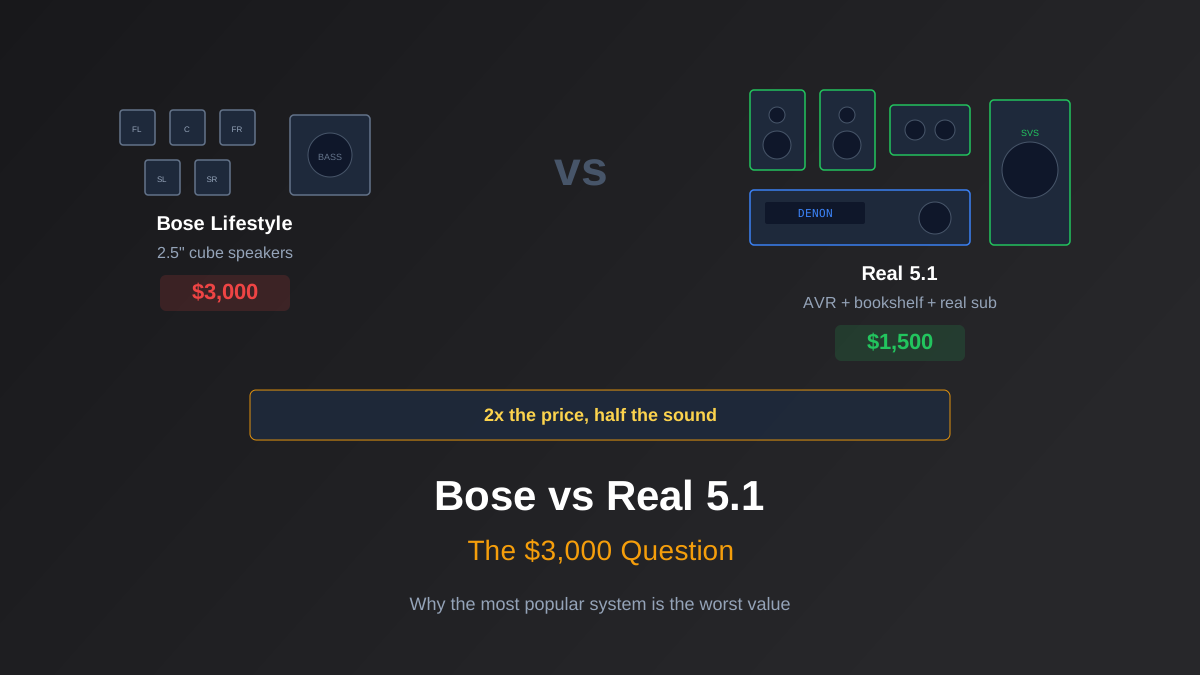
Bose makes the most popular home theater systems sold at Best Buy. They're also the worst value in home audio, and it's not even close.
The Bose Lifestyle 650 retails for $3,000. For that money you get five tiny cube speakers with 2.5-inch drivers, a bass module that Bose calls a "subwoofer" (it isn't), and a control console that handles source switching and amplification. The whole thing looks like it was designed by the same team that does Bang & Olufsen mood lighting. It is, by any reasonable standard, a beautiful piece of industrial design.
It is also, by any reasonable standard, a $3,000 system that gets outperformed by a $1,500 component system in every measurable acoustic dimension. Let me explain why, acknowledge why people buy Bose anyway, and build you the alternative.
The Physics Problem Bose Can't Solve
Speaker driver size is not a marketing gimmick. It is physics. A 2.5-inch driver physically cannot move enough air to reproduce the full frequency range that a 5.25-inch or 6.5-inch bookshelf speaker handles effortlessly. Bose compensates for this by aggressively high-passing the cube speakers (rolling off everything below roughly 200 Hz) and sending it all to the bass module.
That bass module is doing double duty. It is not a subwoofer in the way that an SVS PB-1000 Pro or a Monolith 10 is a subwoofer. Those are dedicated low-frequency transducers optimized for deep bass extension, typically reaching down to 20-25 Hz. The Bose Acoustimass module covers everything from about 50 Hz up to 200 Hz, which is mid-bass territory that normal bookshelf speakers handle on their own. It is compensating for the cubes' inability to produce midrange frequencies, not adding low-end extension.
The result: the system has a gap. The cubes can't reach down. The bass module can't reach up cleanly. And the crossover point where they hand off is managed by Bose's proprietary processing with no user-accessible controls. You can't set your crossover frequency. You can't adjust phase. You can't run room correction software like Audyssey or Dirac. You get what Bose decided sounds good in their lab, and that's it.
Rob's take
Bose's lifestyle systems are exceptionally well-engineered for their design constraints. A cube speaker genuinely cannot move as much air as a 5.5-inch bookshelf, and Bose's DSP compensates meaningfully for that physics limitation. But compensation is not equivalence. At the same price point, a conventional speaker system produces more accurate timbre, more dynamic range, and more low-frequency extension. Buy Bose when aesthetics and space are the primary constraints, not when audio quality is.
What $1,500 Actually Buys
Here is a 5.1 system that costs half as much and outperforms the Lifestyle 650 in frequency response, dynamic range, bass extension, and imaging. Every component is user-replaceable, every setting is adjustable, and the whole thing runs industry-standard room correction.
- Denon AVR-S760H ($350): 7.2 channel receiver with Audyssey MultEQ XT room correction, HDMI 2.1, eARC, and enough power (75W per channel) to drive efficient bookshelf speakers without breaking a sweat. This single component replaces the Bose control console and adds features the Bose system doesn't have at any price.
- Emotiva B1+ ($230/pair): 5.25-inch woofer, 1-inch silk dome tweeter. Frequency response down to 50 Hz on their own, which already overlaps with what the Bose bass module is doing. Two pairs for front L/R and surrounds: $460.
- Emotiva C1+ ($250): Matching center channel. Timbre-matched to the B1+ so dialogue pans smoothly across the front stage.
- SVS PB-1000 Pro ($600): A real subwoofer. 12-inch driver, 325 watts RMS, reaches down to 17 Hz (-3 dB). This is the component that makes the biggest difference. The PB-1000 Pro produces bass the Bose system literally cannot reproduce. You will feel explosions, not just hear a vague rumble from the bass module.
Total: $1,660. Call it $1,500 if you catch any of these on sale, which happens regularly. For a detailed component breakdown at multiple price points, our budget build guide covers tiers from $500 to $2,000.
Where the Bose Falls Apart on Paper
Frequency response tells the story. The Emotiva B1+ reaches 50 Hz to 20 kHz on its own. The SVS PB-1000 Pro extends that down to 17 Hz. Together with the Denon's Audyssey room correction setting the crossover at 80 Hz (the THX standard), you get a flat, corrected response from 17 Hz to 20 kHz across the entire system.
The Bose Lifestyle 650's frequency response is not published. Bose does not provide -3 dB points for the cube speakers or the Acoustimass module. That alone should tell you something. Companies that make speakers with impressive specs publish those specs. The cubes are estimated by independent measurements to roll off steeply below 200 Hz, and the bass module bottoms out around 40-50 Hz. That is a full octave of deep bass the system simply does not produce.
Then there is room correction. The Denon's Audyssey MultEQ XT runs a microphone-based calibration that measures your room's acoustic response at multiple listening positions and applies corrective EQ. This compensates for room modes, standing waves, and reflection patterns that color the sound in every room. The Bose system has Bose's proprietary ADAPTiQ calibration, which is a simplified version of the same concept with far fewer adjustment points and no user access to the resulting EQ curve.
Where Bose Actually Wins
I've spent the last several paragraphs beating up on Bose, so let me be honest about what they do better than a component system.
Size and aesthetics. The Lifestyle cubes are tiny. They disappear on a bookshelf, mount flush on a wall, tuck behind a TV. The Emotiva B1+ is a real bookshelf speaker: 6.5 x 11 x 7.5 inches, 11 pounds each. Five of those plus an AVR plus a 15-inch-tall subwoofer take up real space. In a small apartment or a room where visible speakers are a dealbreaker, the Bose form factor genuinely solves a problem.
Partner acceptance factor. This is the real reason Bose sells as many systems as it does. The Lifestyle 650 looks like a piece of modern furniture. It comes in one box. Setup takes 30 minutes. There is no receiver to configure, no speaker wire to run (the cubes use proprietary cables that are thinner and easier to hide), and no settings to tweak. You plug it in and it works. For households where one person wants good sound and the other person wants the living room to look like a living room, the Bose is a genuine compromise that keeps the peace.
Brand trust. Walk into Best Buy and ask a salesperson for a home theater recommendation. They will point you to Bose or Sonos. They will not point you to Emotiva, SVS, or a Denon AVR with separate speakers. Bose has spent decades building brand recognition that makes people feel confident spending $3,000 without doing any research. That confidence has value, even if the acoustic result doesn't justify the price.
The Honest Recommendation
If aesthetics and simplicity are genuinely your top priority, if your partner has veto power over visible speakers, and if you have $3,000 to spend on a system you'll never think about again, the Bose Lifestyle will make you happy. You will have sound that is meaningfully better than your TV speakers, it will look great, and it will just work. Many people have bought this system and are perfectly satisfied.
But if sound quality matters to you at all, if you have ever watched a movie and thought "I wish I could feel that explosion," if you care about dialogue clarity during quiet scenes, or if spending $3,000 on a system that a $1,500 alternative outperforms in every measurable way bothers you on principle, the component route is not even a close call.
The Denon/Emotiva/SVS system described above will produce cleaner dialogue, wider stereo imaging, deeper and more impactful bass, and a more accurate surround field. It will run real room correction. Every component can be individually upgraded over time. And it costs half as much.
Not sure what components match your room? CinemaConfig's builder tool matches speakers to your room size and budget, handles crossover and impedance matching, and builds you a complete system. It is the "it just works" experience that Bose promises, applied to components that actually sound good. And if you are still on the fence about whether separates are worth it versus an all-in-one, our soundbar comparison lays out exactly where all-in-one solutions hit their ceiling.
The $3,000 question has a pretty clear answer. Bose is selling industrial design and brand confidence at a steep premium. The sound is fine. For half the money, you can have sound that's dramatically better. The only question is whether "fine" is good enough for you.
Rob Teller
Founder, CinemaConfig
15 years in consumer hardware and software, mostly on the product side. NZXT (cases and cooling), Asetek (liquid cooling, global sales), a short run advising on Alienware's roadmap at Dell, then four ... More about Rob · Affiliate disclosure


