Stereo vs Surround for Music - I Tested Both and One Isn't Even Close
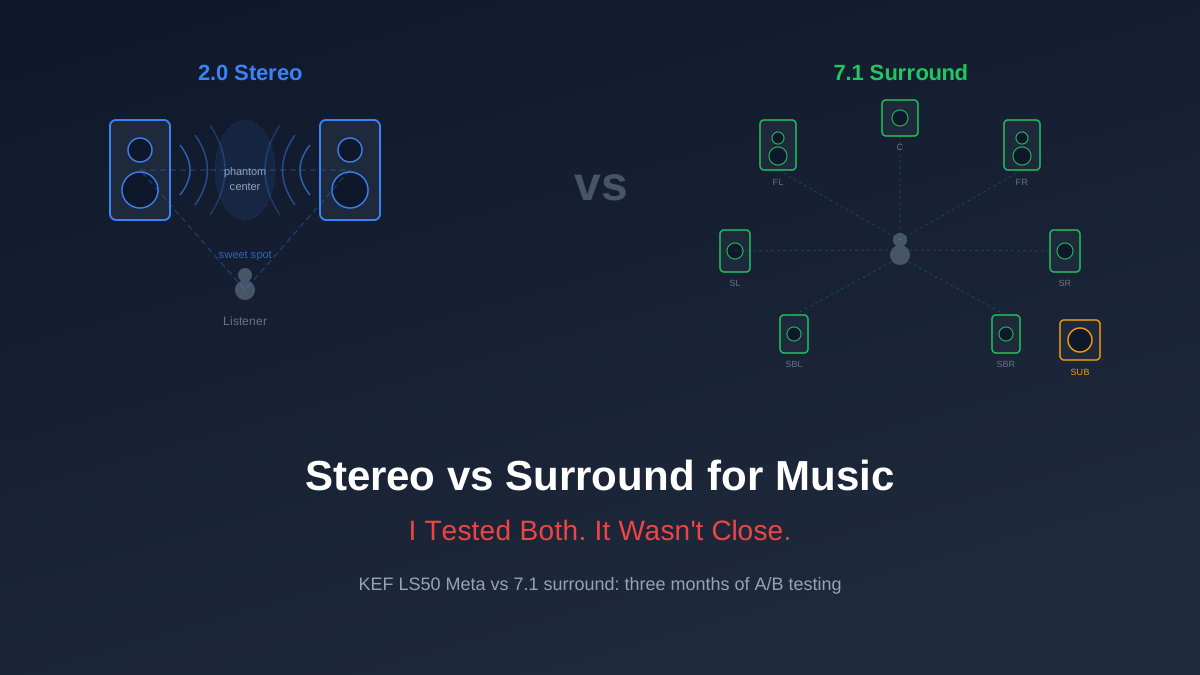
For critical music listening, stereo is better. Full stop. I spent three months A/B testing a dedicated 2.0 stereo pair (KEF LS50 Meta, $1,600/pair) against a full 7.1 surround system, switching between them for every genre I could throw at the setup. Stereo won on imaging, detail retrieval, and that hard-to-quantify sense of musical coherence that makes you close your eyes and forget you are listening to speakers at all.
But there is a twist. And it genuinely surprised me.
Why Music Is a Two-Channel Problem
Almost every piece of recorded music released in the last 60 years was mixed and mastered for two channels. The engineer sat between two monitors, panned instruments left and right, and made decisions about depth, width, and placement based on what those two speakers reproduced. When you play that recording through a stereo pair, you are hearing it the way it was designed to be heard.
Add more speakers and you are not getting "more" of the music. You are asking your AVR's DSP to fabricate channel data that the mixing engineer never created. Dolby ProLogic IIx Music mode, DTS Neo:6, Yamaha's various surround processing modes: they all take a stereo signal and algorithmically spread it across your surrounds. The result sounds wider, sure. But wider is not better when the original mix already contained precise spatial information baked into two channels.
This is the fundamental difference between music and film. A movie soundtrack is natively multichannel. Dialogue is mixed to center, effects are panned to surrounds, overhead channels get discrete Atmos objects. Your surround speaker placement matters because there is real, intentional audio going to each location. With stereo music through surround processing, your side and rear speakers are playing a guess.
Rob's take
Stereo is still the right format for music in 2026, with one exception: immersive Atmos music on Apple Music and Tidal, mixed by people who know what they're doing, sounds genuinely different and interesting through a capable Atmos system. Not better than a great stereo mix on a great two-channel system — different. If you have both a surround system and music sources that support Atmos, it's worth trying before dismissing.
What Stereo Imaging Actually Is (and Why More Speakers Hurts It)
Stereo imaging is the ability of two speakers to create the illusion that sounds exist in specific locations between and around them. A well-recorded jazz trio should sound like the upright bass is slightly left of center, the piano is right, and the drums are spread behind both. That is not a trick of your imagination. It is the result of precise amplitude and timing differences between the left and right channels that your brain decodes into spatial position.
The KEF LS50 Meta does this remarkably well. The Uni-Q driver (tweeter mounted concentrically inside the midrange) means both drivers radiate from the same point, which eliminates the timing errors that conventional two-way speakers introduce when your ear is slightly off-axis. Sit in the sweet spot with the LS50 Metas toed in about 5 degrees past your ears, and the speakers disappear. You do not hear left speaker and right speaker. You hear a continuous soundstage with instruments placed in three-dimensional space.
When I switched to the 7.1 system running Dolby Surround upmixing, that precision collapsed. Instruments that had been pinpoint-located in the stereo image became vaguely smeared across the room. The phantom center (that invisible vocalist floating between the speakers) moved into the physical center channel, which sounds different from the phantom. Not worse in isolation, but wrong, because the mix was never designed to have a discrete center.
I tested this with a dozen reference tracks. Steely Dan's "Aja" (the studio separation on that record is surgical). Radiohead's "In Rainbows" (dense, layered, lots of spatial tricks in the mix). Norah Jones' "Come Away With Me" (intimate vocal that should feel like she is in the room). Every time, stereo won. Not by a little. By a lot.
The Test Setup
To be fair about methodology: the stereo setup was the KEF LS50 Meta ($1,600/pair) driven by a Marantz Model 40n integrated amp ($2,500). No subwoofer. The 7.1 system used a Denon AVR-X3800H ($1,500) with KEF Q350 front L/R ($600/pair), a KEF Q250c center ($350), four KEF Q150 surrounds ($600 total), and an SVS PB-1000 Pro sub ($600). Total surround cost: roughly $3,650.
So the stereo setup was actually cheaper. That matters, because the common assumption is that surround "should" sound better because there is more hardware. More speakers, more amplification, more processing. But for music reproduction, all that extra hardware is solving a problem that does not exist.
I ran both systems in the same room (14 x 18 feet, carpeted, with basic absorption panels at first reflection points). The surround system was calibrated with Audyssey MultEQ XT32. The stereo system was manually positioned using REW measurements. Both setups were level-matched to 75 dB at the listening position.
The Exception That Changes Everything
Three weeks into the test, I subscribed to Apple Music and started exploring their Dolby Atmos Music catalog. This is where I have to eat some of my words.
Dolby Atmos Music is not upmixed stereo. These are native multichannel mixes where the artist and mixing engineer placed instruments in a three-dimensional sound field with intention. When you play Abbey Road in Atmos, the guitars do not just pan left and right. They exist in space around you. The harmonies on "Because" come from above and behind. It is not a gimmick. It is a fundamentally different presentation of music you have heard a thousand times, and on some tracks, it is revelatory.
The same applies to multichannel SACDs if you can find them. The surround mix of Pink Floyd's "Dark Side of the Moon" on SACD is a genuine argument for surround music. So is the 5.1 mix of Fleetwood Mac's "Rumours." These are not upmixed stereo. They are discrete multichannel mixes created (or approved) by the original artists.
On the 7.1 system, these Atmos tracks were stunning. The KEF Q350s handled the front stage, the Q150 surrounds placed instruments behind and beside me exactly where the mixer intended, and the spatial presentation was unlike anything stereo can do. I sat through the entire Beatles catalog in Atmos over a weekend and heard details I had missed in 20 years of stereo listening.
This was the finding I did not expect. Stereo is better for stereo music. Obviously. But Atmos Music on a proper surround system is not just "different," it is genuinely, meaningfully better for the tracks that have native Atmos mixes. The catch: Apple Music's Atmos catalog, while growing, still covers maybe 10-15% of what I actually listen to. So it is an occasional revelation, not a daily driver.
The Practical Recommendation
If you already own a surround system (and if you are reading CinemaConfig, you probably do), here is what to actually do for music:
- Use Direct or Pure Direct mode. Every modern AVR has this. It bypasses all DSP processing, room correction, and surround upmixing. Music plays through your front left and right speakers only, with the signal path as clean as the AVR can make it. On the Denon X3800H, the difference between "Auto" and "Pure Direct" for stereo music is not subtle.
- Invest disproportionately in your front L/R speakers. If your budget is $2,000 for a 5.1 system, do not spend $400 per speaker evenly. Spend $800-1,000 on the front pair and scale down from there. Your front L/R do double duty: stereo music and the most important channels in a film mix. The speaker type you choose matters here, and bookshelves or towers give you the best music performance.
- Explore Atmos Music. If you have a 5.1.2 or better system, Apple Music's spatial audio catalog is worth trying. The Atmos mixes of classic albums are worth the subscription alone. Enable it, find an album you know inside-out, and listen with fresh ears.
- Skip surround upmixing for music. Dolby Surround, DTS Neural:X, Yamaha CINEMA DSP for music: turn them all off. They smear stereo imaging and add nothing that the original mix intended. The one exception is Yamaha's "2ch Stereo" mode, which is essentially their version of Direct and works well.
Do You Need a Separate Stereo Setup?
If music listening is a primary hobby and you have the budget and space, a dedicated stereo system will outperform even an expensive surround system's front channels for two-channel music. The Marantz Model 40n driving the LS50 Metas had a palpable sense of dynamics and control that the Denon AVR, good as it is, could not match with the Q350s. Dedicated stereo amps allocate all their power and engineering to two channels instead of seven.
But for most people reading this, the answer is no. A surround system with great front L/R speakers running in Direct mode gets you 85-90% of a dedicated stereo rig for music, plus the full surround experience for movies. That is the right trade-off for a single-room setup. Put the money you would have spent on a separate stereo amp into better front speakers instead.
Stereo wins for stereo music. That part was never in question. The part I did not expect: when music is actually mixed for surround, surround is not just competitive. It is transcendent. The format just needs to catch up to the hardware.
Rob Teller
Founder, CinemaConfig
15 years in consumer hardware and software, mostly on the product side. NZXT (cases and cooling), Asetek (liquid cooling, global sales), a short run advising on Alienware's roadmap at Dell, then four ... More about Rob · Affiliate disclosure


