LG G5 vs Sony Bravia 9 II - OLED Clearance vs Mini LED Debut
Quick Verdict
- Best for dark theater rooms and under-$3,500 budgets: LG G5 65" at $2,499 on clearance (down from $3,399 MSRP per lg.com) — Primary RGB Tandem WOLED with Brightness Booster Ultimate, Alpha 11 Gen2 processor, 120Hz native / 165Hz VRR gaming, four HDMI 2.1 ports, Dolby Vision, and a 5-year panel warranty
- Best for bright living rooms with 75"+ budgets: Sony Bravia 9 II 75" at roughly $4,500 pre-launch estimate — Sony's first True RGB Mini LED with up to 15,000 dimming elements, XR Cognitive Processor, Dolby Vision, and Sony's best-in-class motion handling. Does not ship until late spring 2026 and does not come in a 65-inch size
- Not actually the same matchup: The G5 is LG's 2025 flagship clearing out after the G6 shipped. The Bravia 9 II is Sony's 2026 debut. Different product cycles, different sizes, different pricing reality — which is exactly why the decision is more interesting than the forums suggest
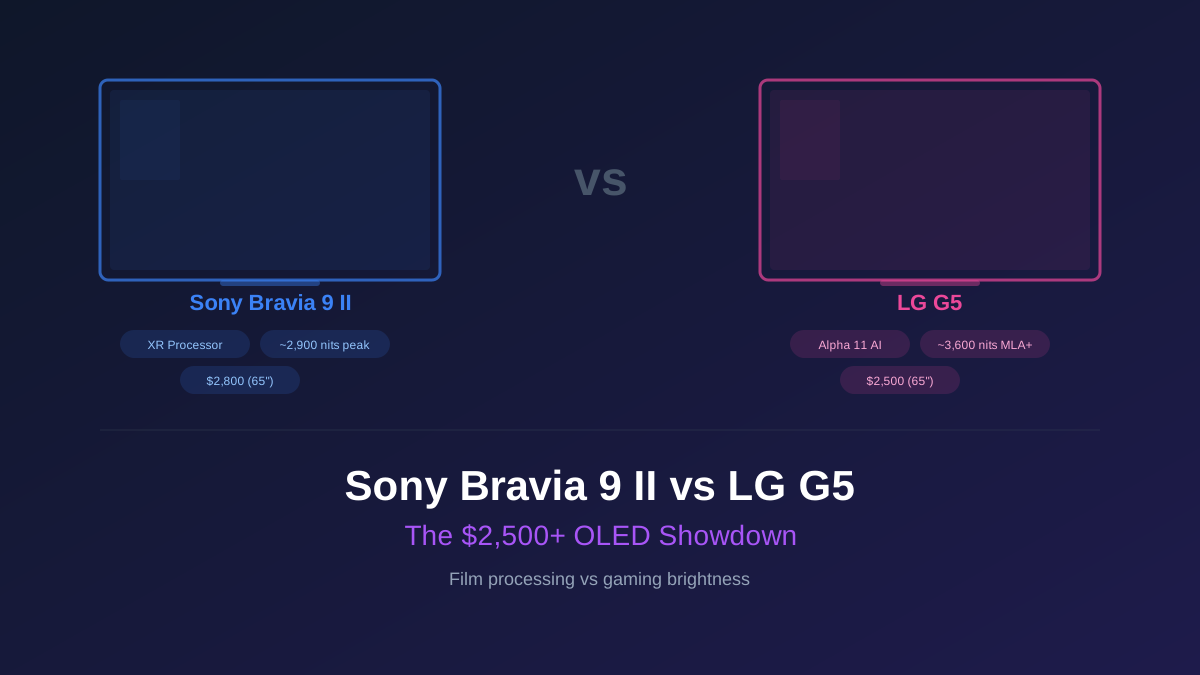
This is not the comparison LG or Sony designed. The LG G5 is a 2025 flagship whose MSRP was $3,399 for the 65-inch and which is now selling at $2,499 on lg.com because the G6 shipped in April 2026. The Sony Bravia 9 II is Sony's 2026 flagship and the first television to ship with True RGB Mini LED — a backlight architecture where the red, green, and blue mini-LEDs are all driven independently, rather than a single white LED array with a color filter on top. It has never been shipped in a consumer panel at this scale before. It does not arrive until late spring 2026. It does not come in a 65-inch size. The smallest Bravia 9 II is 75 inches.
If you read the previous paragraph and thought "these two barely overlap," you are right. The realistic cross-shop is the LG G5 77" at $3,299 on sale (down from $4,499 MSRP) against the Sony Bravia 9 II 75" at roughly $4,500 estimated. At that pairing, LG saves you $1,200 on a mature panel that has been out for a year and has real reviewer measurements behind it. Sony charges $1,200 more to be an early adopter of a backlight architecture that has never shipped before.
Rob's Take
I would buy the LG G5 77" at $3,299 right now without thinking twice. It is the best deal in OLED because LG already shipped the G6 and needs the shelf space. The G5 has a mature Primary RGB Tandem panel, real RTINGS measurements I can check, a 5-year panel warranty, and a price that reflects the fact that LG has already moved on. The Bravia 9 II is fascinating as a technology debut and I want to see independent measurements on it — but $4,500 for a 75-inch whose pricing is a pre-launch estimate, whose brightness is a pre-launch claim, and whose backlight is a first-generation consumer implementation of a new architecture is a lot of asterisks to accept. I would rather spend $1,200 less and get the proven OLED. The honest exception: if your living room has big uncurtained windows, the Mini LED sustained brightness advantage is real, and the G5 will disappoint you during the day no matter how good its anti-glare layer is. Windows decide.
Panel Technology: Two Honest Architectures for Different Problems
The LG G5 uses what LG markets as Brightness Booster Ultimate — a Primary RGB Tandem WOLED panel with a new anti-reflective layer that UL certifies as Glare Free. "Tandem" means the emission stack has two layers of OLED material instead of one, which roughly doubles the light output per pixel without adding proportional power draw. LG's own marketing puts the G5 at 45% brighter than the B5 at 10% APL based on internal testing. That is a relative claim against LG's own step-down model, not an absolute measured nit number. Early RTINGS measurements of the G5 landed in the 2,000-nit range on a 10% HDR window, which is the highest I have seen measured on a WOLED panel to date but noticeably short of Sony's ~4,000-nit Mini LED target.
The Sony Bravia 9 II uses a completely different architecture. True RGB Mini LED replaces the white mini-LED backlight used in conventional Mini LED LCDs with individually driven red, green, and blue mini-LEDs behind a standard LCD layer. Sony's pitch is that independently controlling the color channels produces a wider color gamut, better color uniformity across zones, and higher sustained brightness than white-LED Mini LED at similar zone counts. Sony targets approximately 4,000 nits peak brightness and claims up to 15,000 dimming elements in the backlight. These are manufacturer claims, not measured results. The panel does not ship until late spring 2026 and no independent lab has tested one yet. Treat the numbers as directional, not verified.
A quick architectural reality check that matters more than any spec sheet. The G5 is an OLED. Each pixel generates its own light. When a pixel is off, it is off, and the black between lit pixels is perfect. Contrast ratio is infinite by definition. The Bravia 9 II is an LCD. A pixel cannot turn itself off. Dark areas rely on the backlight dimming that region of the screen, and with 15,000 zones the dimming is very precise but never perfect. You will occasionally see blooming around bright objects on dark backgrounds on the Bravia 9 II. You will not see it on the G5. If you have watched a movie on a good Mini LED next to a good OLED in a dark room, the difference is obvious. If you have not, you will probably not notice until someone points it out.
Brightness and Ambient Light: The Honest Decision Point
OLEDs have a governor called Automatic Brightness Limiter (ABL). When a large portion of the screen stays bright for a sustained period, the panel dims itself to protect the organic compounds from thermal degradation. A bright hockey rink, a snowy mountain vista, a daytime sports broadcast with a full crowd — any of these can trigger ABL on any OLED, including the G5. The Tandem panel is less aggressive about ABL than previous LG generations, but it still happens, and you can see the image visibly ramp down during extended high-APL content if you are watching for it.
The Bravia 9 II has no ABL. It is an LCD. A bright hockey rink stays bright for as long as you keep watching the bright hockey rink. Full-screen brightness is sustained at whatever the backlight can produce, which with 15,000 True RGB Mini LED elements is more light than any consumer Mini LED has delivered to date if Sony's claims hold up in review. If your TV lives in a room where you watch daytime sports, morning news, or bright HDR content against ambient light from windows, the Bravia 9 II's lack of ABL is a structural advantage that the G5 cannot match no matter how bright its peak highlights get.
The other half of this conversation is the anti-reflective coating. The G5's UL Glare Free layer is genuinely excellent — it scatters ambient reflections in a way that keeps the panel usable in rooms that would have washed out a C5 or B5. Sony's anti-reflection layer on the Bravia 9 II is also reportedly improved for 2026, though I have not seen it tested yet. Neither of these coatings replaces raw brightness, but both meaningfully reduce the visible impact of overhead lights and off-axis windows.
Peak brightness (10% window): Sony Bravia 9 II claims ~4,000 nits. LG G5 measures in the ~2,000 nit range on the first few lab reviews. Measured numbers for the Bravia 9 II are not yet available.
Contrast ratio: LG G5 wins. Infinite, by definition. OLED is OLED.
Sustained full-screen brightness: Sony Bravia 9 II wins. No ABL. Mini LED LCDs can hold peak brightness indefinitely on bright content.
Blooming around bright objects: LG G5 wins. OLED has no backlight to bloom.
Viewing angles: LG G5 wins. OLED pixels emit light in all directions. LCD viewing angles on the Bravia 9 II will narrow at the edges of a wide couch.
Ambient light rooms with windows: Sony Bravia 9 II wins on sustained brightness, though the G5's Glare Free coating is better than most people expect.
Price at closest cross-shop (LG 77" vs Sony 75"): LG G5 wins by ~$1,200 at current sale prices.
Sizes and Pricing: Not the Same Catalog
The LG G5 ships in 55", 65", 77", 83", and 97". As of April 2026 on lg.com, the sale prices are $1,899 (55"), $2,499 (65"), $3,299 (77"), $4,999 (83"), and $17,999 (97"). The original MSRPs were $2,499, $3,399, $4,499, $6,499, and $24,999 respectively. The discounts exist because LG has shipped the G6 and is clearing G5 inventory to make room, not because anything is wrong with the G5. This is the best time of the year to buy one.
The Sony Bravia 9 II ships in 75", 85", and 98" only. No 55", no 65", no 77". Pre-launch pricing estimates put the 75" near $4,500 and the 85" near $5,700 based on Sony's historical pricing curve for Bravia 9-tier products. The 98" is new territory and has no public price yet. These numbers are estimates, not confirmed MSRPs — Sony has not posted final US pricing on its site as of this writing, and that matters for anyone trying to budget this purchase.
The size mismatch makes most head-to-head comparisons academic. If you want a 55" or 65" TV, the Bravia 9 II is not on your shopping list — you cross-shop the G5 against the Sony Bravia 8 II (2025 WOLED), the LG C6, or the Samsung S95H. If you want 75" or larger, the cross-shop becomes real and the G5 77" at $3,299 versus the Bravia 9 II 75" at ~$4,500 is the decision most buyers at this tier will actually face in stores.
Before committing to any size, run the numbers through CinemaConfig's viewing distance calculator. A 77-inch TV at 10 feet is a meaningfully different experience than an 85-inch at the same distance, and the difference is usually larger than the price gap suggests. Size-for-dollar is often a bigger factor than panel technology, and plenty of buyers talk themselves into 85 inches when 75 would have been the right answer for their room.
HDR Formats: Both Do Dolby Vision
The G5 supports Dolby Vision, HDR10, HLG, and Filmmaker Mode. LG does not ship HDR10+, which is Samsung's format and Samsung's alone among the majors. The Bravia 9 II also supports Dolby Vision, HDR10, and HLG, and also does not ship HDR10+. That means Netflix, Disney+, and Apple TV+ Dolby Vision streams will render with full scene-by-scene dynamic metadata on both TVs. So will Dolby Vision 4K Blu-rays.
This is one of the few easy answers in the comparison. If you are coming from a Samsung panel that had to fall back to HDR10 on Dolby Vision streams, you get your format back with either of these TVs. No asterisks, no "but Samsung doesn't support it" conversations. Both the G5 and the Bravia 9 II render every HDR format you care about.
Motion and Processing: Sony Is Still Sony
Sony's reputation for motion handling on 24fps film content is earned, and it has not changed with the move from WOLED to True RGB Mini LED. The XR Cognitive Processor in the Bravia 9 II is an evolution of the XR Processor that has been in Sony's flagships since 2021, with updated AI models for scene analysis, motion prediction, and tone mapping. On a slow pan across a cityscape in a Christopher Nolan film, the Bravia 9 II will render smoother motion with less judder than the LG G5. This has been true for every Sony vs LG comparison at any price point for five years running, and Sony going Mini LED does not change it.
LG's Alpha 11 AI Processor Gen2 in the G5 — not the Gen3 that LG put in the G6 — is a capable processor. It handles Dolby Vision tone mapping well, its scene detection is decent, and its upscaling of 1080p Blu-rays and streaming content is above average. But on motion, Sony's edge is real and visible if you watch a lot of cinematic content and know what to look for. If you have never noticed judder on your current TV, you probably will not notice the Sony advantage either, and that is fine. If you have been annoyed by the slight stutter during slow pans, the Bravia 9 II handles that specific problem better than anything else in the consumer space, and probably will for another year.
Upscaling is where the gap shows up on non-4K content. The XR Cognitive Processor reconstructs texture in compressed streams and older Blu-rays in a way that adds perceived detail without the over-sharpening halos that LG's processor occasionally produces. Alpha 11 Gen2 does good upscaling. XR Cognitive does the best upscaling in the industry. If most of what you watch is 4K HDR from a disc or a premium streaming tier, the gap is small. If you watch a lot of cable sports, network TV, or 1080p streaming, the Sony advantage is a real improvement every night.
Gaming: LG Has the Bandwidth
The LG G5 has four HDMI 2.1 ports, all supporting 4K/120Hz natively with VRR up to 165Hz (a PC with a 165Hz-capable graphics card is required to hit the 165Hz ceiling — consoles top out at 120Hz). Input lag is in the 9-10ms range in game mode based on prior G-series measurements. NVIDIA G-Sync, AMD FreeSync Premium, and HDMI Forum VRR are all supported. LG's Game Optimizer menu lets you adjust black stabilizer, response time, and crosshair overlay without leaving the game. For a high-end PC gaming setup or a PS5 Pro / Xbox Series X at 120Hz, the G5 is a more than capable gaming display and has been since its 2025 launch.
The Sony Bravia 9 II's gaming spec sheet is thinner. Based on Sony's 2025 flagship gaming configurations, it is likely to support 4K/120Hz on only two of its four HDMI ports, with VRR and ALLM but no 144Hz or 165Hz ceilings. Input lag on Sony's recent flagships has landed in the 13-18ms range, which is fine for most console gaming but higher than the G5. Sony does not position its flagship Mini LED as a gaming-first display and historically has not chased the competitive PC market. If gaming is a primary use case, the G5 is the clearer pick even before the price advantage comes into it.
Audio: A Correction Worth Making
I want to flag something I got wrong in an earlier draft of this post. I described the Bravia 9 II as using Sony's Acoustic Surface Audio+ technology, which vibrates the screen itself as a speaker. That is incorrect. Acoustic Surface Audio+ is a Sony OLED feature — the actuators mount behind the organic emission layer and use the screen as the driver diaphragm. The Bravia 9 II is an LCD with a rigid backlight assembly, so it uses conventional speakers in Sony's Acoustic Multi-Audio configuration with front-facing tweeters and woofers integrated into the chassis. The result is still above-average for integrated TV audio, and Sony's dialogue intelligibility tuning is good, but it is not the "voice comes from the screen" effect that Sony OLEDs deliver. If you were specifically buying a Sony for the screen-as-speaker audio, the Bravia 9 II is not that product.
The LG G5 has a thin, wall-mount-focused design with a minimal built-in speaker array. LG more or less expects you to pair the G5 with a soundbar and will try to sell you their S95TR alongside it. Both TVs deserve a real sound system. Neither is going to wow you on built-in audio alone, and the gap between them on speakers is not meaningful enough to make or break a purchase decision at this price tier.
Smart TV Platform
The G5 runs webOS with LG Channels (350+ free ad-supported channels) and LG's Re:New Program for software updates. webOS has gotten noticeably slower and more ad-heavy over the last few releases, but it still works and the G5 will keep getting feature updates for years. The Bravia 9 II runs Google TV, which has a wider app catalog and better voice search than webOS but has historically stuttered on Sony panels during home screen loads and app launches.
Neither platform is a reason to buy either TV. If interface speed matters to you, buy an Apple TV 4K or a recent NVIDIA Shield Pro and use the built-in smart platform as a backup for the one app that does not have a dedicated streamer client. This is the same honest answer I give for every TV comparison, and it is still the right answer at this price point.
Burn-In and Longevity
This is the one category where the comparison is genuinely not close, and it tilts toward the Sony. Mini LED LCDs do not burn in. The LCD layer is inorganic and is not susceptible to the differential pixel aging that causes OLED burn-in. The G5 has LG's latest pixel refresh routines and the Tandem panel is more resistant to burn-in than previous WOLED generations, and I have written before about how OLED burn-in in 2026 is mostly a non-issue for normal users (see the OLED burn-in data piece). But "mostly a non-issue" is not "zero risk," and if your use case involves long hours of a single news channel or a static game HUD, the LCD-based Bravia 9 II is genuinely the safer long-term choice.
That said, 5-year panel warranty vs. 1-year is a real delta too. LG's G5 has a 5-year panel warranty (years 2-5 cover the panel only, not labor). Sony's warranty on the Bravia 9 II has not been announced for the US market as of this writing, but Sony's historical pattern is 1-year standard with extended coverage available for purchase. If you are burn-in-worried, LG's warranty is a meaningful safety net.
Who Should Buy Which
Buy the LG G5 if: You want an OLED. You want a 55-inch, 65-inch, or 77-inch size. You game on PC or console. You watch in a room with reasonable light control, even if it is not a dedicated theater. You want a 5-year panel warranty. You want to save $1,200 or more on a panel that is one generation behind the newest but still competitive with anything else on the market. You like the idea of getting last year's flagship at clearance pricing because it is still better than most manufacturers' 2026 models.
Buy the Sony Bravia 9 II if: You want 75 inches or larger. Your living room has significant ambient light you cannot control. You watch a lot of daytime sports, morning shows, or other bright sustained content. You want the best motion handling and upscaling Sony has ever shipped. You are willing to pay a premium for the first implementation of a new backlight architecture, understanding that first-generation tech always carries some risk. You are a dedicated Sony household and XR Cognitive is worth the money to you. You are burn-in-averse for specific use case reasons.
Buy neither if: You want a 55-inch or 65-inch TV under $2,000. The LG C5 on clearance, the LG C6, the Samsung S90H (now WOLED rather than QD-OLED), and the options in the 2026 OLED buying guide are all better matches for that budget. Neither the G5 nor the Bravia 9 II is priced at what I would call the value tier of the OLED or Mini LED lineups.
The Thing That Changed in 2026
For years, the OLED vs Mini LED conversation had a clean answer: OLED for dark rooms, Mini LED for bright rooms, done. The G5 and the Bravia 9 II complicate that a little. Tandem OLED has closed most of the brightness gap that used to separate OLED from high-end LCD, which means the G5 is competitive in more room conditions than any previous OLED at this price. True RGB Mini LED is pushing color volume and accuracy closer to OLED territory than any previous LCD backlight architecture, which means the Bravia 9 II is competitive in more content scenarios than any previous Sony Mini LED.
The old rule still mostly holds. If your room is dark and you watch movies, OLED. If your room is bright and you watch sports, Mini LED. But the overlap in the middle, where "it depends on what you watch" actually matters, has gotten wider. For the first time in a while, both technologies have a real argument in the space between pure theater and pure daytime living room.
Matching a premium TV to the rest of a home theater system is where most projects fall apart. The CinemaConfig builder will pair either of these panels with compatible AVRs, speakers, and sources based on your room size, seating distance, and budget — and it will warn you when your TV is outpacing the rest of your gear.
Prices cited for the LG G5 are current sale prices on lg.com as of April 2026. Pricing for the Sony Bravia 9 II is pre-launch estimate based on Sony's 2025 Bravia 9 pricing curve. Sony has not published final US MSRPs as of this writing. Cross-check against RTINGS once their Bravia 9 II review publishes, which should be within a few weeks of the US launch window.
Forums will tell you the G5 is dated because the G6 shipped. They will tell you the Bravia 9 II is unproven because it is new. Both are true, and neither disqualifies the TV. Pick the panel that fits your room and your budget, buy from a retailer with a reasonable return window, and spend the hours you would have spent reading another comparison review actually watching something on the new screen.
Rob Teller
Founder, CinemaConfig
15 years in consumer hardware and software, mostly on the product side. NZXT (cases and cooling), Asetek (liquid cooling, global sales), a short run advising on Alienware's roadmap at Dell, then four ... More about Rob · Affiliate disclosure


