Picking the best Apartment Soundbar 2026: The Only 3 Worth Buying
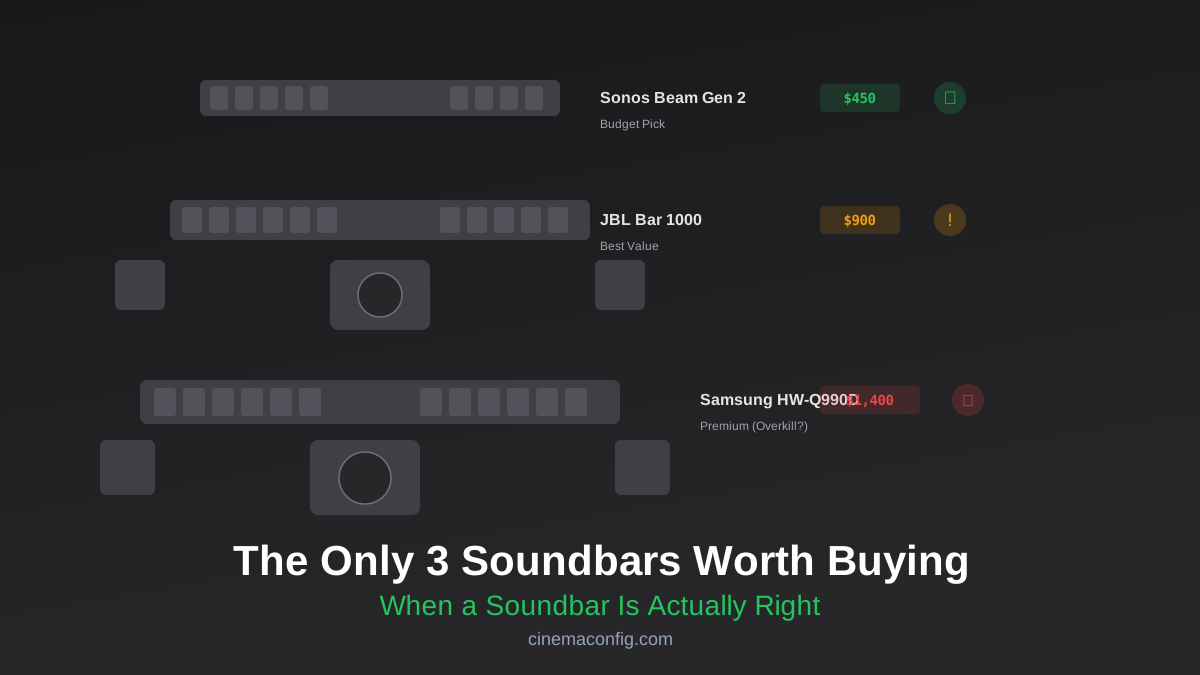
Most soundbars are bad. I wrote an entire post about why, and I stand by every word. But "most" is not "all," and pretending otherwise ignores reality. Some of you live in 500-square-foot apartments with paper-thin walls. Some of you have partners who will not tolerate speaker stands in the living room. Some of you rent and cannot run wire through walls. I get it. If you genuinely cannot do separates, here are the three soundbars that will not make me cringe.
Quick Picks
- Budget pick: Sonos Beam Gen 2 ($450). Best compact bar for small rooms under 200 sq ft. Dolby Atmos support, room correction via Trueplay, no subwoofer needed in tight spaces.
- Best value: JBL Bar 1000 ($900). Detachable wireless surrounds and a real 10" subwoofer. The closest thing to a proper 5.1 system without running any cables.
- Premium: Samsung HW-Q990D ($1,400). True 11.1.4 Atmos with wireless rear speakers and sub. The only soundbar system that genuinely approaches what a dedicated setup delivers. But at $1,400, you should seriously ask yourself why you are not just buying separates.
Rob's take
A soundbar is the right choice for apartments where speaker placement is impossible, not a budget compromise. The argument that soundbars are always inferior misses the point: a $400 soundbar correctly placed in a small apartment living room beats a $400 bookshelf pair jammed into corners six inches from side walls with no room to breathe. Setup context determines outcome, not specs.
When a Soundbar Actually Makes Sense
Before we get into the picks, let me be specific about who should be reading this instead of our apartment home theater guide. A soundbar is the right call when:
Your room is under 200 square feet and you are not trying to build a cinema. You rent and your lease prohibits wall mounting or wire runs. Your partner has vetoed speakers, and the relationship matters more than the Dolby Atmos spec sheet. You have a second TV in a bedroom or office where "good enough" audio is legitimately all you need. You are buying for an elderly relative who needs one remote and zero configuration.
If none of those apply to you, close this tab and go read the apartment guide. A pair of Neumi BS5 bookshelf speakers ($90) and a Fosi Audio BT20A amp ($70) will outperform every soundbar on this list for $160 total. That is not an exaggeration. Physics does not care about marketing budgets.
Budget Pick: Sonos Beam Gen 2 ($450)
The Beam Gen 2 is a 25.6-inch bar with five drivers, Dolby Atmos decoding, and Sonos's Trueplay room correction (iOS only, which is annoying). It will not shake your floor or fill a large living room, and that is fine, because it is not trying to.
What it does well: dialogue clarity in a small to mid-size room is genuinely good. The center channel driver is dedicated, not virtualized from the L/R array like cheaper bars. Trueplay calibration walks your phone's microphone around the room and adjusts the EQ to compensate for your specific reflections. The result is noticeably better than the uncalibrated output.
The downsides are real. Bass response rolls off around 55 Hz, so you are losing the bottom octave of movie soundtracks entirely. There is no HDMI passthrough, just one eARC connection, so everything routes through your TV first. And the Sonos app has been a dumpster fire since the 2024 redesign. You will fight with it during setup. After that, most people use their TV remote via HDMI-CEC and rarely touch the app.
At $450, the Beam is not cheap for a soundbar. But it is the cheapest option that does not actively degrade your experience compared to decent TV speakers. That is a low bar (literally), but it is the honest bar.
Best Value: JBL Bar 1000 ($900)
This is where things get interesting. The Bar 1000 ships with a 10-inch wireless subwoofer and two detachable satellite speakers that magnetically dock to the ends of the main bar. When you want surround, you pull the satellites off, set them behind your couch, and the system runs as a proper 7.1.4 configuration. When you want a clean look, they snap back on.
The concept is clever, and in practice it mostly works. The surrounds connect wirelessly with about 20ms of latency, which JBL's processing compensates for. The subwoofer hits down to around 35 Hz, which is deep enough to feel explosions and bass drops in most music. Room correction is handled by JBL's own calibration mic, and the results are decent if not Trueplay-tier.
The catch: those detachable surrounds need to be charged. JBL claims 10 hours of battery life, and real-world use confirms about 8. If you forget to dock them after movie night, you will sit down to watch something the next evening and discover your "surround system" is a stereo bar with a sub. It is manageable, but it adds friction that separates simply do not have.
The other issue is the bar itself. At 34 inches wide, it can look awkward under TVs larger than 65 inches. The build quality is good but plasticky compared to the Sonos. And 7.1.4 from satellites the size of a coffee mug is marketing optimism, not acoustic reality. Call it 5.1 with some height cues. That is still impressive for the form factor.
Premium: Samsung HW-Q990D ($1,400)
The Q990D is the soundbar I recommend when someone insists on spending over a thousand dollars on a bar system despite my best efforts to talk them into separates. It ships with a wireless subwoofer and two wireless rear speakers, runs a true 11.1.4 Dolby Atmos configuration, and includes Samsung's Q-Symphony feature that uses your Samsung TV's built-in speakers as additional channels.
In terms of raw performance, this is the ceiling for soundbar systems in 2026. The up-firing Atmos drivers create a more convincing height effect than any other bar I have heard. The sub hits 30 Hz clean. The rear speakers are actual speakers, not puck-sized afterthoughts. In a room under 300 square feet with hard ceilings (no vaulted, no popcorn), the Atmos effect is legitimately noticeable.
But here is the thing. At $1,400, you are firmly in separates territory. A Denon AVR-S670H ($250), a set of Polk R200 bookshelves ($500/pair), a Polk R300 center ($300), and an SVS SB-1000 Pro sub ($500) comes to $1,550. That is $150 more than the Q990D, and it will sound dramatically better. Not subtly, not "if you have golden ears." Dramatically. The stereo imaging, the bass authority, the dialogue clarity, the dynamic range: separates at this price point are a different class of experience.
The Q990D earns its spot on this list because some people genuinely cannot or will not do separates, and for those people, it is the best available option. But if you are spending $1,400 on audio and you have the room for bookshelf speakers on stands, please reconsider. CinemaConfig's system builder can show you exactly what a proper 5.1 setup looks like at that budget.
What About Vizio, Roku, TCL, and Everyone Else?
Skip them. The sub-$300 soundbar market is a wasteland of 2.0 and 2.1 systems with undersized drivers, fake Atmos processing, and build quality that degrades noticeably within 18 months. The Vizio M-Series was a decent budget pick two years ago. The current lineup has cut corners on driver size and amplification to hit lower price points.
Roku and TCL soundbars exist to be bundled with their TVs at checkout. They are not serious audio products. If your budget is under $400, you are better off with passive bookshelf speakers and a mini amp. It is not even close.
The Honest Take
A soundbar is a compromise. The three on this list are the best compromises available in 2026. The Sonos Beam Gen 2 is for people who want something small that sounds decent and integrates well. The JBL Bar 1000 is for people who want the surround experience without permanent speaker placement. The Samsung HW-Q990D is for people who want the absolute best a soundbar can do, cost be damned.
None of them will match a properly set up 5.1 system at equivalent cost. That is not opinion, it is acoustics. But "properly set up" assumes you have the space, the permission, and the willingness to run cables and place speakers. When those assumptions fail, these three bars are the ones that will not leave you wondering why you did not just keep using your TV speakers.
Rob Teller
Founder, CinemaConfig
15 years in consumer hardware and software, mostly on the product side. NZXT (cases and cooling), Asetek (liquid cooling, global sales), a short run advising on Alienware's roadmap at Dell, then four ... More about Rob · Affiliate disclosure


![Best TV for Nintendo Switch 2: Top Picks [2026]](/images/blog/best-tv-nintendo-switch-2.svg?dpl=dpl_A7yvEusbtVmAimLWJZTA31x7Ag82)