The Best Home Theater Speaker Packages (2026): 5.1, 7.1 and Atmos Bundles
For most living rooms in 2026 the SVS Prime Satellite 5.1 ($999 with the SB-1000 Pro 12-inch sub) is the package buy that actually makes sense, and the Klipsch Reference Theater Pack 5.1 ($999) is the lifestyle alternative if the satellites need to be smaller than a paperback novel.
The reason to buy a packaged system instead of piecing together a 5.1 from individual SKUs is tonal match. Five speakers from the same line, voiced together, with crossovers designed to hand off cleanly between the center and the mains. Get that wrong with mixed-brand stragglers and dialogue starts pulling left, surrounds smear into the front stage, and you spend a year wondering why nothing sounds right. The real fights in this category live below the badge. The SVS Prime Satellite 5.1 throws in the SB-1000 Pro (a 12-inch sub with a 325-watt RMS Sledge amp that SVS sells for $599 standalone, per the SVS product page), which is the entire reason that bundle works. The Klipsch Reference Theater Pack 5.1, by contrast, ships with an 8-inch wireless sub rated at 50 watts RMS / 150 watts peak that rolls off at 38 Hz (per Klipsch's spec sheet). One of those is a real subwoofer, the other is a tonally matched accessory. If you want to do Atmos on a budget, the Focal Sib Evo Dolby Atmos 5.1.2 ($1,999 MSRP) puts upfiring drivers in the L/R satellites so you skip the ceiling installation entirely, but a TechHive review fairly described it as a convenient but ineffective substitute for in-ceiling speakers, which is the honest take.
Five picks across configurations and budgets. The SVS Prime Satellite 5.1 gets the most space because most readers are buying their first packaged system and a 12-inch sub for $999 is the deal of the category. The Klipsch is the satellite-and-wireless-sub lifestyle pick. The SVS Prime Pinnacle Tower 5.0 is the no-compromise step up for a real room. The Focal Sib Evo Atmos covers the cant-install-ceiling-speakers crowd. The Enclave CineHome PRO is the rare wireless system that earns its THX badge.
How We Score
We score speaker packages on tonal match across channels, the quality and authority of the included subwoofer, channel count appropriate to the room, build and finish, and dollar-per-channel value. Sub quality is weighted hardest because it is the spec that separates a real home theater package from an HTIB pretending to be one. We count driver topology consistency (horn-loaded across all five mains, or dome-tweeter across all five, not a mix), measured frequency response from the manufacturer or a credible review, sensitivity in dB/W/m where published, and AVR requirements (powered sub plus passive mains, or fully wireless with a hub). Atmos channel count counts only if the height drivers are real, not a passive resonator marketed as one. Street pricing is used for any package shipping today.
What you get at each price point
Four tiers, each step up changes what kind of room the package can fill.
$500–$1,000Real-sub starter bundles
Klipsch Reference Theater Pack 5.1 ($999) for satellite-small footprint with a Tractrix-horn front stage, or SVS Prime Satellite 5.1 ($999) if you want the SB-1000 Pro 12-inch sub in the box. Below $500 you are buying an HTIB.
$1,500–$2,000Wireless or compact-Atmos territory
Enclave CineHome PRO ($1,600) if you cannot run speaker wire, or Focal Sib Evo Atmos 5.1.2 ($1,999) if you want height channels without ceiling drillwork. Both ship with their own amplification, so no AVR purchase needed for the Enclave.
$2,500–$3,500Bookshelf and tower-based 5.0 bundles
SVS Prime Pinnacle Tower 5.0 ($2,992) drops the included sub but the towers run usefully full-range. Plan on adding an SB-1000 Pro or SB-3000 for movie LFE. The Klipsch Reference 5.0.2 Bundle ($2,499) bundles a 7.2 Onkyo AVR into the same price tier, which is the unusual move in the category.
$3,500+Lifestyle Atmos and design-room systems
Focal Dome Flax Pack 5.1 ($3,419) for the small-chassis Atmos-precursor system where the satellite cabinet has to be furniture-grade. Past $4,000 most buyers are spec'ing item-by-item rather than packages, because the constraint shifts from value to room geometry.
Best OverallScore: 60/100
SVS
PRIME SATELLITE 5.1
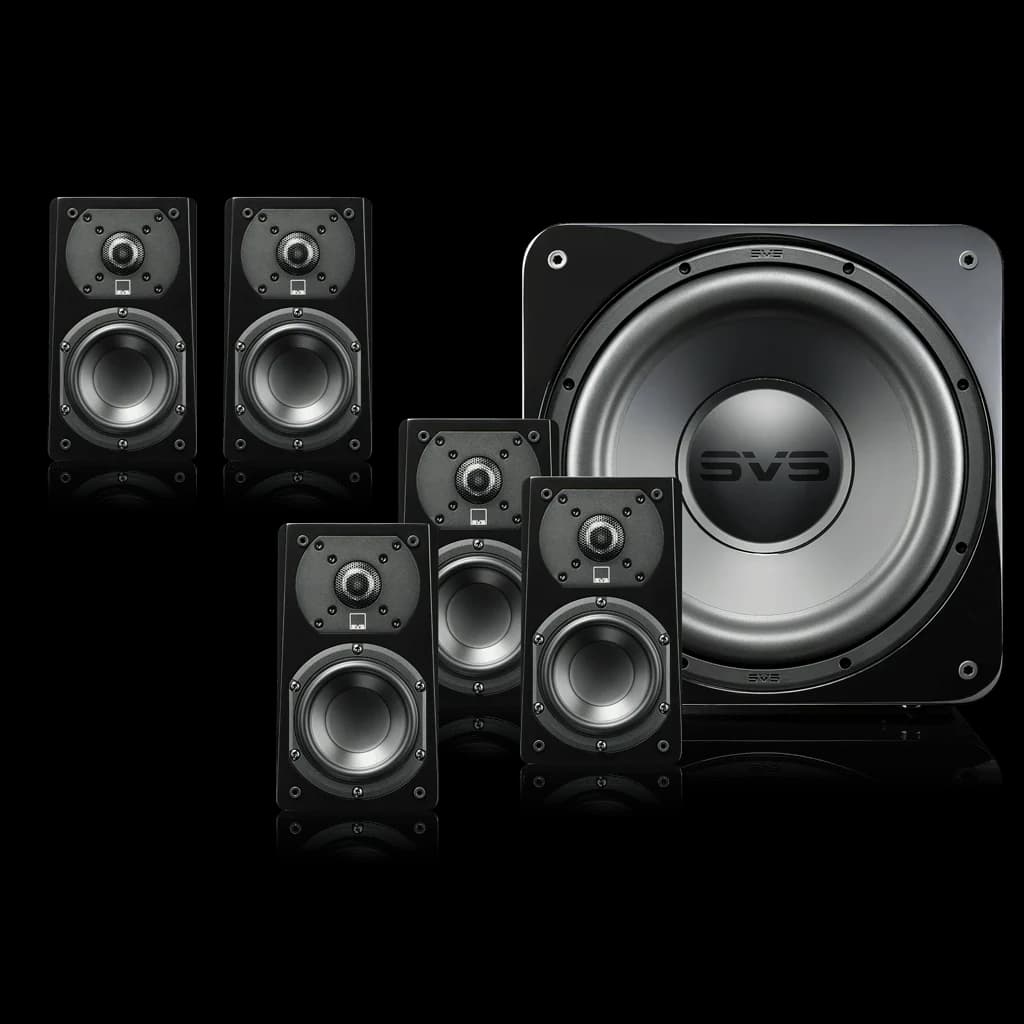
The SVS PRIME SATELLITE 5.1 earns our top pick in this category at $1,000.
The Prime Satellite 5.1 is SVS's small-footprint bundle, four compact Prime Satellite speakers plus a horizontal center channel plus the SB-1000 Pro 12-inch subwoofer with a 325-watt amplifier. The SB-1000 Pro is the pivot: it's the same sub SVS sells standalone for $599, and including it in this bundle pulls the package value substantially. At its price tier it competes with the Bose Acoustimass 10 V and the Polk Audio Blackstone TL1600 5.1; the SVS buy reason is the SB-1000 Pro genuine LFE authority that satellite-system competitors rarely match, the trade-off versus the bookshelf or tower bundles is the satellite mids and high frequencies that don't scale to the same SPL ceiling as a Prime Bookshelf.
Trade-off: The SVS Prime Satellite 5.1 is the right package for most rooms because the SB-1000 Pro is the part of the bundle that does the real work. A 12-inch driver, 325 watts RMS, 820+ watts peak with a Sledge amp and a 50 MHz DSP, all in a 13-inch sealed cabinet (per SVS's product page) is genuinely the same sub SVS sells standalone, not a stripped-down OEM variant. The satellite speakers themselves are the trade-off. SVS rates them 69 Hz to 25 kHz at 85 dB sensitivity, which is fine for dialogue and surround effects but starts running out of headroom at action-movie SPLs. If your room is bigger than about 2,000 cubic feet, or if you watch movies at reference level, step up to the Prime Bookshelf Surround System ($1,250, mains only) and add the SB-1000 Pro separately.
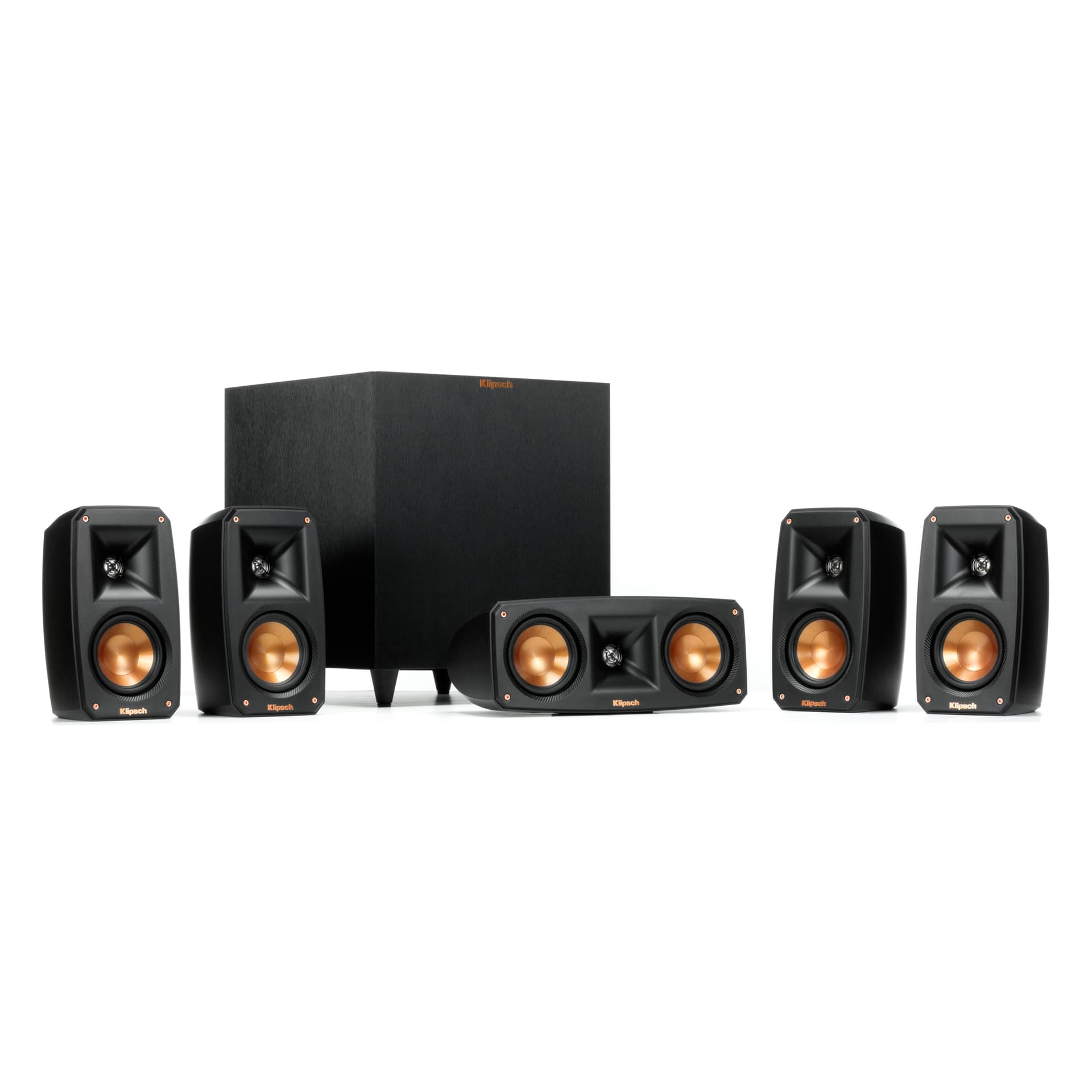
For the best bang for your buck, the Klipsch REFERENCE THEATER PACK 5.1 stands out in this category at $999.
The Reference Theater Pack 5.1 is Klipsch's all-in-one bundle, four matched satellite speakers plus a horizontal center channel plus an 8-inch wireless subwoofer in a single purchase. Tractrix horn-loaded tweeters across all five mains keeps the timbral match consistent across the front stage and surrounds, and the wireless sub skips the LFE cable run from the AVR position. At its price tier it competes with the Polk Audio TL1600 5.1 system and the Definitive Technology ProCinema 600; the Klipsch buy reason is the horn-loaded high frequencies that scale with output (Klipsch satellites stay composed at higher SPL than dome-tweeter competitors), the trade-off is the 8-inch sub that runs out of authority below ~40 Hz and demands a sub upgrade if action-movie LFE is the priority.
Trade-off: The Klipsch Reference Theater Pack 5.1 wins on tonal consistency across the front stage because all five satellites use the same 3.5-inch IMG woofer plus 0.75-inch Tractrix-horn tweeter combo, rated 110 Hz to 23 kHz (per Klipsch's spec sheet). Sound & Vision's review found the horn-loaded tweeter scales better at higher SPL than dome competitors at this price. The honest trade-off is the wireless sub. An 8-inch down-firing driver with 50 watts RMS (150 watts peak) that rolls off at 38 Hz is not a real LFE source. It moves the cushions a bit during explosions and that is the ceiling. For a bedroom or apartment system the bundle is fine. For a real home theater room, plan to swap the sub for an SVS PB-1000 or PB-2000 Pro within the first year.
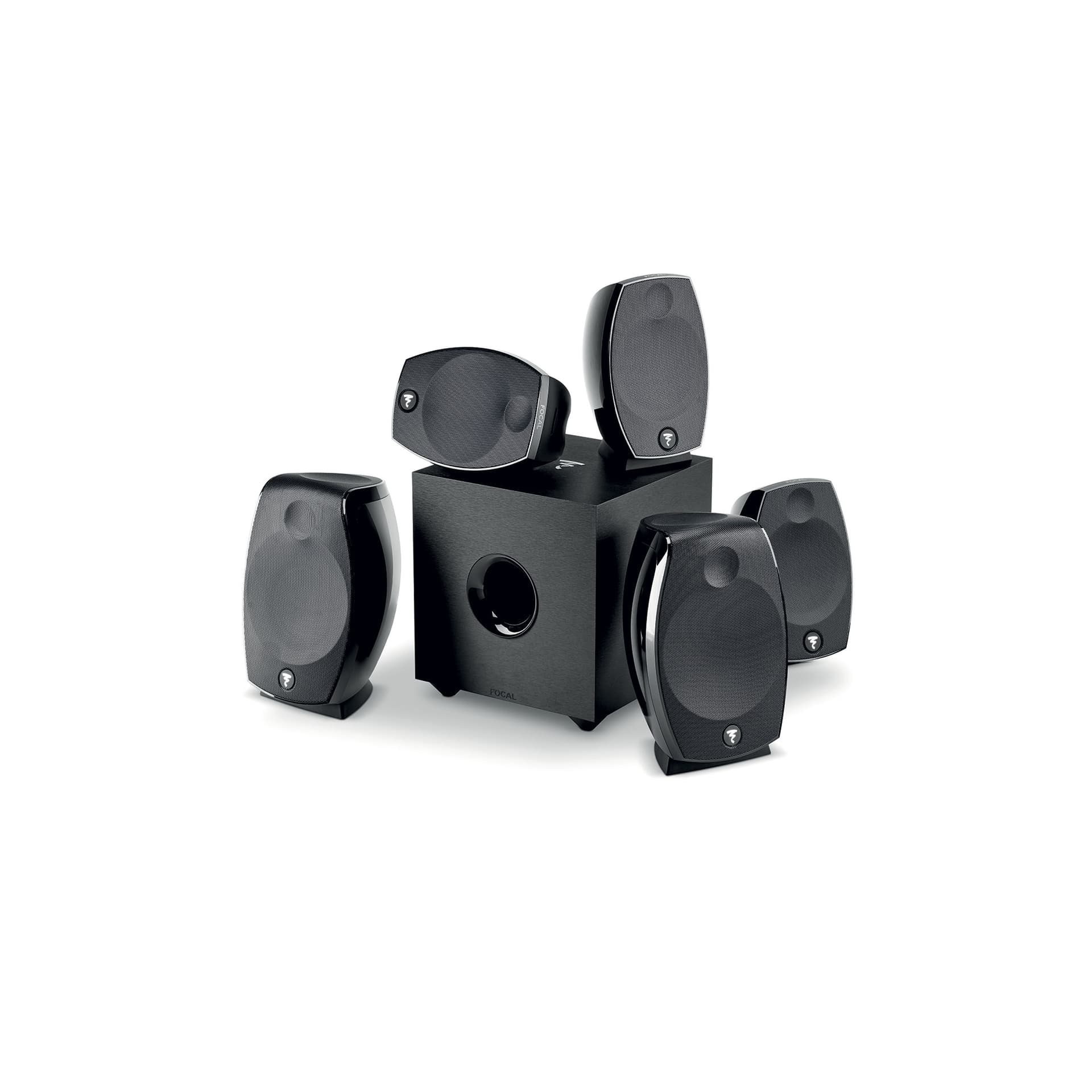
The Focal SIB EVO DOLBY ATMOS 5.1.2 proves you don't need to break the bank in this category at $1,999.
The Sib Evo Dolby Atmos 5.1.2 is Focal's entry into the Atmos satellite category, the 5.1.2 package where the front L/R Sib Evo satellites carry built-in upfiring Atmos drivers (so you get height channels without ceiling speakers or separate elevation modules). Five satellites total, the Cub Evo sub, AVR-required. At its package price it competes with the SVS Prime Pinnacle Atmos 5.1.2 and the ELAC Debut 2.0 Atmos package; the Focal buy reason is upfiring Atmos in the front satellites (a smaller install footprint than separate elevation modules), the trade-off is the same compact-cabinet bass extension as the standard Sib Evo 5.1 and the limited Atmos placement geometry from upfiring drivers in seated positions.
Trade-off: The Focal Sib Evo Dolby Atmos 5.1.2 is the cleanest packaged path to Atmos that does not require ceiling work. Two of the front satellites have a 4-inch upfiring driver built into the top of the cabinet (claimed 90 Hz to 20 kHz per Focal's spec), three regular satellites for center plus surrounds, and the Cub Evo 8-inch front-ported sub with 200 watts of Class D (35 Hz to 150 Hz, per Focal). Where the bundle gets honest is its physics. Upfiring drivers bounce sound off the ceiling to fake a height channel, and the bounce only works if the ceiling is flat, untextured, and 8 to 12 feet up. Vaulted ceilings, popcorn texture, or open lofts all defeat it. TechHive's review called the result a convenient but ineffective substitute for in-ceiling speakers, and that is the right framing. If you can install proper Atmos modules, do that instead. If you cannot, this is the next-best thing and the bundle voicing is genuinely good.
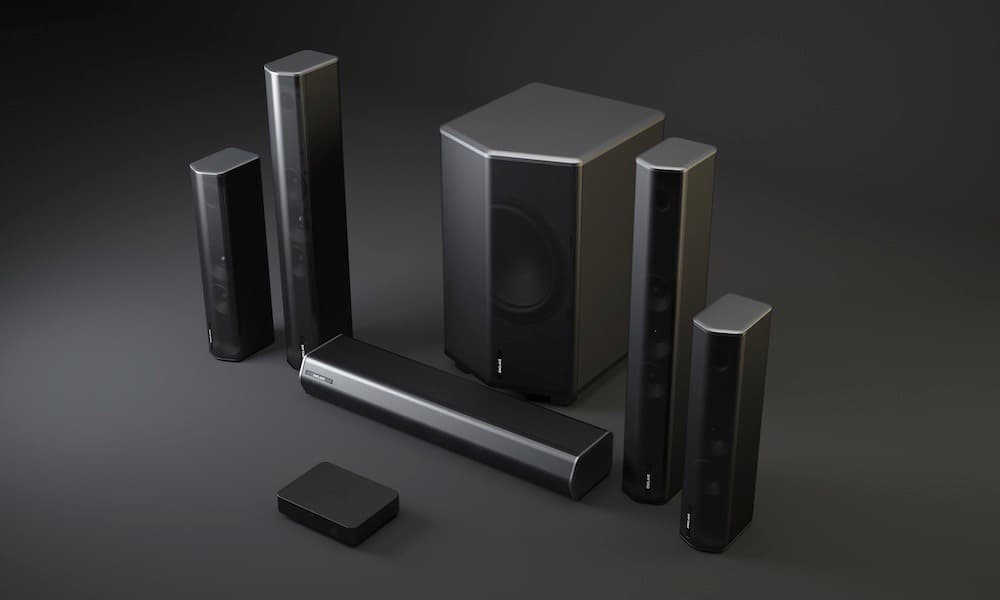
The Enclave CINEHOME PRO represents the pinnacle in this category at $1,600.
The CineHome PRO is Enclave's fully wireless 5.1 home theater system, the THX-certified package where every speaker (including the surrounds) connects to the included hub via the WiSA wireless protocol rather than speaker wire. 24-bit/96 kHz wireless audio (full lossless quality, not Bluetooth-tier compression), no AVR required, just the hub and the speakers. At its launch price it competes with the Bang & Olufsen Beolab line and a Sonos Era 300 5.1 setup; the Enclave buy reason is THX certification on a fully wireless system (rare, and meaningful for buyers who can't run speaker wire), the trade-off versus a wired 5.1 plus AVR is the price tier and the dependence on the hub for any future expansion.
Trade-off: The Enclave CineHome PRO is one of the very few wireless 5.1 systems that earns a THX certification, which means UL's THX Integrated Systems test (uniform response at any listening position, system efficient enough for cinema SPL in a 6 to 8 foot viewing distance, per Residential Systems' review) said yes. The WiSA backbone carries 24-bit/96 kHz uncompressed to each speaker with about 5 ms of latency and sub-microsecond inter-channel sync (per the WiSA spec), which is the real reason wireless surround works here at all. The trade-off is the platform lock-in. Eleven Class-D amps and a 10-inch sub are tuned by Enclave to this specific configuration, and the hub is the only path in. Adding height channels later means buying Enclave's roadmap, not raiding a Best Buy speaker aisle. For renters and apartment owners who cannot run wire, the lock-in is worth it. For anyone who can pull speaker wire, a Klipsch Reference Cinema 5.1.4 plus a midrange AVR delivers more capability for similar money.
Is a speaker package better than buying individual speakers?
For a first system, almost always yes. A package guarantees the five (or seven) mains were voiced together and the crossovers match, which is the single most common failure mode of a DIY-assembled surround stage. Mismatched front-to-surround timbre makes panning effects fall apart and dialogue sound disconnected from the on-screen mouth. Where individual-SKU buying wins is at higher tiers where you want a serious sub (SVS, Rythmik, HSU) paired with neutral bookshelves and a real center, because no packaged bundle puts a $1,500 sub in the box.
5.1 vs 7.1 vs 5.1.2: which channel count is right for my room?
Room dimensions decide it, not budget. 5.1 wants a rectangular room with the listening position about two-thirds of the way back from the front wall and side walls within 4 to 6 feet of the surrounds. 7.1 adds rear surrounds and requires at least 4 feet of clearance behind the seating, which excludes most living rooms with the couch against the back wall. 5.1.2 (Atmos) needs a flat 8 to 12 foot ceiling for the upfiring trick to work, or in-ceiling speakers if you can install them. For an apartment or open living room, 5.1 is almost always the right answer.
Is the subwoofer in a packaged system any good?
Mostly no. The SVS Prime Satellite 5.1 is the obvious exception because it bundles the same SB-1000 Pro SVS sells standalone for $599. Most other packaged subs are 8-inch or 10-inch units rated 50 to 100 watts that roll off at 35 to 40 Hz, which is fine for music and weak for movie LFE. If a package is your starting point, budget for a sub upgrade within the first year unless the package is the Prime Satellite 5.1, the Prime Satellite Pro 5.1, or one of the bundles that explicitly includes an SVS sub or equivalent.
Can I add Atmos height channels to a 5.1 package later?
Depends on the package. The SVS Prime, Klipsch Reference, and Definitive Technology ProCinema lines all sell matching Atmos elevation modules or upfiring add-ons that bolt onto the existing fronts. The Focal Sib Evo already has upfiring in its Atmos 5.1.2 variant. The Enclave CineHome PRO does not currently sell height add-ons, so if Atmos matters to you in 2 to 3 years, the Enclave is the wrong pick today.
Do I need a separate AVR if I buy a speaker package?
For the SVS Prime Satellite 5.1, Klipsch Reference Theater Pack, Focal Sib Evo Atmos, Definitive ProCinema 6D, and most other passive packages, yes. The satellites need amplification and the AVR handles surround decoding and bass management. Budget a Denon AVR-S670H or Onkyo TX-NR5100 at the low end, or the AVR-X1800H if you want Audyssey MultEQ XT room correction. The exceptions are the Enclave CineHome PRO and CineHome II, which include their own amplification and connect to the TV via HDMI eARC. No AVR purchase needed for those.
We have not run our own SPL or frequency response measurements on any of these systems, and several of the satellite numbers above come from manufacturer spec sheets rather than independent measurement (Audioholics measures the Prime Pinnacle tower individually but the packaged 5.1 satellites in this category are less well-documented than standalone speakers). The Klipsch wireless sub's 38 Hz floor in particular is a manufacturer claim; in-room response below 50 Hz is going to vary with placement more than the spec sheet suggests. Sib Evo Atmos upfiring effectiveness varies so much with ceiling geometry that anyone claiming a single quality number for it is lying.
The interesting question for 2027 is whether WiSA E (the next-gen WiSA spec promising 8-channel uncompressed at lower latency) ships in a real product, because that is what unlocks wireless 5.1.4 systems at the price tier where the Enclave currently sits. Until then the packaged-Atmos question keeps having the same answer it has had for five years: run the ceiling wire or accept the bounce.
CinemaConfig may receive compensation for purchases made at participating retailers linked on this site. This compensation does not affect what products or prices are displayed, or the order of prices listed. See our affiliate disclosure.