LG G6 vs Sony Bravia 9 II - Which 2026 Flagship Wins?
Quick Verdict
- Best overall: LG G6 ($3,400 for 65") -- 4,500 nits peak brightness, infinite OLED contrast, 4K/165Hz gaming, and 178-degree viewing angles. It wins more categories than any TV released this year.
- Best for film purists: Sony Bravia 9 II ($3,200 for 65") -- The XR processor handles motion, tone mapping, and upscaling better than LG's chip. If 24fps film content is your priority, Sony's processing edge is real.
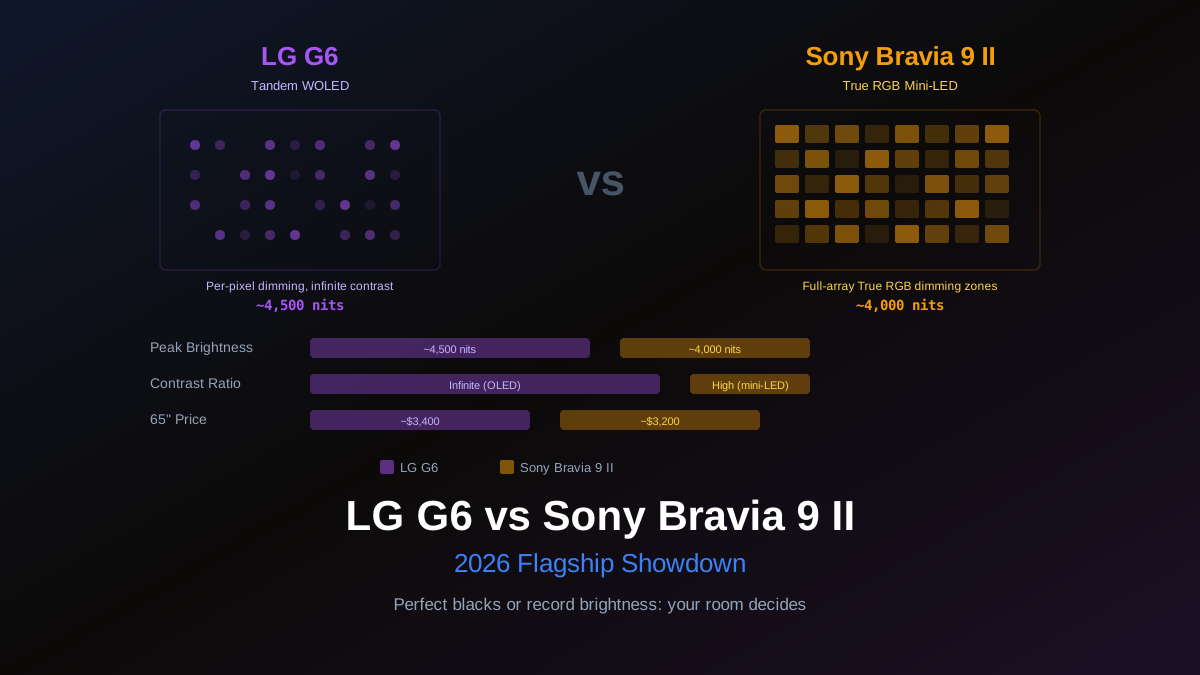
The LG G6 and Sony Bravia 9 II are built on fundamentally different display technologies competing for the same $3,000+ buyer. LG doubled down on Tandem WOLED, stacking four emission layers to reach a panel-spec peak of 4,500 nits (FlatpanelsHD measured the retail G6 at around 2,481 nits in calibrated Filmmaker mode) while keeping the infinite contrast ratio that defines OLED. Sony went the opposite direction with True RGB mini-LED, a backlight architecture that drives each red, green, and blue diode independently, pushing peak brightness to around 4,000 nits with dramatically improved color accuracy over conventional mini-LED.
The G6 is the better TV on paper. The Bravia 9 II makes content look better through processing. That distinction matters more than it sounds.
Rob's Take
The G6 winning on brightness over a mini-LED flagship is a sentence I genuinely didn't expect to write in 2026. Tandem OLED at a 4,500-nit panel-spec peak (with calibrated retail measurements landing closer to 2,500 nits in 10% HDR) with infinite contrast and zero blooming puts the G6 in a category of one. But I keep coming back to Sony's processing. What Hi-Fi's Tom Parsons saw the True RGB prototype in Tokyo and reported colors stayed accurate "regardless of window size," which is something traditional mini-LEDs have never achieved. And Sony's motion handling on 24fps film is still the best in the industry. If I'm building a dedicated theater room, I'm buying the G6. If I'm a film nerd who watches mostly streaming and Blu-rays, the Bravia 9 II's processing makes a real case. For everyone else, the G6 wins too many categories to ignore.
Brightness: LG Wins, and That's New
For years, the pitch for OLED was "perfect blacks, limited brightness." The G6 rewrites that. Early adopters on AVS Forum are reporting the G6 hits around 3,300 nits sustained and 4,500 nits peak on a 10% HDR window. The True RGB prototype measures close to 4,000 nits. The OLED is brighter than the mini-LED. That has never happened before at the flagship level.
In a dark room, both are absurdly bright for HDR highlights. The 500-nit gap between them on specular highlights (sun reflections, chrome bumpers) is barely visible when your eyes are adapted to darkness.
Where it gets nuanced: OLED panels use automatic brightness limiting (ABL) to protect the organic material during sustained bright scenes. A full white screen or a long, bright daytime sports shot will trigger ABL on the G6, reducing output below its peak. The Bravia 9 II, being an LCD, can sustain full-panel brightness indefinitely without throttling. If you watch a lot of sports with sustained bright fields (soccer, football, tennis), the Sony maintains more consistent brightness over time. For everything else, the G6's higher peak and zero blooming make it the brighter-looking TV in practice.
The G6's Reflection Free Premium coating cuts screen reflectance below 0.5%, which compounds the brightness advantage in rooms with ambient light. A bright highlight on the G6 is a clean, precise point of light. On the Sony, even with True RGB's improved dimming, there will be some halo from backlight zone bleed around bright objects on dark backgrounds. The persistent rumor is 15,000 dimming zones on the Bravia 9 II, roughly five times what the original Bravia 9 shipped with. Sony hasn't confirmed the number.
Contrast: LG Wins, and It Is Not Close
Infinite contrast ratio. That is the OLED value proposition in four words. When a pixel is black on the LG G6, it is off. No light leaks from adjacent zones. No elevated black floor in dark scenes. A starfield looks like actual stars against actual void.
The Bravia 9 II's True RGB backlight is the best LCD contrast implementation available, but it is still an LCD. Dark scenes will have slightly elevated black levels, and scenes with mixed bright and dark content (a candle in a dark room, text on a black background) will show some light bleed at the zone boundaries. Sony's XR processor mitigates this better than any competitor through intelligent zone management, but the physical limitation remains.
For dedicated home theater rooms where you control the lighting and watch dark cinematography (think Denis Villeneuve, David Fincher, anything from A24), the G6's contrast advantage is the single most important spec on this page.
Peak brightness: LG G6 wins (~4,500 nits vs ~4,000 nits)
Sustained brightness: Sony Bravia 9 II wins (no ABL throttling on sustained bright scenes)
Contrast ratio: LG G6 wins (infinite OLED vs high mini-LED)
Viewing angles: LG G6 wins (178 degrees vs ~70 degrees usable)
Motion processing: Sony Bravia 9 II wins (XR processor, best in industry)
Gaming: LG G6 wins (4K/165Hz, 5ms input lag, zero blooming)
Upscaling: Sony Bravia 9 II wins (cleaner streaming from compressed sources)
Price (65"): Sony Bravia 9 II wins ($3,200 vs $3,400)
Processing: The Reason Sony Still Has a Case
On raw specs, the G6 wins brightness, contrast, viewing angles, and gaming. So why does the Bravia 9 II exist at this price? Processing.
Sony's XR Cognitive Processor does things with motion that LG's Alpha 11 Gen 3 simply does not match. A slow pan across a cityscape, a tracking shot following a character through a market, the camera drift in a dialogue scene: Sony renders these with less judder and more natural cadence. If you have ever noticed "soap opera effect" on other TVs and hated it, Sony's motion processing walks the line between smoothing and judder better than anyone in the industry.
The XR processor's tone mapping is also superior in mixed-brightness scenes. A window behind a person's silhouette, a fire in a dark room. The Sony holds more shadow detail while rolling off highlights more naturally. LG clips highlights slightly earlier in these situations.
For streaming content specifically (which is most of what people actually watch), the Sony's upscaling from compressed 15-20 Mbps streams produces a cleaner image with fewer visible compression artifacts. Netflix and Disney+ content, which is often heavily compressed, genuinely looks better on the Sony. This is where the processing gap is most noticeable day-to-day.
A tangent about processing and "director intent"
The home theater community loves to argue about whether processing "respects director intent." It mostly does not, and it mostly does not matter. Directors master for reference monitors in grading suites. Your living room is not a grading suite. Sony's processing makes content look better on a consumer display in a consumer environment, and calling that a betrayal of artistic vision is like refusing to use reading glasses because the author wrote the book assuming 20/20 vision. Use the tools that make the picture look good to your eyes. (Purists: Filmmaker Mode exists on both TVs. Turn it on and the processing backs off.)
Gaming: LG Takes This One
The G6 supports 4K at 165Hz, exclusive to LG for 2026. The Bravia 9 II tops out at 4K/120Hz. For PC gamers with an RTX 5080 or 5090, those extra 45 frames per second at 4K resolution are a real advantage. For PS5 Pro and Xbox Series X owners, both consoles cap at 4K/120Hz, so the difference is irrelevant.
Input lag is comparable: roughly 5ms on the G6 in game mode versus approximately 8ms on the Bravia 9 II. Both support VRR, ALLM, and HGiG. LG's webOS game dashboard provides real-time frame rate and HDR status overlays that Sony's Google TV interface lacks.
The OLED advantage also matters for competitive gaming. Zero blooming means bright UI elements (health bars, minimaps, crosshairs) on dark game environments render without any halo or glow. On the Sony, fast-moving bright objects against dark backgrounds may show slight trailing from the backlight zone response time. It is subtle, but competitive FPS players notice it.
Which Room Gets Which TV
The G6 is the better all-rounder
Higher peak brightness, infinite contrast, zero blooming, 178-degree viewing angles, 4K/165Hz gaming, and Reflection Free Premium coating. The G6 wins in dark rooms, bright rooms, and gaming rooms. TechRadar tested the G6 side-by-side against Samsung's S95F and declared Samsung "no longer the OLED king of bright rooms." For most people, in most rooms, the G6 is the pick.
The Bravia 9 II is the film specialist
If you primarily watch 24fps film content, stream Netflix and Disney+ more than anything else, and value natural motion handling and upscaling above all other specs, the Bravia 9 II's processing advantage is real and visible. It also sustains full-screen brightness better during long, bright scenes (sports, nature documentaries) because LCD doesn't throttle the way OLED does. And at $200 less than the G6, the price favors Sony.
Still not sure?
Figuring out the right display for your room dimensions and viewing habits is exactly the kind of thing CinemaConfig's builder can help with.
Building a system around a new TV? The CinemaConfig builder matches your display to compatible AVRs, speakers, and sources based on your room size and what you actually watch.
Specs at a Glance
LG G6
- Best for: Most rooms, gaming, wide seating, bright and dark environments
- Key advantage: 4,500 nits peak + infinite contrast + zero blooming. The complete package.
- Key weakness: ABL limits sustained full-screen brightness; processing trails Sony on motion and upscaling
- Price: ~$3,400 (65"), ~$4,500 (77")
Sony Bravia 9 II
- Best for: Film enthusiasts, heavy streaming viewers, sustained-brightness content (sports)
- Key advantage: Best-in-class motion processing, tone mapping, and streaming upscaling
- Key weakness: LCD viewing angle limitations (~70 degrees), blooming in dark scenes, 4K/120Hz cap
- Price: ~$3,200 (65"), ~$4,300 (77")
Prices estimated as of April 2026 based on announced MSRPs and early retailer listings. Street prices may shift at launch. Check current prices on CinemaConfig.
True RGB mini-LED is still in its first generation, and the fact that it already lost the brightness war to OLED tells you how fast Tandem panels have moved. Sony's case now rests entirely on processing, and that's actually a stronger position than it sounds. Processing improves with firmware. Brightness is fixed at the panel.
Rob Teller
Founder, CinemaConfig
15 years in consumer hardware and software, mostly on the product side. NZXT (cases and cooling), Asetek (liquid cooling, global sales), a short run advising on Alienware's roadmap at Dell, then four ... More about Rob · Affiliate disclosure


