The Best Turntables for Home Theater and Hi-Fi (2026)
The Pro-Ject Debut PRO B at $1,099 is the deck to buy if you want one turntable that you will not outgrow, the Pro-Ject E1 at $349 is the honest entry point that won't chew up your records, and the Rega Planar 6 at $1,925 is where the hobby stops being about the deck and starts being about the pressing.
Vinyl is the one home-theater category where the cheapest version of the thing is fundamentally a different product from the expensive version, and the gap matters. A $99 all-in-one suitcase deck and a $1,099 Pro-Ject both spin records, but only one of them won't slowly destroy them. Below $300 you are usually buying a ceramic-cartridge plastic plinth with a tracking force that wears grooves down to noise. Above $300 the deck stops being the limiting factor and the cartridge does. One thing up front about this list: we stock Pro-Ject and Rega, and that is the whole roster here. We do not carry the Audio-Technica AT-LP120, the Fluance RT series, the U-Turn Orbit, or the Technics SL-1500C, all of which are decks we would happily recommend to a friend. So read this as "the best turntables we actually sell," not "the only good turntables," and where one of those outside decks is the smarter buy for your situation, we say so. The thing nobody tells beginners is that the stock cartridge is almost always the weakest link, and a cartridge upgrade two years in is a bigger jump than buying the next deck up. Most modern AVRs no longer have a phono input, so plan on either a deck with a built-in preamp or an external one before you click buy.
Three picks from the two brands we carry, spanning entry to audiophile. None of them are suitcase decks. None of them ship with a ceramic cartridge. The cheapest one on this list still tracks lighter than the heaviest deck on Amazon's bestseller chart.
How We Score
We score turntables on six things, weighted roughly in this order: cartridge quality and tracking force at stock setup (a deck that destroys records gets disqualified), tonearm build and bearing quality (the part that actually does the work), motor and platter speed stability, plinth material and resonance control, feature set relative to the buyer's amp situation (built-in phono, balanced output, Bluetooth), and upgrade path (replaceable stylus, adjustable tonearm geometry). Specs are pulled from manufacturer pages and cross-referenced against Stereophile, What Hi-Fi, and The Absolute Sound where available. Subjective character ("this Rega sounds more musical") we leave to the audiophile press. Our job is to identify the deck that plays records well at each price, from the brands we stock.
What you get at each price point
Turntable pricing has clearer tiers than most home-theater gear, partly because the parts are mechanical and the cost-per-improvement is visible. Across Pro-Ject and Rega our catalog runs from $349 to nearly $15,000.
$0–$300The danger zone, mostly
Below $300 is where you find Crosley suitcase decks, Victrolas, and Amazon-bestseller plastic plinths with ceramic cartridges that track at 5+ grams. They wear records. We don't sell anything in this tier on purpose. If $349 is genuinely out of reach this month, the honest move is to wait and save rather than buy a deck that damages the music you're buying it to play.
$349–$600Your first real turntable
This is where vinyl stops being a novelty and starts being a hi-fi source. The Pro-Ject E1 at $349 is our entry pick: real belt drive, a factory-fitted Ortofon OM 5E cartridge, and a proper aluminum tonearm. Rega's Planar 1 ($595) sits at the top of this tier if you want the Rega house sound from the start. The jump from a $99 deck to a $349 deck is the difference between "records are a fun curiosity" and "records sound better than streaming for the music I care about."
$750–$1,300The one-deck tier
This is where most buyers should land and stop. The Pro-Ject Debut PRO B ($1,099), the Rega Planar 3 ($1,125), and Pro-Ject's X1 ($1,099) all live here. These are decks you keep for a decade. You are paying for a serious tonearm, a better cartridge, and build quality that holds its setup. Above this tier you are buying refinement, not fundamentally better record-playing.
$1,900+The audiophile lane
Rega Planar 6 ($1,925), Pro-Ject X2 ($1,699), the Rega Planar 8 ($4,145), all the way up to the Rega Naia at $12,995 and Pro-Ject's Signature 12 at $14,999. We do cover the Planar 6 below because it is the sane on-ramp to this tier. Above it, the buyer has usually already auditioned three decks and read forty forum threads and does not need our recommendation.
Best OverallScore: 0/100
Pro-Ject
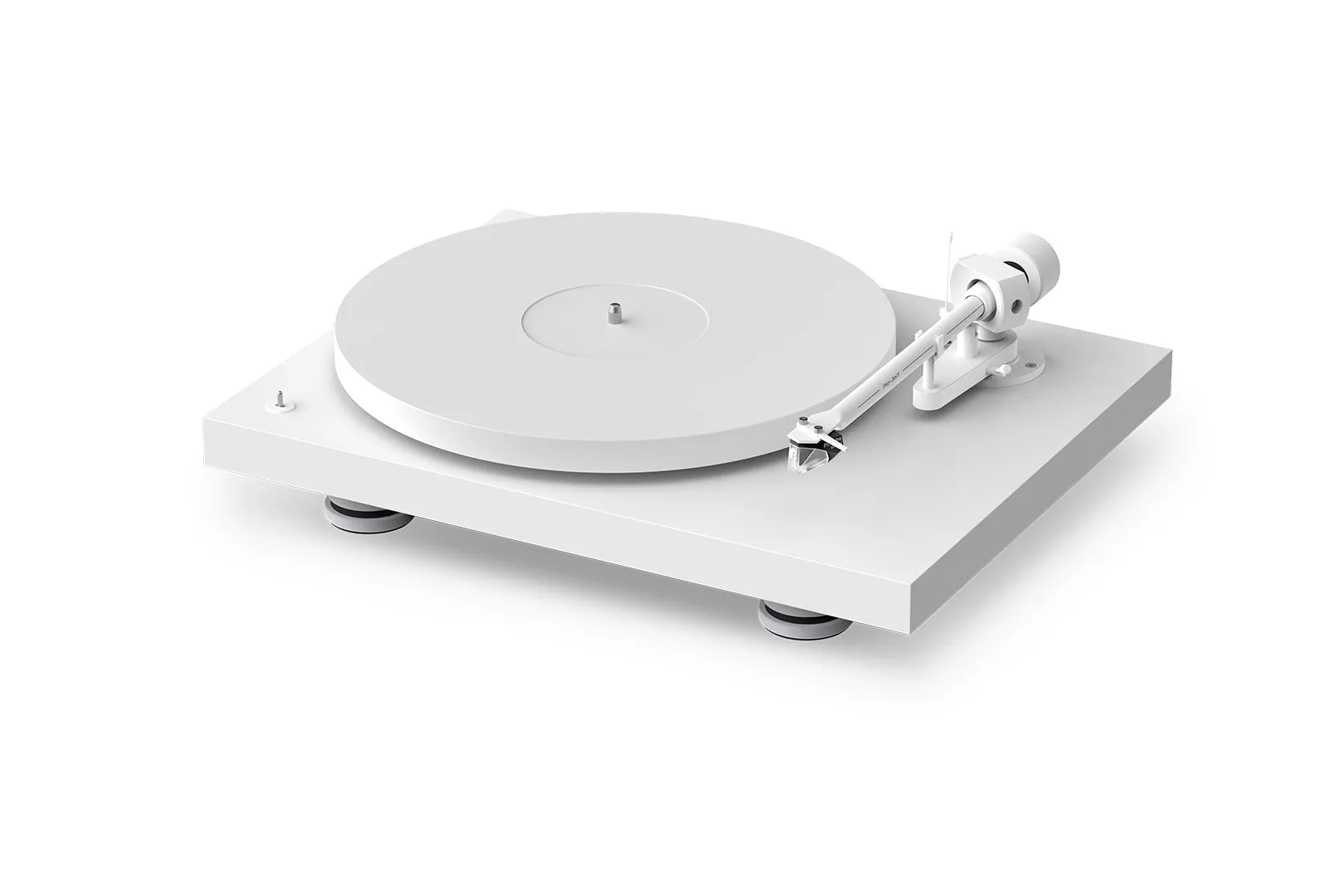
Debut PRO B White Edition
The Pro-Ject Debut PRO B White Edition earns our top pick in this category at $1,099.
The Debut PRO B White Edition is the white-finish variant of the Debut PRO B, with the same aluminum-sandwich plinth, S-shape carbon-aluminum tonearm, and Pick It PRO MM cartridge as the standard model. Performance is identical; the buy reason is the room aesthetic. Pro-Ject's pattern of finish-variant SKUs at the flagship Debut tier matches the pattern at the Debut entry, T1, and X-line tiers across the catalog.
Trade-off: The Pro-Ject Debut PRO B at $1,099 is the deck we recommend to anyone who asks "what one turntable should I buy." The one-piece carbon-and-aluminum sandwich tonearm is genuinely rigid and well-damped, the tonearm base lets you set azimuth and VTA (rare at this price), and it ships with Pro-Ject's Pick it PRO Balanced cartridge and a true-balanced mini-XLR output for systems that can use it. The catch is the same catch as most serious decks: no built-in phono preamp, no USB, no Bluetooth. If your amp doesn't have a phono input you're spending another $130-$150 on a Pro-Ject Phono Box before you can play a record. Budget for that before you order. If you want plug-and-play at this money instead, the Technics SL-1500C (which we don't carry) has a built-in preamp and auto-lift and is the better fit for a set-and-forget buyer.
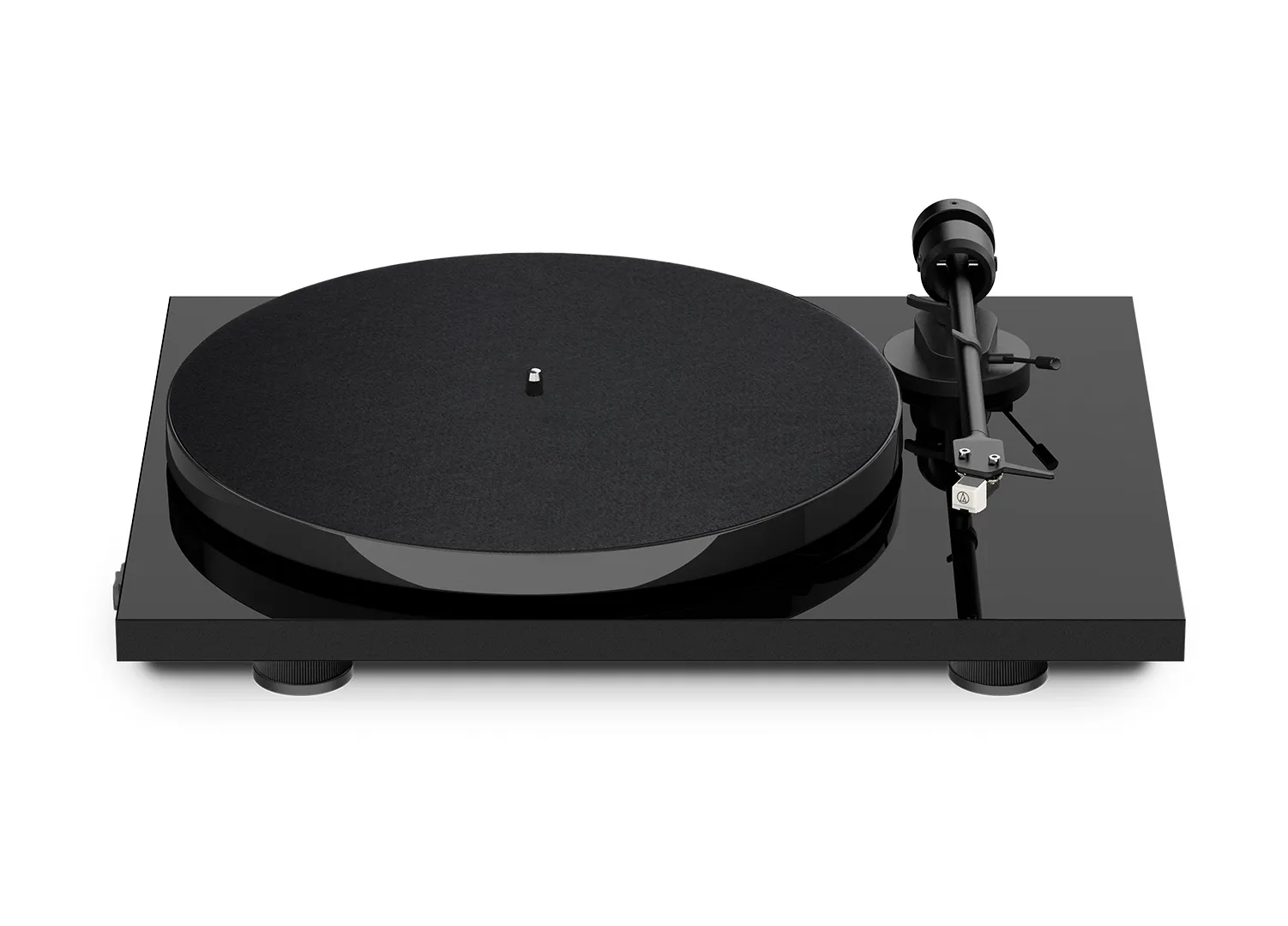
For the best bang for your buck, the Pro-Ject E1 stands out in this category at $349.
The E1 is Pro-Ject's E-line entry, the value tier just below the T-line in price and one rung above the Elemental in engineering. An MDF plinth, an 8.6-inch aluminum tonearm, and an Ortofon OM5e MM cartridge factory-mounted. The E-line is positioned to compete with the U-Turn Orbit and the Audio-Technica AT-LP120 at sub-$300 pricing. The trade-off versus the slightly more expensive T1 EVO is a simpler tonearm and motor isolation; the upgrade path through the E1 family (Phono, BT, Standard) mirrors the T1 family's variant pattern.
Trade-off: The Pro-Ject E1 at $349 is the cheapest deck we'll put our name on, and it earns it. Belt drive with a damped DC motor, an electronic 33/45 speed switch, a CNC-machined composite plinth with no hollow resonant cavities, and a factory-fitted Ortofon OM 5E with tracking force and anti-skate pre-set at the factory. It is genuinely plug-and-play in the sense that matters: you will not destroy records with it. The honest caveats: the base E1 has no built-in phono preamp (the E1 Phono at $399 does, and the E1 BT at $499 adds Bluetooth), and the stock OM 5E is the obvious first upgrade two years in. If you specifically need a deck under $400 that ships ready to plug into any modern amp AND rip records over USB, the Audio-Technica AT-LP120XUSB is the deck to buy and we don't stock it. Inside our catalog, the E1 is the entry point and the E1 Phono is the version most people should actually order.
The Rega Planar 6 represents the pinnacle in this category at $1,925.
The Planar 6 is Rega's upper-mid turntable, sitting between the Planar 3 and the flagship Planar 10. The phenolic-resin polyplate plinth is the buy-up over the Planar 3's standard plinth, with the same RB330 tonearm scaled up in mass by virtue of the heavier mounting platform. The standard cartridge package pairs with the Ania MC or the Exact MM depending on the buyer's phono-stage preference. Cross-shop at this tier is the Clearaudio Concept Wood or the Pro-Ject X8 Evolution; the Planar 6 buy reason is the Rega engineering ladder and the polyplate plinth, the trade-off versus the Clearaudio Concept is no built-in motor speed-control system.
Trade-off: The Rega Planar 6 at $1,925 is what you buy when you've decided vinyl is permanent. The plinth is Tancast 8 aerospace polyurethane foam, chosen to be ultra-light and rigid rather than heavy and damped, which is the opposite of the mass-loaded philosophy and a big part of why Regas sound the way they do. It ships with the RB330 tonearm, a dual-layer float-glass platter, and the outboard Neo PSU that handles speed selection and fine adjustment and is hand-matched to the motor. Factory cartridge options run from the Nd5 and Nd7 moving-magnets to the Ania Pro moving-coil. The trade-off versus a Pro-Ject at similar money is philosophy: Rega is light, rigid, manual, and ritual; Pro-Ject is more adjustable and feature-flexible. Both are correct. Pick the one that matches how you actually listen.
For home listening, belt drive is generally quieter because the motor is mechanically isolated from the platter, and every deck on this list (Pro-Ject and Rega both) is belt drive. Direct drive wins for DJ use or anywhere you need the platter at full speed instantly. For the average hi-fi listener, the difference between a well-made belt drive and a well-made direct drive is smaller than the difference between any of them and the speakers they're connected to. If you specifically want direct drive with a built-in preamp and USB, that points you at the Audio-Technica AT-LP120XUSB, which we don't carry.
Do I need a phono preamp?
Yes, somewhere in the chain. A turntable cartridge outputs a signal about 1,000 times quieter than a line-level source, and it needs RIAA equalization. In our catalog, the Pro-Ject E1 Phono ($399) has the preamp built in; the base E1 ($349), the Debut PRO B, and every Rega Planar do not. Some integrated amps and a few older AVRs have a phono input. If neither applies, you need an external preamp: the Pro-Ject Phono Box at around $130 is the easy in-house pairing, and the Schiit Mani 2 at $149 is the one we reach for most often outside it. Most AVRs made in the last ten years do not have phono inputs, so check before you assume.
Why don't you list the Audio-Technica AT-LP120 or a Technics?
Because we don't stock them, and we'd rather tell you that than pretend our catalog is the whole market. We carry Pro-Ject and Rega. Both make excellent decks across the full price range, so you can build a complete system from this list without compromise. But if your specific need is a direct-drive deck with a built-in preamp and USB ripping (AT-LP120XUSB) or a plug-and-play premium deck with auto-lift (Technics SL-1500C), those are genuinely the right tools and they're worth buying elsewhere. We'd rather you get the right deck than the right brand.
How much should I budget for the cartridge upgrade?
On a $349-$1,100 deck, the stock cartridge is usually the weakest link, and a $150-$250 upgrade two years in is the biggest single improvement you can make. On the Pro-Ject E1, stepping the Ortofon OM 5E up to an OM 10 or OM 20 stylus is a cheap, drop-in jump. On the Debut PRO B, Pro-Ject's own Pick it PRO line and Ortofon's 2M family both fit. On a Rega, the factory Nd-series and Ania cartridges are already strong, so the same logic applies but the starting point is higher. Spend the upgrade money on the cartridge before you spend it on the next deck up.
Suspended vs rigid plinth, and what is the Rega foam plinth about?
Most decks on this list are rigid: they rely on a solid surface underneath them and control resonance through plinth material rather than springs. Rega takes that further with the Planar 6's Tancast 8 polyurethane foam core, an aerospace material chosen to be extremely light and stiff so there's less mass to store and release vibration. It's the opposite of the heavy mass-loaded approach and it's a big part of the Rega sound. Practically: if your turntable is going on a flimsy shelf above a 15-inch sub, get a wall shelf or a heavy rack regardless of which deck you buy. Isolation is mostly about what's under the deck.
Are the 45 RPM and Bluetooth features worth caring about?
45 RPM is worth it if you buy 7-inch singles or 12-inch 45 RPM audiophile reissues, which are a real format in modern vinyl. Every deck on this list does 33 and 45. Bluetooth is a different question: the Pro-Ject E1 BT ($499) adds a Bluetooth transmitter so you can send vinyl to wireless speakers or headphones, which is genuinely useful in a casual room and pointless in a dedicated listening setup. If you're feeding a real amp, skip it and put the $150 toward the E1 Phono plus a cartridge upgrade fund.
Two boundaries worth stating plainly. First, we stock Pro-Ject and Rega only, so this list is the best of those two lines, not the best turntables on Earth. The AT-LP120XUSB, Fluance RT82, U-Turn Orbit, and Technics SL-1500C are all decks we'd recommend and don't sell, and we've named them above where they're the better fit. Second, we have not measured wow and flutter on any of these decks ourselves; the specs we cite come from manufacturer sheets and Stereophile / What Hi-Fi / Absolute Sound bench tests. Subjective character ("the Rega sounds more PRaT") is also outside what we'll commit to in print. If that's what you're chasing, audition before you buy. Most hi-fi dealers will let you bring a record.
The bigger shift in vinyl over the next two years is going to happen at the cartridge end, not the deck end. Ortofon, Rega, and Sumiko have all been refining their entry-level lines, and the gap between a stock cartridge and a $200 aftermarket upgrade is closing. The turntable you buy in 2026 will probably still be the turntable you own in 2030. The stylus will not be.
CinemaConfig may receive compensation for purchases made at participating retailers linked on this site. This compensation does not affect what products or prices are displayed, or the order of prices listed. See our affiliate disclosure.