The Best Surround Speakers for Home Theater (2026)
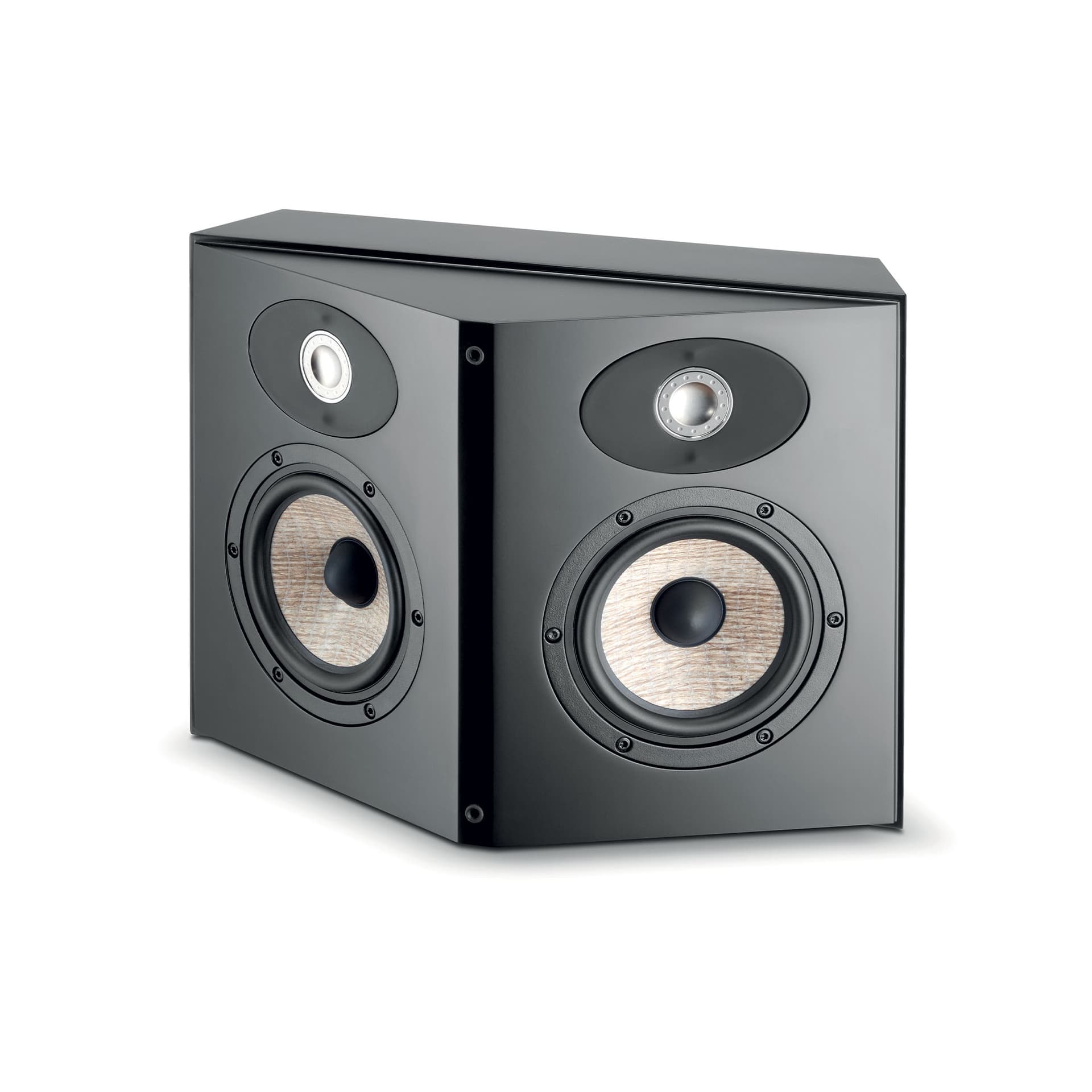
The Focal Aria SR900 ($1,099 each) is the surround most serious enthusiasts should buy in 2026, a 2-way bipolar design with dual 5-inch Flax-cone woofers that timbre-matches the popular Aria and Evo X front speakers, and for buyers with a dedicated theater room and a serious budget the M&K Sound S300T tripole ($2,574.50 each) is what the people mixing the films you watch actually have on the wall.
Surround speakers do not have to match your LCR the way the center channel does. The center carries 60% of the dialogue, so an off-timbre center channel is a daily annoyance. Surrounds carry ambient effects, occasional pans, and Atmos object placements, which means the brain accepts a much wider tolerance for tonal difference between the fronts and the rears. This is the single most useful fact when shopping surrounds: the money you save by not buying matched-LCR surrounds is real, and it almost never costs you on movie nights. It can cost you on multichannel SACD or Atmos Music, but that is a smaller fraction of most systems' use.
The picks below span $150 to over $5,000 a pair. The Fluance Elite SXBP2 at $149.99/pair is the honest entry point for a 5.1 system that just needs ambient rears. The Atlantic Technology 4400 SR at $900/pair is the THX-certified value pick when you want bipole and dipole on the same speaker via a switch. The Focal Aria SR900 is the step-up for buyers who want their surrounds to keep up with a serious LCR. The S300T is the reference target for dedicated theaters.
Four picks across four real price tiers. The Focal Aria SR900 is the recommendation for enthusiasts running a quality front stage. The SXBP2 is the smart budget pick because it commits to bipolar dispersion at a price where a direct-radiating bookshelf would feel compromised. The 4400 SR is the THX-pedigree switchable option for buyers who cannot decide between bipole and dipole, at half the Focal's price. The S300T is the theater build target.
How We Score
We score surrounds on four pillars: dispersion architecture (bipole, dipole, direct, or switchable, scored against the listener's actual format mix), tonal match to the LCR family (matters more for multichannel music than movies), mounting flexibility (keyhole, integrated bracket, or stand-only), and dynamic headroom for surround peaks. We weight dispersion and mounting hardest. A surround that beats every spec sheet but cannot wall-mount is useless in 80% of rooms, because that is the percentage of installs where surrounds end up on a wall rather than on stands. Sensitivity and amplifier-load behavior get scored too, since most AVRs run the surround channels off the weaker side of the amp section.
What you get at each price point
Where the dollars actually go as you climb the ladder.
$100–$200/pairAmbient surrounds for a 5.1 movie system
Bipolar or small bookshelf-form direct-radiating designs. 4-inch class drivers, frequency response that almost certainly needs an 80 to 120 Hz crossover to a sub. Wall-mountable via keyhole. The Fluance SXBP2 sits here.
$700–$1,000/pairReal surround speakers for a mixed-format system
Dual-woofer cabinets, switchable dipole/bipole architecture, and the build quality to localize Atmos surround content without smearing it. The Atlantic Technology 4400 SR (THX Select, switchable) lives here at a $900/pair MSRP that frequently streets closer to $700.
$2,000–$2,500/pairTimbre-matched surrounds for a high-end LCR
When you have already spent $5,000+ on mains and a matching center, dropping back to a $200 surround breaks the tonal continuity on multichannel music. The Focal Aria SR900 (around $1,099 each) sits here, with its Flax-cone woofers matching the Aria and Evo X front range; similar dedicated surround models from KEF, Revel, and Polk Reserve also live in this band.
$5,000+/pairReference-grade theater surrounds
The M&K Sound S300T territory at $2,574.50 each. THX certification, switchable tripole or dipole modes, integral wall brackets engineered into the design, and Scan-Speak drivers for genuine reference timbre. Justifiable for dedicated rooms and Hollywood-mix-faithful builds.
Best OverallScore: 34/100
Focal
ARIA-SR900
High sensitivity (90 dB)Easy to drive (8 ohm)
The Focal ARIA-SR900 earns our top pick in this category, offering High sensitivity (90 dB) and Easy to drive (8 ohm) at $1,099.
The Aria SR900 is the dedicated surround in Focal's previous-generation Aria 9xx line, a 2-way design with a 5-inch woofer and aluminum dome tweeter optimized for side-wall surround mounting. 85 Hz at the low end (a sub at 80 or 100 Hz crossover is non-negotiable), 90 dB sensitivity into 8 Ω, 25 to 120 W recommended power. The cross-shop is the Definitive Technology BiPolar BP9000-series and the Klipsch RP-502S II; the Focal argument is the timbre match with the rest of the Aria 9xx line (now being replaced by the Aria Evo X at retail), the trade-off is the SR900 is on the older Aria platform and inventory is closing out. Specify when an existing Aria 9xx system needs matching surrounds and the Aria Evo X SR equivalent isn't yet available.
Trade-off: The Focal Aria SR900 is a 2-way bipolar surround built on the Aria Evo X platform: two 5-inch Flax-sandwich-cone woofers and two 1-inch TNF aluminum/magnesium inverted-dome tweeters per cabinet, firing from opposing faces for wide, enveloping dispersion. The reason to buy it over a cheaper surround is timbre continuity. If your mains are Focal Aria or Evo X, the SR900 uses the same Flax driver family, so multichannel music stays tonally seamless across the front and rear of the room. The trade-off is price and dispersion type: at roughly $1,099 each it is a real investment, and the bipolar pattern is the right call for movies and legacy multichannel but smears discrete Atmos object placement slightly compared to a direct-radiating design. If your format mix is mostly object-based Atmos in a small room, a direct radiator localizes better.
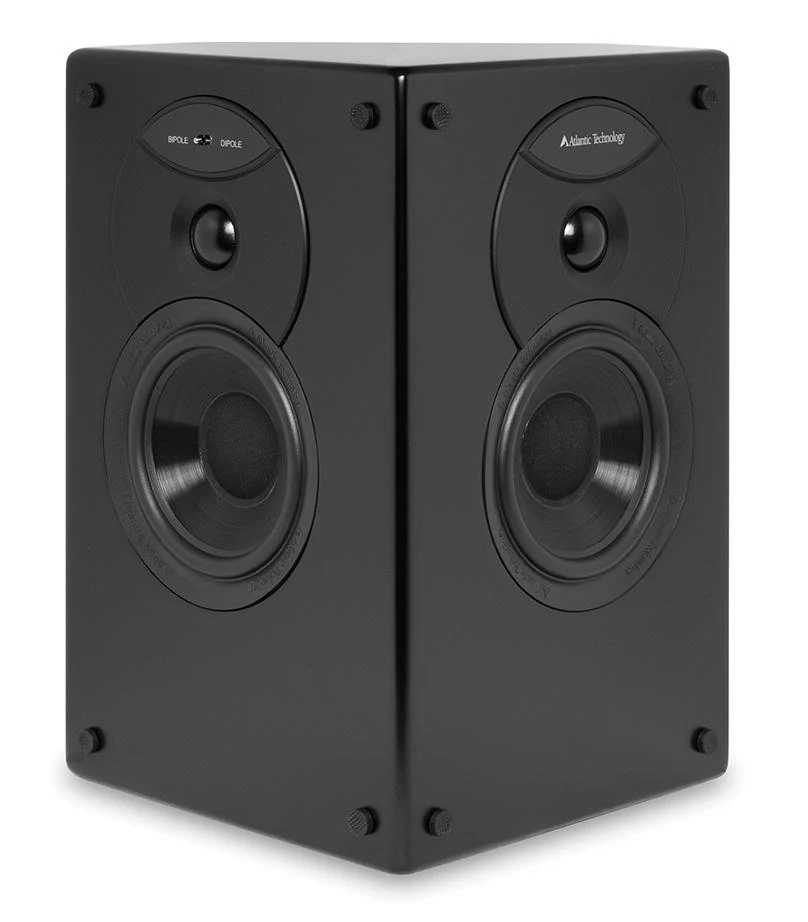
For the best bang for your buck, the Atlantic Technology 4400SR stands out in this category, offering High sensitivity (90 dB) and Easy to drive (8 ohm) at $450.
The 4400SR is the surround speaker in Atlantic's 4400 line, a sealed direct-radiating design (not bipole or dipole) sized for side-wall mounting in a 5.1 or 5.1.4 layout. Twin 4.5-inch woofers and a silk dome tweeter in a sealed cabinet, 90 dB sensitivity, 80 Hz low-end. The direct-radiating choice is the architectural call: in an Atmos system the overhead beds carry the diffuse height effects, so direct surrounds at ear level can localize specific effects sharply rather than smearing them. The trade-off shows up in non-Atmos 5.1 content, where a bipole/dipole surround creates a more diffuse rear soundstage that some listeners prefer for older surround-encoded material.
Trade-off: The Atlantic Technology 4400 SR is THX Select certified and built around a switchable dipole/bipole design: two 4.5-inch GLH woofers and two silk-dome tweeters, with a front-panel switch that runs the pair out of phase (dipole, diffuse) or in phase (bipole, more localized) so you can match the speaker to side-surround or rear-surround duty. 90 dB sensitivity, 80 Hz to 20 kHz +/- 3 dB, 8 ohm sealed box. The $900/pair MSRP often streets near $700, which makes it the value play: THX-certified switchable dispersion for less than half the Focal. The trade-off is it is an older design and the 4.5-inch woofers run out of low end early, so an 80 Hz crossover to a sub is mandatory, not optional.
The Fluance ELITE-HIGH-DEFINITION-2-WAY-BIPOLAR-SURROUND-SPEAKERS proves you don't need to break the bank in this category, offering Good sensitivity (88 dB) and Easy to drive (8 ohm) at $75.
The Elite bipolar surround is the architectural counterpoint to direct-radiating surround speakers: drivers fire from both faces of the cabinet for diffuse, non-localized surround envelopment. Bipolar (in-phase) versus dipolar (out-of-phase) is the design choice; bipolar is better suited to modern object-audio formats like Atmos that want some directional content. The 130 Hz low-end means the speaker depends entirely on the subwoofer for bass; it's a mid-and-up surround by design. Compete-against is the Definitive Technology DI 6.5R or the Polk LSiM702. Pick the Fluance bipolar when room layout puts surrounds against the back wall or close to seating where direct radiation would localize too sharply.
Trade-off: The Fluance Elite SXBP2 commits to a bipolar dispersion pattern at $149.99/pair, which is the architectural choice almost nobody else makes at this price. It is a 2-way, 4-driver design: dual 4-inch polymer-treated woofers and dual 1-inch neodymium ferrofluid-cooled dome tweeters in an MDF trapezoidal cabinet, 20 to 100 watts RMS power handling. The catch is the low-end limit (Fluance specs roughly 130 Hz), which means a sub crossed at 100 or 120 Hz is mandatory rather than recommended. Wall-mountable via the included keyhole hardware. Skip these if your format mix is 80% Atmos because bipolar dispersion will smear object-based surround placement. Buy them if you watch mostly legacy 5.1 and 7.1 content.
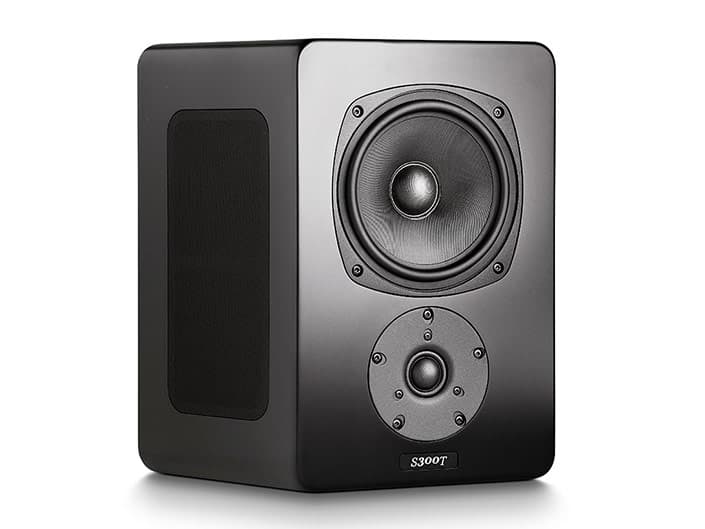
The Miller & Kreisel S300T represents the pinnacle in this category, offering Good sensitivity (89 dB) at $2,574.5.
The S300T is M&K's high-output 6.5-inch surround, the larger-driver counterpart to the S150T's 5.25-inch design for build-outs where the surrounds need the same bandwidth and dynamic range as the LCR. Eighty-nine dB sensitivity and 400 W RMS handling means this speaker holds reference levels in surround positions without compression artifacts, which is the design priority for a Hollywood-mix-style theater build. The dipole/tripole switching is the THX-spec feature shared with the S150T family. Spec this for large dedicated theater builds where surround dynamic range matters; for medium rooms the S150T is enough surround.
Trade-off: The M&K Sound S300T tripole runs $2,574.50 each, which is the price most people would budget for a whole 5.1 surround system. The justification: this is the speaker M&K has been refining for THX dub-stage installations for two decades, the tripole switching between dipole and direct modes is real and noticeable on the same content, and the integral wall bracket is engineered into the cabinet rather than bolted on. It uses a 6.5-inch glassfibre bass-midrange driver and 1-inch dome on the front face plus four 3.5-inch side drivers in isolated chambers, with Scan-Speak drivers and Danish manufacture. The 4 ohm impedance is the catch. Pair this with an AVR that has a real amp section (Marantz Cinema, Anthem MRX, or separates) rather than the cheapest entry receiver. The 89 dB sensitivity into 4 ohms behaves like roughly 92 dB into 8 ohms from the amp's perspective, which is generous.
Do my surround speakers need to match my front speakers?
Not for movies. The center channel needs to match the left and right mains tonally because dialogue pans across all three. The surrounds carry ambient effects and Atmos objects, which the brain accepts from off-timbre speakers without losing the illusion. For multichannel music (SACD, Atmos Music, Auro-3D), timbre match across all channels matters more because instruments pan across the full circle, which is exactly why a Focal Aria SR900 next to Focal Aria mains is worth the premium. Most home theater buyers prioritize movies and can save serious money by not buying LCR-grade surrounds.
Bipole or dipole surround speakers for Atmos?
Direct-radiating or bipole, not dipole. Dipole surrounds fire out of phase from each face of the cabinet, which creates a deliberate null at the listening position and smears the surround image into a diffuse cloud. That worked well for matrixed 5.1 surround content in the 1990s and 2000s, but Atmos places discrete objects in space and the dipole smear washes the placement out. Direct-radiating bookshelves or bipole designs (in-phase from both faces) preserve enough localization for Atmos to work as intended. A switchable speaker like the Atlantic Technology 4400 SR lets you run bipole for Atmos and flip to dipole for legacy content.
Where should surround speakers be mounted?
Side surrounds belong slightly behind and slightly above the primary listening position, about ear-level plus 2 feet, and 90 to 110 degrees off the front axis. Rear surrounds in a 7.1 layout sit behind the listening position, again slightly elevated. Almost all surrounds end up wall-mounted because the placement is too high for stands and most people will not run floor-to-ceiling speaker stands in a living room. Check the bracket spec before buying: the M&K S300T has its bracket engineered into the cabinet, while the Fluance SXBP2 and most others use keyhole hardware.
Can I use bookshelf speakers as surrounds?
Yes, and many enthusiasts do. Dedicated surround speakers offer wider dispersion patterns and integrated wall mounting, but a matched pair of bookshelves from your LCR family will give you better timbre continuity for multichannel music. The trade-off is mounting and dispersion. If your surrounds need to wall-mount and you watch mostly movies, a dedicated surround like the Atlantic Technology 4400 SR beats a bookshelf. If your surrounds can sit on stands at the right height and you care about music, a matched bookshelf (or a timbre-matched dedicated surround like the Focal Aria SR900) wins.
What crossover should I use for surround speakers?
80 Hz is the THX standard and the right starting point for most surrounds. Small surrounds like the Fluance SXBP2 (roughly 130 Hz low-end) need 100 or even 120 Hz to keep the speaker out of its mechanical-limit band. Larger surrounds like the Atlantic Technology 4400 SR (80 Hz +/- 3 dB) or the M&K S300T can run at 80 Hz cleanly. The CinemaConfig builder reads the surround spec and sets the crossover automatically when you assemble a system, including the offset above the speaker's -3 dB point.
I have not measured any of these in-room. Manufacturer dispersion plots for bipole, dipole, and tripole designs are usually generated in anechoic conditions, and the actual in-room behavior depends heavily on side-wall reflectivity, ceiling height, and listener distance. Cross-brand sensitivity comparisons get fuzzy because not every manufacturer specifies the same way (2.83V/1m versus 1W/1m, anechoic versus in-room). If a third-party lab (Audioholics, ASR) publishes anechoic measurements that contradict any of the manufacturer numbers below, take their measurements over the spec sheet.
The interesting question for surround speakers in 2027 is whether the industry consolidates on direct-radiating designs as Atmos object content keeps growing as a share of available titles, or whether bipole and dipole architectures get a second life because the new 9.1.6 and 11.1.6 layouts have so many channels that the rear surrounds become ambient again by definition. The switchable designs (Atlantic's dipole/bipole, M&K's tripole) are both bets on the same answer: build one cabinet that works as either, and let the buyer decide. That is probably where the market is heading.
CinemaConfig may receive compensation for purchases made at participating retailers linked on this site. This compensation does not affect what products or prices are displayed, or the order of prices listed. See our affiliate disclosure.