The Best Soundbars for Home Theater (2026): Real Atmos vs. Marketing Atmos
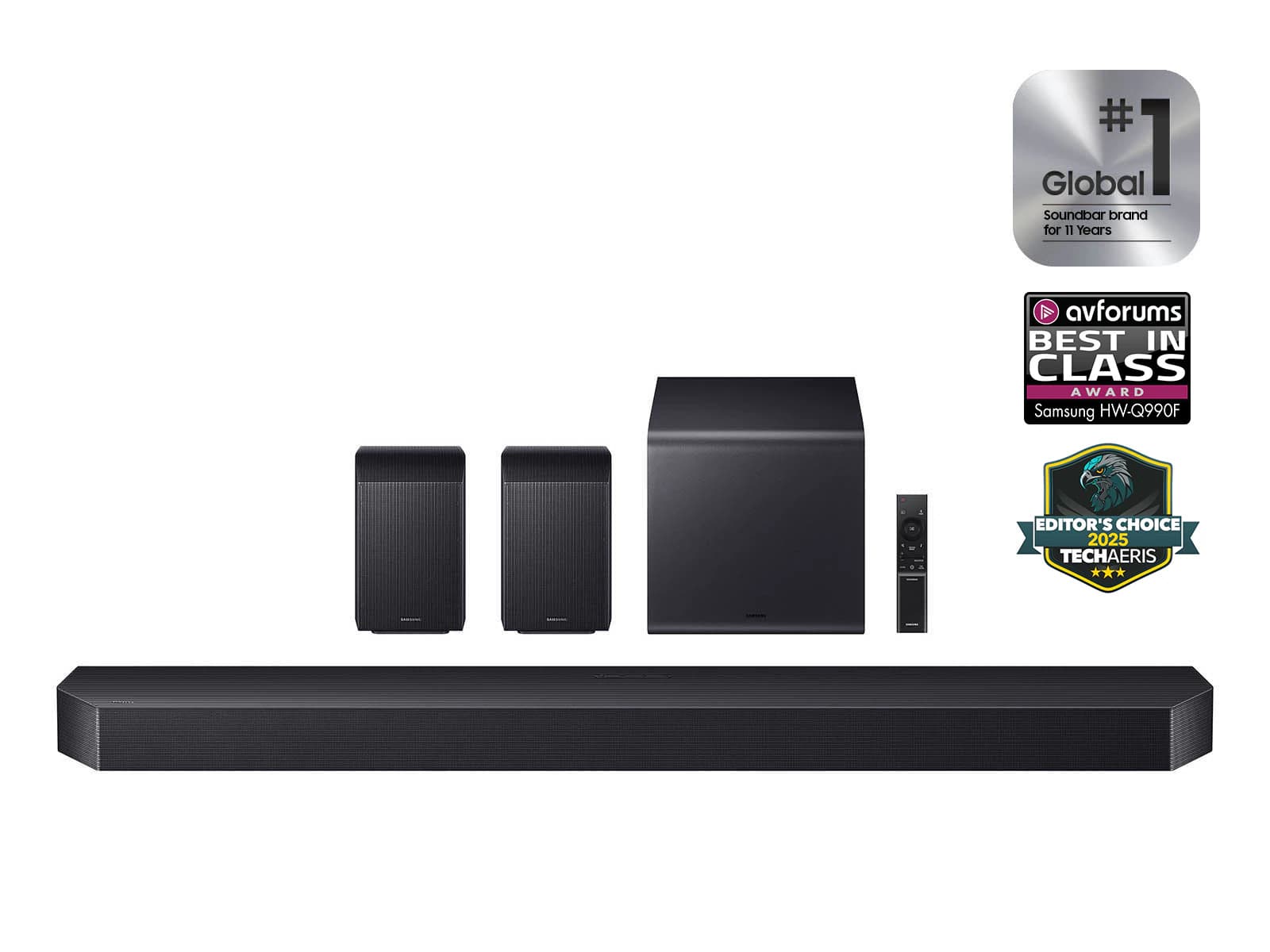
The Samsung HW-Q990F ($1,797, 11.1.4 channels with a wireless sub and detachable rear satellites in the box) is the soundbar to buy if you want something that sounds like a real surround system, and the Sonos Arc Ultra ($999, 9.1.4 from a single bar with two dedicated up-firing drivers) is the bar to buy if you can't fit anything else in the room.
A soundbar is the answer when you can't run speaker wire. That's the whole pitch. If you can put a center channel under the TV, two towers in the front corners, two surrounds behind the couch, and a sub anywhere on the floor, you should do that instead. A $1,500 5.1 system from Klipsch, ELAC, or Polk will outperform a $1,500 soundbar at almost every metric that matters. The soundbar exists because most living rooms can't accept that wiring, or the partner running the room won't accept it, or the apartment lease won't accept it. The second thing worth saying up front: the Dolby Atmos badge on a soundbar means almost nothing on its own. Atmos is a height format, and a bar with no up-firing drivers and no rear satellites is reproducing height the way a 2D photo reproduces depth. Some of the cheaper "Atmos" bars on this list (the Sonos Beam Gen 2, the Polk Signa S4 base model) use psychoacoustic processing to fake it, and a few of those tricks are convincing on the right content. Most are not. When a bar costs under $600 and advertises Atmos, assume the height effect is software until you read the driver list.
Picks below split into two groups. Real-Atmos systems (up-firing drivers or discrete rear speakers, sometimes both) sit at the top: the Samsung Q990F, the Sonos Arc Ultra, the Sony HT-A9, the JBL Bar 1000. Simpler one-piece bars sit underneath, with the Sonos Beam Gen 2 as the default recommendation for anyone whose primary job for the bar is making TV dialogue intelligible.
How We Score
We score soundbars across five axes: channel topology and whether the Atmos claim is honest (up-firing drivers, discrete rears, or pure DSP virtualization), bass authority (is there a sub in the box, and how big is the driver), HDMI surface area (eARC is mandatory in 2026, passthrough is a bonus), ecosystem and room calibration polish, and price-per-channel value relative to assembling the same coverage from a budget AVR plus speakers. Measured data comes from RTINGS where available and from manufacturer spec pages otherwise. We don't weight "perceived Atmos width" because the measurement methodology across review sites isn't consistent enough to compare.
What you get at each price point
Soundbar pricing ladders cleanly into four bands, and the marginal benefit at each step is well defined.
$200–$500Dialogue and a sub
What you get: a 2.1 or 3.1 bar with a wireless 6.5- to 10-inch sub, no real Atmos, eARC. The job is to clean up the TV's built-in speakers and add bass. The Polk Signa S4D and JBL Bar 2.1 Deep Bass MK2 live here. Skip the Atmos branding at this tier; it's almost always virtualized.
$500–$1,000Real up-firing in a single bar
Adds dedicated up-firing drivers (Sonos Arc Ultra at $999 is the benchmark) and real-content Atmos height. Sub may or may not be included. This is the tier where one-piece bars become honest about Atmos.
$1,000–$2,000Detachable or wireless rear satellites
Adds real rear channels. The Samsung HW-Q990F ($1,797 MSRP, often $1,400 street) and JBL Bar 1000 ($1,199) put battery-powered or wireless surrounds behind the couch without wiring. This is where soundbars start to genuinely compete with separates.
$2,000+Modular discrete satellites
The Sony HT-A9 architecture: four wireless speakers placed at the corners of the listening area, with phantom front center derived from the front pair. Closer to a wireless 4-speaker AVR system than to a soundbar. Bundle with the SA-SW5 sub for full 7.1.4.
Best OverallScore: 60/100
Samsung
HW-Q990F
The Samsung HW-Q990F earns our top pick in this category at $1,800.
The HW-Q990F is the 2025 Samsung Q-series flagship, the 11.1.4-channel system with wireless rear surrounds (each carrying its own upfiring driver) and a wireless subwoofer in the box. Twenty-three total speakers, four upfiring channels for Atmos height, SpaceFit Sound Pro auto-calibration, Q-Symphony pairing with a Samsung TV's speakers as additional channels, and full HDMI 2.1 4K/120 Hz passthrough on multiple inputs. At ~$1,997 MSRP it competes with the JBL Bar 1300X MK2 ($1,699) and the Sennheiser AMBEO Soundbar Max ($2,499); the Samsung buy reason is the 11.1.4 channel count with rears that carry their own upfiring height drivers, the trade-off is the wireless rears need AC power at the listening positions.
Trade-off: The Q990F's tradeoff is the subwoofer footprint. The 8-inch wireless sub is small for a 2025 sub, but it still needs floor space and a wall outlet, and the detachable rear speakers each need a power outlet within reach. Wireless doesn't mean cordless. The other real tradeoff is the Q-Symphony tie-in: the bar is engineered to pair with a Samsung TV's speakers as additional channels, and that integration is meaningfully tighter than what you get on an LG or Sony TV. Not a dealbreaker on a non-Samsung TV, but it's the spec that justifies the price premium over the Q900F.
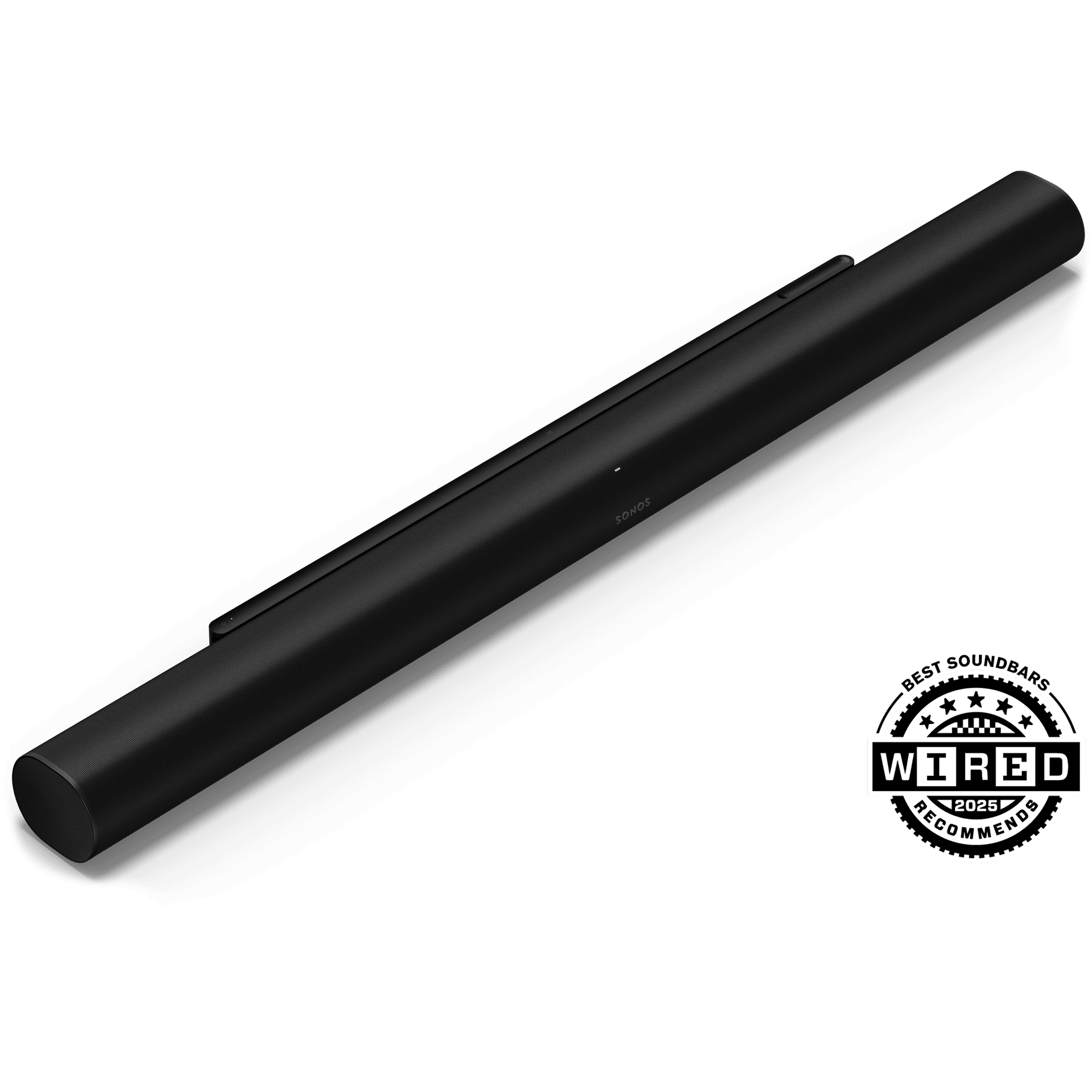
For the best bang for your buck, the Sonos Arc Ultra Black stands out in this category at $999.
The Arc Ultra is Sonos's 2024 flagship soundbar, the 9.1.4-channel replacement for the original Arc that adds Sound Motion subwoofer technology (a magnetized motor-driven woofer that doubles low-end output without doubling cabinet volume) and bumps the channel count from 5.0.2 to 9.1.4. Trueplay room calibration over Wi-Fi 6, Sonos S2 multi-room ecosystem, Speech Enhancement dialogue mode, HDMI eARC. At ~$999 MSRP it competes with the Marshall Heston 120 ($999) and the JBL Bar 1000 ($1,199); the Sonos buy reason is Trueplay calibration plus the S2 ecosystem if the rest of the home is Sonos, the trade-off is HDMI eARC rather than HDMI 2.1 passthrough and no included sub.
Trade-off: The Arc Ultra is a 9.1.4 bar with no included sub. If you add the Sonos Sub 4 ($799), you're at $1,800 and at that point you've matched the Q990F price without the rear satellites. The Arc Ultra makes sense as a bar-only purchase. If you know you'll add the sub, the Q990F is the better-value system.
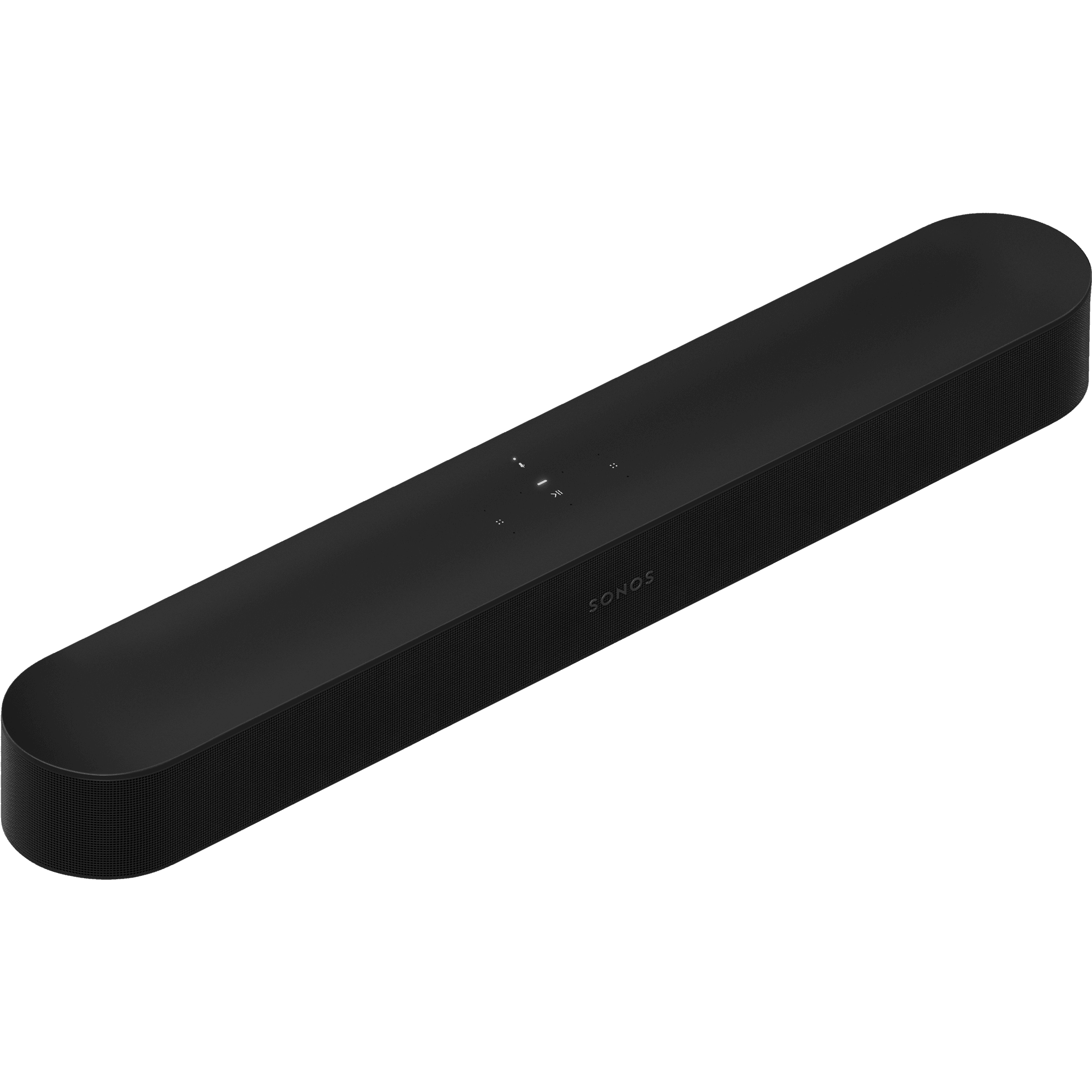
The Sonos Beam Gen 2 Black proves you don't need to break the bank in this category at $499.
The Beam Gen 2 is Sonos's compact mid-range soundbar, the 5.0-channel bar with virtualized Atmos rather than dedicated upfiring drivers and a 25.6-inch chassis sized for 50-to-65-inch TVs. Trueplay room calibration, HDMI eARC, Wi-Fi 6, AirPlay 2, full Sonos S2 ecosystem integration. At ~$499 MSRP it's the consensus benchmark in this price tier; competitors include the Bose Smart Soundbar 600 and the Samsung HW-Q600F. The Sonos buy reason is the S2 ecosystem; the trade-off is no included sub and virtualized Atmos rather than real upfiring channels. The Black finish is the standard residential option that disappears under most modern TVs.
Trade-off: The Beam Gen 2 has no real Atmos. Five front-facing drivers, no up-firing, and the height effect is psychoacoustic HRTF processing. On the right Atmos content it's convincing, on the wrong content it disappears entirely. Buy it for dialogue and the Sonos S2 ecosystem, not for height.
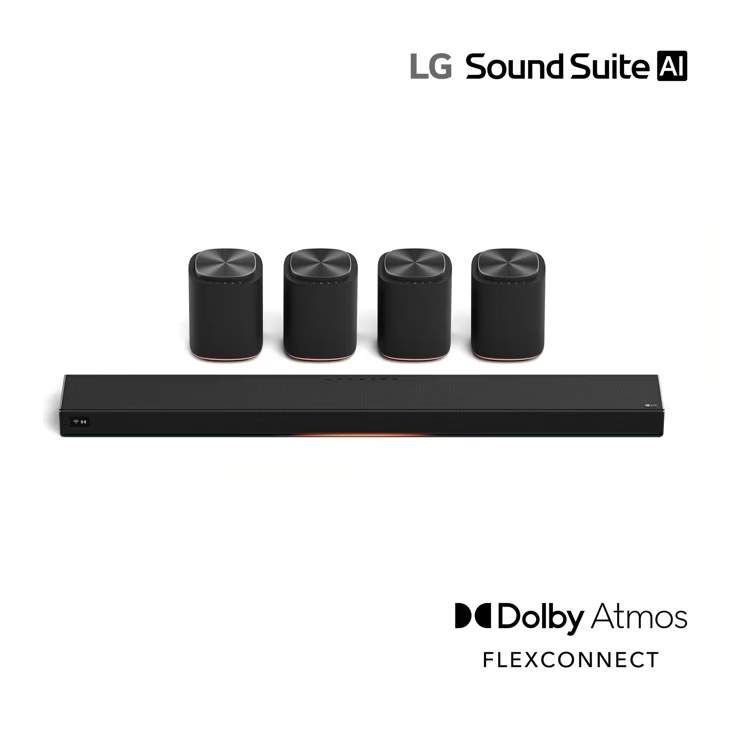
The LG M5-P4_H7 represents the pinnacle in this category at $1,919.95.
The M5-P4_H7 is LG's flagship soundbar package — the H7 main bar paired with four M5 wireless rear/surround speakers, which together expose a 9.1.7 channel layout with Dolby Atmos and eARC over a single HDMI connection. The buy reason is the wireless surround topology: the M5 satellites are battery-buffered Wi-Fi speakers, so the only cable touching them is power. Atmos height channels come from up-firing drivers in both the bar and the rears. Rivals at this MSRP are the Samsung HW-Q990D ($1,899, the most direct competitor with similar 11.1.4 wireless topology) and the Sonos Arc Ultra + Era 300 surrounds ($2,200 assembled). Trade-offs versus the Samsung Q990D: LG doesn't publish total wattage and the bar uses eARC only — no discrete HDMI inputs — so all sources must pass through the TV. The right pick for a TV-centric rack where wireless surrounds matter more than direct HDMI switching.
Only if the bar has dedicated up-firing drivers (look for 5.1.2, 7.1.4, or 9.1.4 channel counts where the last digit is height channels) or ships with discrete rear or up-firing satellites. A bar that advertises Atmos with a 3.1 or 2.1 channel layout is using DSP virtualization, which is height-effect-on-paper rather than height-effect-in-room. The processing is fine for music and games, less convincing for movies mixed with strong overhead cues.
Soundbar vs. AVR plus speakers at the same price?
At $1,000 to $1,500, a Denon AVR-S670H or Marantz NR1200 plus a Klipsch Reference 5.1 set will outperform any soundbar on dialogue clarity, bass authority, and dynamic range. The catch is the speaker wire and the five-component install. If your room can accept that wiring, build separates. If it can't, the Samsung HW-Q990F or Sony HT-A9 are the closest a single-purchase system gets to that experience.
Is the wireless subwoofer actually wireless?
The audio signal is wireless. The sub still needs a wall outlet within reach of its placement, which is the part most buyers forget. The same goes for the wireless rear speakers on the Samsung Q990F and JBL Bar 1000. Plan for power, not just signal.
Does eARC matter if my TV only has ARC?
Yes. eARC is what carries uncompressed Atmos and DTS:X from the TV's HDMI input back to the soundbar. ARC compresses everything to Dolby Digital 5.1 (lossy) and strips out the height metadata. If your TV is older than 2019 and doesn't have an eARC-capable HDMI port, your Atmos soundbar can still get a full Atmos signal by connecting an Atmos source (a 4K disc player, an Apple TV 4K, a PS5) directly to the bar's HDMI input, assuming the bar has one. The Sonos Arc Ultra does not. The JBL Bar 1000 and Samsung Q990F do.
Can I add rear speakers later to a soundbar I already own?
Depends on the ecosystem. Sonos lets you add Era 100s or Era 300s as wireless rears to any of their soundbars (Beam, Arc, Arc Ultra). Samsung's SWA-9500S is a wireless rear kit that pairs with most modern Samsung bars. Most other brands don't support after-purchase rear expansion. If you think you'll add rears later, buy into Sonos or Samsung. If you know you want rears now, buy a system that includes them (Q990F, JBL Bar 1000, HT-A9).
We haven't bench-measured any of these in-house. The frequency response, max SPL, and dispersion numbers come from RTINGS, manufacturer pages, and What Hi-Fi where the methodology is documented. Where measurement is thin (the Sony HT-A9's phantom center accuracy in real rooms, the Arc Ultra's Sound Motion driver low-end extension below 50 Hz) we've flagged it explicitly. Take the perceived-Atmos-width descriptions in any review with skepticism (including ours) because there's no standardized test for that.
The interesting story for 2026 is the Sound Motion driver in the Arc Ultra and whether competitors copy the topology. Sonos shrunk a meaningful low-end driver into a chassis that previously couldn't fit one, and if Samsung and Sony match the trick on their 2026 refreshes, the included-sub value proposition starts looking dated. Watch the fall refresh cycle.
CinemaConfig may receive compensation for purchases made at participating retailers linked on this site. This compensation does not affect what products or prices are displayed, or the order of prices listed. See our affiliate disclosure.