The Best Center Channel Speakers for Home Theater (2026)
The Klipsch RP-500C II ($329) is the cheapest center we'd put in a real movie system, the KEF Q6 Meta ($850) is what you buy when you actually have outer seats to worry about, and the Monitor Audio Silver C250 7G ($1,150) is the one most people should stop shopping at.
A center channel handles roughly 60 to 70 percent of a movie's dialogue. Everything else flows around it, but if the center is muddy or beams its top end at the middle seat, your wife on the end of the couch is going to ask you to turn on subtitles. So the spec that matters most is not how loud the cabinet gets. It is how the cabinet behaves off-axis through the speech band, roughly 500 Hz to 5 kHz. Almost every center under $1,000 is a horizontal MTM with two woofers flanking a tweeter, and that geometry guarantees comb-filtering past about 10 degrees off the listening axis (the RP-500C II and the RP-504C II both visibly narrow in the midrange according to Erin's Audio Corner). The KEF Q6 Meta sidesteps this with a coincident Uni-Q driver in the middle. The Silver C250 7G goes the other way and uses a dedicated 3-inch midrange dome so the speech band never crosses through a woofer at all. Those are the two structural solutions to the center-channel problem, and they cost what they cost.
Picks below are tiered, not ranked flat. Match the center to your front pair when you can. A timbral mismatch between the L/C/R hits you on every pan from left to right and there is no calibration trick that fixes it.
How We Score
We score centers on four things: published sensitivity vs measured sensitivity (Klipsch's 94 dB rating on the RP-500C II measures closer to 87 dB at Erin's Audio Corner, which is a 7 dB lie we account for in the value calculation), horizontal off-axis behavior through the speech band, low-end extension at the manufacturer's -3 dB point, and driver topology (3-way with a dedicated midrange beats 2-way MTM beats coincident, in that order, for centered seats; coincident wins everywhere else). We weight off-axis dispersion heaviest because a center that beams its tweeter at the middle seat is not solving the problem it exists to solve. Quality divided by street price gives the value score. We do not score user reviews here. Center channels collect ratings dominated by buyers who never measured the room.
What you get at each price point
Spend levels for a center that pulls its weight with the rest of the front stage:
$200–$350Entry that actually works
Two 5.25-inch woofers, a dome tweeter, an 80 Hz crossover to a sub. The Klipsch RP-500C II at $329 anchors this band. Below $200 you are buying a center that compresses on dialogue peaks, and the only honest move is to use a matched bookshelf turned sideways instead.
$400–$700Bigger cabinet, real headroom
Four-woofer centers like the RP-504C II ($519) buy you 3 to 4 dB of clean output above the crossover. Useful in rooms past 3,000 cubic feet or with seats more than 10 feet from the screen. The ELAC DC6.2 ($429) is the alternative if you want a sealed alignment and a timbral match to a DBR6.2 front pair.
$800–$1,200Where the dispersion problem gets solved
This is the band where you can actually pick a topology that handles outer seats. The KEF Q6 Meta ($850) and the Monitor Audio Silver C250 7G ($1,150) are both 3-ways. The KEF puts everything through a coincident point source. The Monitor Audio carves out a dedicated midrange dome. Both work. Below this tier the off-axis problem is real on every horizontal MTM you can buy.
$2,000+Reference-line voice match
You are not here for the center, you are here because the rest of your system is a Focal Kanta or a ProAc Response D pair and the timbre has to match. Pay what you have to pay. The acoustic delta to a Silver C250 7G is small. The voice-match delta is everything.
Best OverallScore: 41/100
Monitor Audio
MA-SS7GC250
Good sensitivity (88.5 dB)Extended high-frequency responseEasy to drive (8 ohm)3-way design
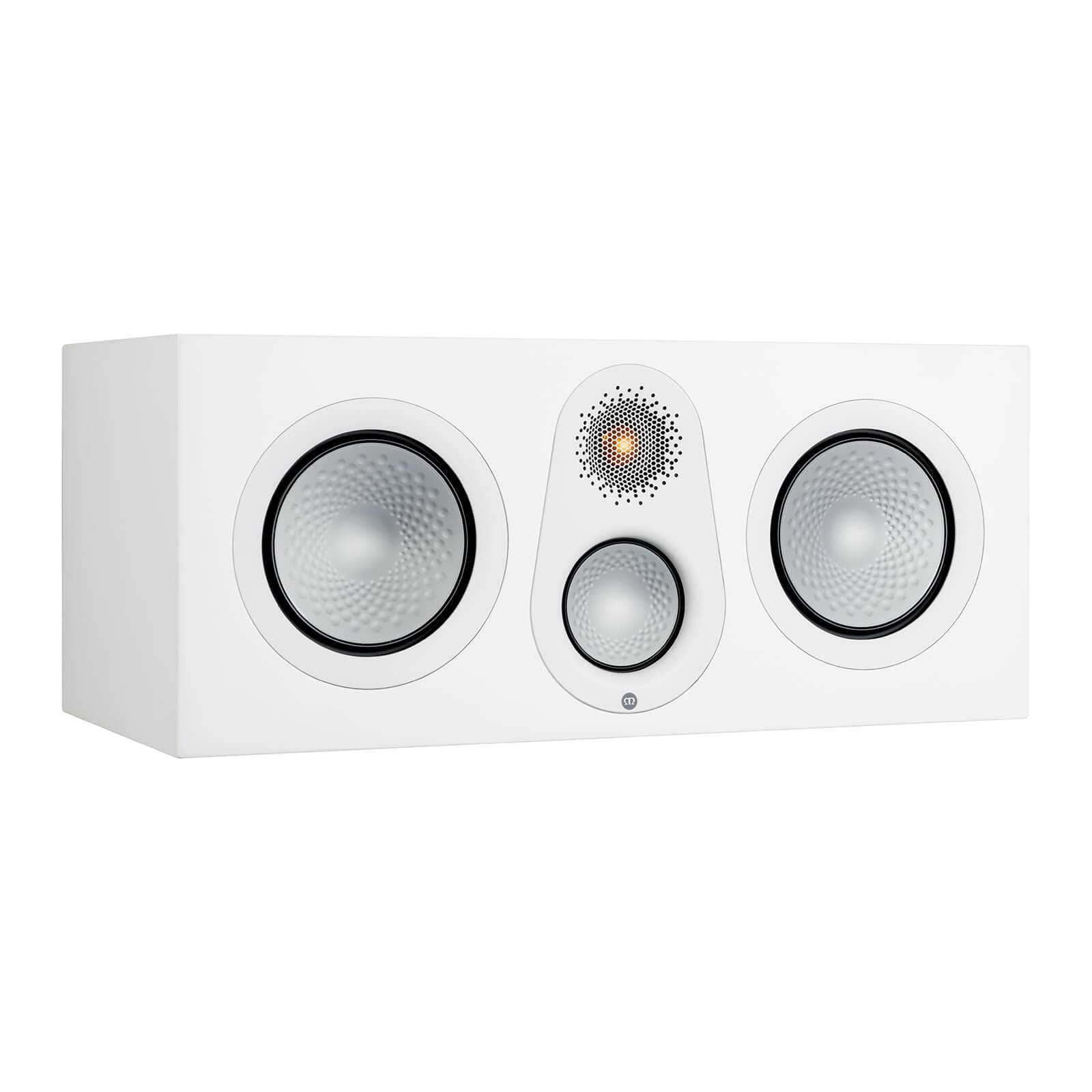
The Monitor Audio MA-SS7GC250 earns our top pick among center channel speakers, offering Good sensitivity (88.5 dB) and Extended high-frequency response at $1,150.
The Silver C250 7G is Monitor Audio's mid-line center, the 3-way sealed cabinet with the C-CAM gold-dome tweeter that defines the Silver-line voice. The 88.5 dB sensitivity and 8 Ω load make this center much easier to drive than the Gold C250 (87.5 dB, 4 Ω); the 3-way design with a dedicated midrange dome is the structural reason this center articulates dialogue without lobing through the speech band, which is rare at this price point. Pair with Silver 300 7G towers for a coherent Silver-line LCR; for the Gold-line tweeter character, step up to the Gold C250.
Trade-off: The Monitor Audio Silver C250 7G is the strongest all-around pick because the 3-way layout means dialogue lives on a driver dedicated to dialogue. The 88.5 dB sensitivity is honest. The 8-ohm load (3.9-ohm minimum at 170 Hz per Monitor Audio's spec sheet) plays nice with any midrange AVR. The downside is cabinet depth: 10.75 inches is deep for a TV stand, and if you wall-mount this thing on a shallow shelf it will hang into the room.
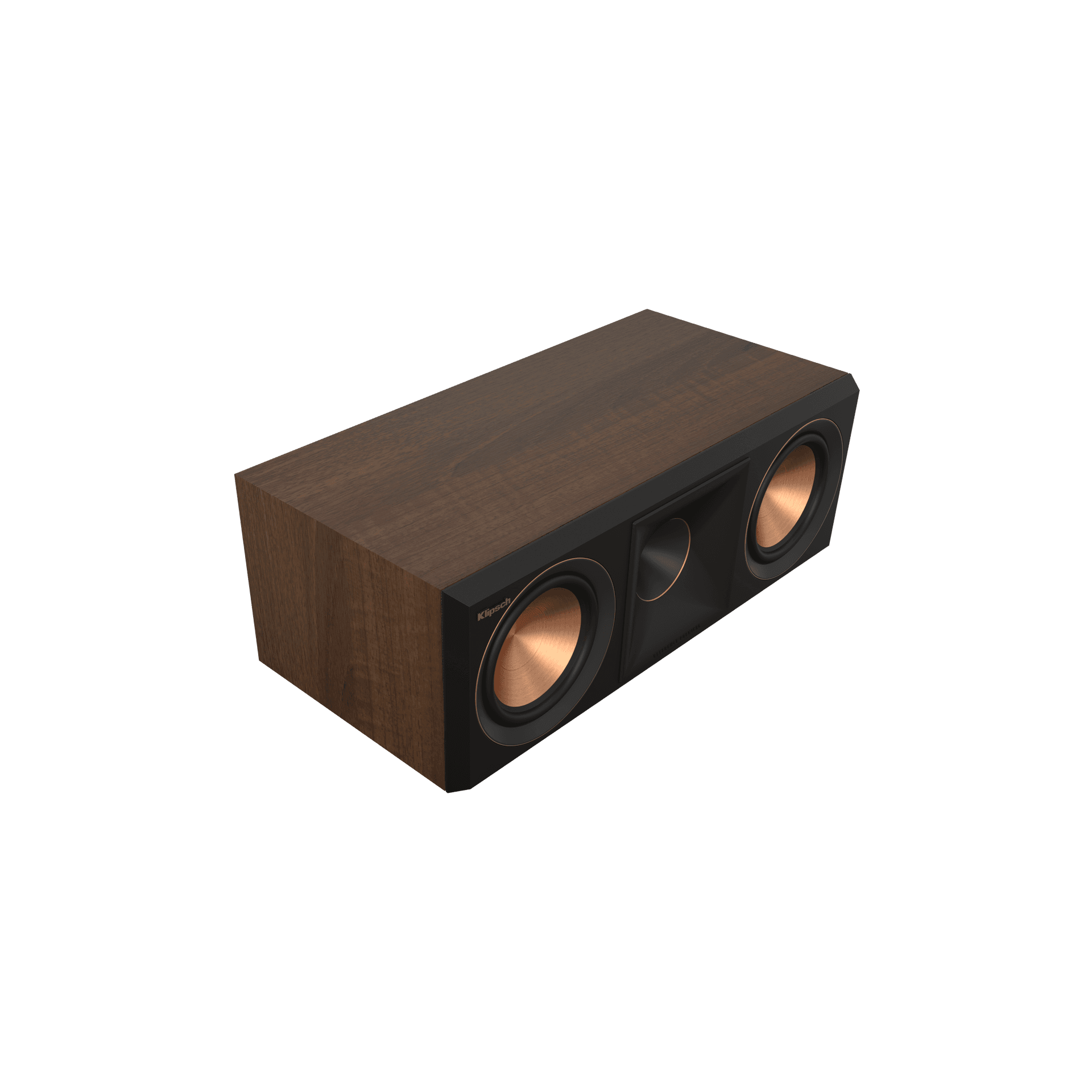
For the best bang for your buck, the Klipsch RP-500CII stands out among center channel speakers, offering High sensitivity (94 dB) and Easy to drive (8 ohm) at $329.99.
The RP-500C II base SKU is the catalog entry for the dual-5.25-inch RP-II center, the model that sells alongside finish-keyed variants (Ebony, Walnut) and ships as the default when the customer hasn't picked a veneer. Same 94 dB sensitivity, same Tractrix-horn tweeter, same 56 Hz low-end as the variant SKUs. At its street price it competes with the Polk Reserve R350 and the SVS Ultra Center; the Klipsch buy reason is the horn-loaded tweeter that handles dialogue at higher SPL than dome-tweeter centers without losing intelligibility, the trade-off versus the larger RP-504C II is cabinet width and the four-woofer headroom the 504 carries for big rooms.
Trade-off: The Klipsch RP-500C II at $329 is the cheapest center we would actually put in a system. We are recommending it with a giant asterisk: Klipsch publishes 94 dB sensitivity, Erin's Audio Corner measured it at 87 dB on the spinorama. That is a 7 dB gap, which is half the amplifier power you thought you were getting. Plan AVR sizing accordingly. The Tractrix horn handles dialogue at high SPL without falling apart. It also beams past 10 degrees off-axis, so the outer seats lose intelligibility. Real trade-off, not a marketing one.
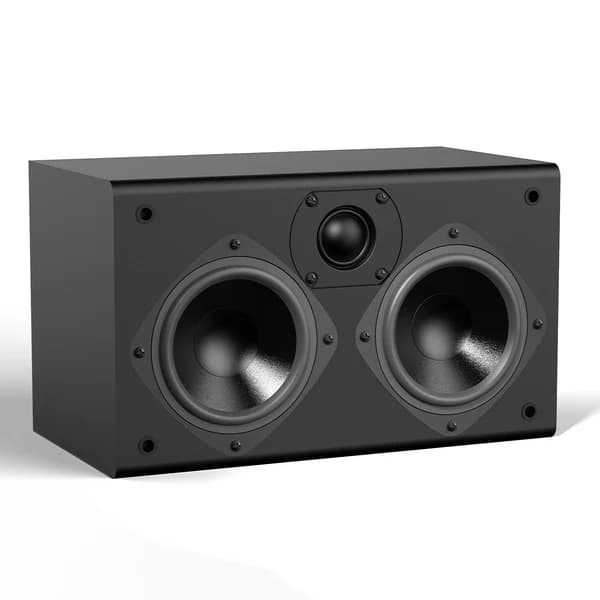
The Ascend Acoustics HTM-200SE2 proves you don't need to break the bank among center channel speakers, offering High sensitivity (90 dB) and Easy to drive (8 ohm) at $208.
The HTM-200SE2 is Ascend's smallest sealed center, the entry to the HTM line and the model that sells on direct-to-consumer pricing. Two 4-inch woofers and a silk dome tweeter in a sealed MDF cabinet, 90 dB sensitivity, 200 W RMS handling. At $208 each it sits in the same price bracket as the Polk Reserve R350 and Klipsch RP-500C; the Ascend trade-off is the smaller driver complement (most centers at this price use 5.25-inch woofers), in exchange for a sealed alignment that integrates more cleanly with a small room and a sub crossed at 80 Hz. The right pick for a compact LCR build where the center can't physically dominate the front stage.
Trade-off: The Ascend Acoustics HTM-200SE2 at $208 is the sealed-alignment, 4-inch-woofer option for compact LCR builds where the center physically cannot dominate the front stage. 85.2 dB measured sensitivity means it draws more power than the Klipsch for the same volume, and a sub crossed at 80 Hz is non-negotiable (sealed rolloff at 64 Hz). The reason it earns a slot: direct-to-consumer pricing on a SEAS tweeter and a sealed cabinet at this size is unusual.
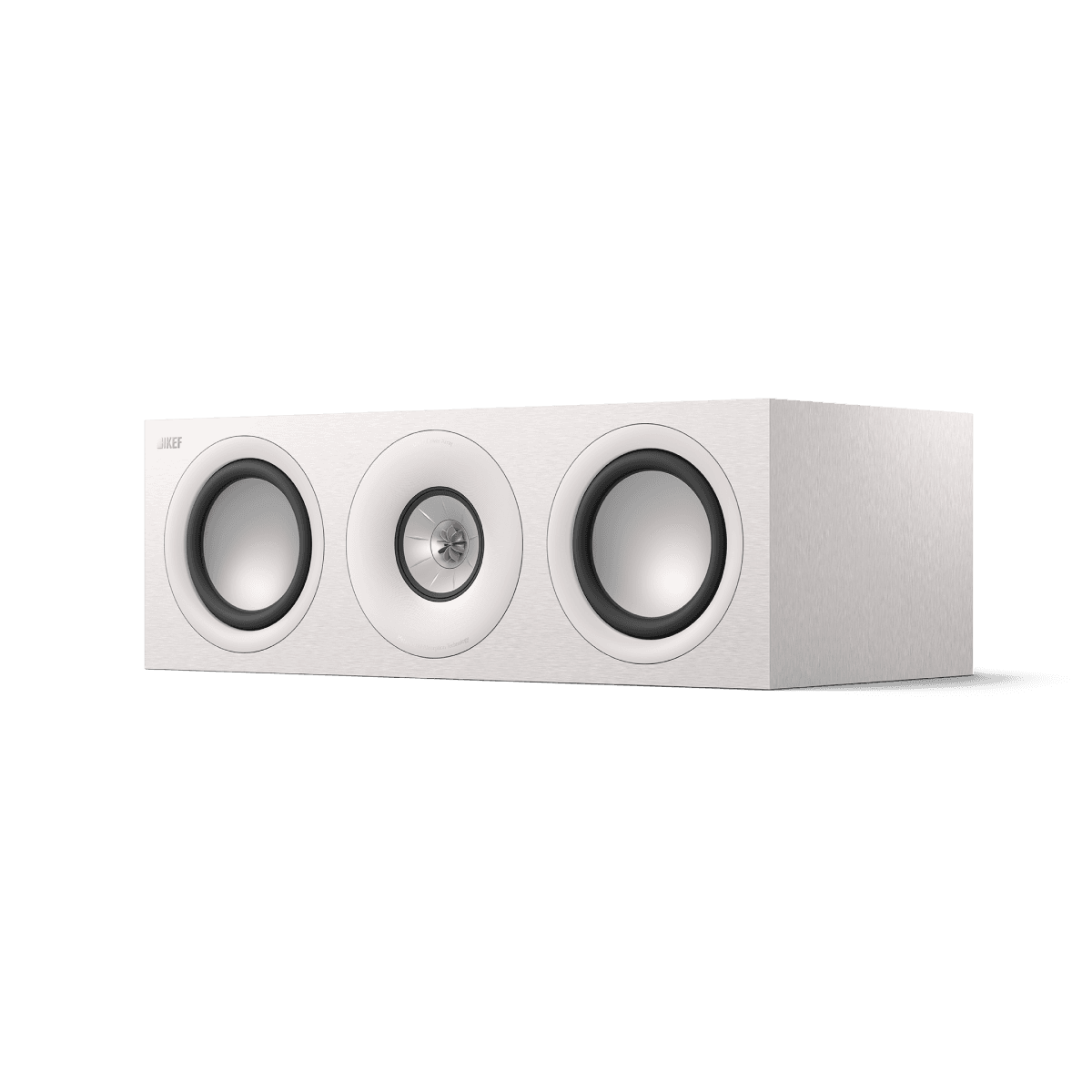
The KEF SP4091B0AA represents the pinnacle among center channel speakers, offering 3-way design at $849.99.
The SP4091B0AA is the catalog SKU for the KEF Q6 Meta center, the 3-way horizontal that pairs twin 6.5-inch woofers around the central Uni-Q driver. 86 dB sensitivity into 4 Ω, 63 Hz at the bottom, sealed cabinet, 200 W power handling. At ~$850 it competes with the B&W HTM6 S3 ($800) and the Monitor Audio Silver C150 7G; the KEF buy reason is the central Uni-Q that kills the off-axis comb-filtering an MTM center inflicts on outer seats, the trade-off is the 4 Ω rating that demands a confident amp section rather than an entry AVR.
Trade-off: Pick the KEF Q6 Meta over the Monitor Audio if you have outer seats more than about 25 degrees off the center axis, or if you already own KEF mains. The Uni-Q driver collapses the source to a point, which kills the lobing every horizontal MTM inflicts on side seats. The catch is the 4-ohm nominal impedance with a 3.2-ohm minimum. An entry Denon or Marantz AVR will run it, but a Denon X3800H or better is the right pairing for a real movie room.
Do I need a matching center, or can I use a third bookshelf turned sideways?
A third matched bookshelf turned vertically (not sideways) is acoustically better than most horizontal centers in the same price range, because you skip the off-axis MTM lobing problem entirely. The reason almost nobody does this: a vertical bookshelf does not fit under a wall-mounted TV. If you have a tall TV stand and can stand a bookshelf upright between the L and R, that is the cleanest setup. Otherwise buy a real center and pick one with topology that handles your seating geometry.
Why does center channel sensitivity matter so much?
Because the center reproduces dialogue at peak SPL on every action scene, and a 3 dB sensitivity difference is twice the amplifier power. The published spec also drifts a lot from measured reality. The Klipsch RP-500C II is rated 94 dB. Erin's Audio Corner measured 87 dB. That is the difference between needing 50 watts for a given output and needing 250 watts. Plan around measured numbers, not datasheet numbers.
Is a horizontal MTM center really worse than a coincident or 3-way design?
For listeners more than about 10 to 15 degrees off the center axis, yes. The two woofers in a horizontal MTM are physically separated, and when they reproduce the same midrange frequency, the phase relationship between them changes with the listener's horizontal angle. The result is comb-filtering in the speech band. A coincident driver like KEF's Uni-Q has no horizontal separation between the midrange and tweeter, so the problem does not exist. A 3-way like the Silver C250 7G routes the speech band through a dedicated midrange dome, also single-source. Both are structural fixes; the MTM design has no fix.
Can I run a center on a cheap AVR?
Depends on the center's impedance. The KEF Q6 Meta is rated 4 ohms nominal with a 3.2-ohm minimum, which will run on a Denon X1800H but will load it hard during long action passages. The Monitor Audio Silver C250 7G is 8 ohms nominal with a 3.9-ohm minimum and is much easier on entry AVRs. The Klipsch RP-500C II is 8 ohms and 94 dB rated, but the real-world sensitivity is 87 dB so you still need amplifier headroom. Rule of thumb: match the center's impedance class to the AVR tier.
What crossover frequency should I use with a center?
80 Hz to the subwoofer, almost universally. Even centers spec'd at 56 Hz like the Klipsch RP-500C II will sound cleaner with the bottom octave handed off to a real sub. The exception is large 3-way centers like the Monitor Audio Silver C250 7G in a small room, where you can experiment with 60 Hz and let the center carry a bit more body. Default to 80 Hz unless you have a measurement reason to change it.
We have not personally measured every center on this list. The off-axis claims for the RP-500C II and RP-504C II are sourced to Erin's Audio Corner spinorama data, which is the most rigorous independent measurement set published for these speakers. We trust those numbers more than Klipsch's own datasheet. For the Monitor Audio Silver C250 7G and KEF Q6 Meta, we are leaning on published specs and design topology since neither has a current independent CTA-2034A measurement set we are aware of. If that data exists and contradicts our reasoning, the picks change.
The center channel is the category where the gap between published spec and measured reality is widest. Klipsch is the most visible offender on sensitivity, but the broader pattern is that almost every center under $1,000 is sold on a number the speaker does not actually hit at the seat. The interesting design move in the next 18 months is going to come from coincident-driver centers at sub-$700 prices. KEF has demonstrated the topology works. Whoever ships the second one wins the segment.
CinemaConfig may receive compensation for purchases made at participating retailers linked on this site. This compensation does not affect what products or prices are displayed, or the order of prices listed. See our affiliate disclosure.